
Lawn Care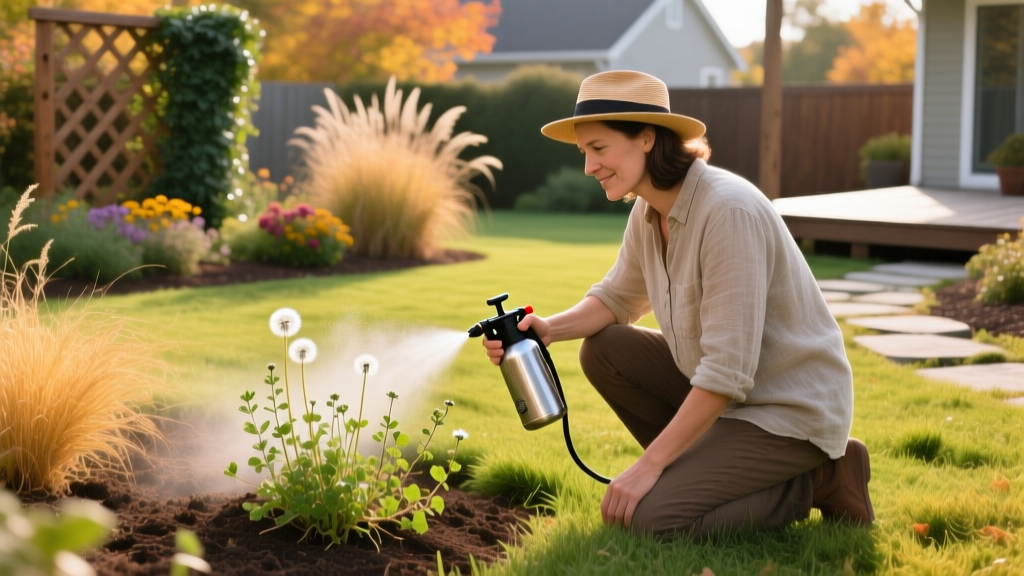
Autumn Weed Control: Spot-Treatment Guide for Cool-Season Weeds
The Biological Window: Why Autumn Weed Control Works
Effective autumn weed control relies on plant physiology, not just herbicide chemistry. As daylight hours shorten and soil temperatures drop below 70°F, perennial and winter-annual weeds shift from top-growth to root development. This physiological shift creates a massive carbohydrate sink in the root zone. When you apply systemic herbicides during this window, the plant actively pulls the chemical down into the taproot or rhizome network, ensuring complete eradication rather than mere foliar burndown.
According to turfgrass researchers at the University of Minnesota, fall applications of broadleaf herbicides are significantly more effective than spring applications because the weeds are actively storing nutrients for winter survival, carrying the active ingredient deep into the root system.
Expert Insight: The ideal soil temperature window for autumn spot-treatment is between 55°F and 65°F (measured at a 2-inch depth). Below 50°F, plant metabolism slows too much for effective herbicide translocation.
Species 1: Annual Bluegrass (Poa annua)
Identification and Lifecycle Triggers
Poa annua is a winter annual that germinates when late-summer soil temperatures consistently drop below 70°F. It features a distinct boat-shaped leaf tip and produces a seed head even under low mowing heights. Because it germinates in autumn, your primary defense is a pre-emergent barrier, but post-emergent spot-treatment is critical for breakthrough weeds.
Spot-Treatment Protocol
- Pre-Emergent Barrier: Apply Prodiamine 65 WDG at a rate of 1.0 to 1.5 lbs per 1,000 sq ft (providing 4-6 months of residual control). Cost: ~$50 for a 5lb bag, treating up to 5,000 sq ft.
- Post-Emergent Spot Spray: Use Mesotrione (brand name Tenacity). Apply at 4 to 8 fl oz per acre (roughly 0.1 to 0.2 fl oz per 1,000 sq ft). Mesotrione is unique because it can be safely applied during the seeding of cool-season turfgrasses like Kentucky bluegrass and fescue.
- Adjuvant Requirement: Always include a Non-Ionic Surfactant (NIS) at 0.25% v/v (2 teaspoons per gallon of water) to break the waxy cuticle of the Poa annua leaf.
Species 2: Dandelion (Taraxacum officinale) and Broadleaf Perennials
The Taproot Problem
Dandelions possess a thick taproot that can penetrate 10 to 15 feet into the soil profile, though the majority of the regenerative mass sits in the top 12 inches. If you merely burn off the foliage, the plant will regenerate from the crown within 14 days. The University of California IPM emphasizes that mechanical removal must extract the entire taproot, making chemical translocation via autumn spot-treatment the more reliable methodology for large infestations.
Spot-Treatment Protocol: Amine vs. Ester Formulations
Most homeowners buy amine-based 3-way herbicides (2,4-D, MCPP, Dicamba) from big-box stores. Amines require warm weather (above 70°F) to effectively penetrate the leaf cuticle and translocate. In autumn, you must switch to ester-based formulations.
Product Recommendation: SpeedZone Herbicide (contains Carfentrazone-ethyl, 2,4-D ester, MCPP-P, and Dicamba). The ester formulation penetrates the dandelion leaf rapidly even when autumn air temperatures drop into the mid-50s. Expect to pay around $55 per gallon. Mix at 2 to 3 pints per acre (approx. 0.75 to 1.1 fl oz per 1,000 sq ft).
Species 3: Henbit and Deadnettle (Winter Annuals)
Identification and Rapid Burndown
Often confused with Creeping Charlie (Ground Ivy), Henbit (Lamium amplexicaule) and Purple Deadnettle (Lamium purpureum) are mint-family winter annuals. They feature square stems and opposite leaves. Henbit has leaves that clasp the stem directly, while Deadnettle has purple-tinged upper leaves. Because they have shallow, fibrous root systems, they do not require deep systemic translocation; rapid contact herbicides are highly effective.
Spot-Treatment Protocol
Utilize Carfentrazone-ethyl (brand name Quicksilver T&O) for ultra-fast burndown. Apply at 0.031 to 0.062 oz per 1,000 sq ft. Carfentrazone causes cell membrane rupture within hours, resulting in visible necrosis in 24 to 48 hours, even in cold autumn weather. It is often mixed with a low rate of 2,4-D to ensure no regrowth from the crown.
Autumn Herbicide Decision Matrix
| Target Weed | Life Cycle | Active Ingredient | Rate (per 1,000 sq ft) | Optimal Soil Temp |
|---|---|---|---|---|
| Annual Bluegrass | Winter Annual | Prodiamine (Pre) | 0.2 - 0.3 oz | < 70°F (Application) |
| Annual Bluegrass | Winter Annual | Mesotrione (Post) | 0.1 - 0.2 fl oz | 55°F - 70°F |
| Dandelion | Perennial | 2,4-D Ester + Triclopyr | 0.75 - 1.1 fl oz | 50°F - 65°F |
| Henbit | Winter Annual | Carfentrazone-ethyl | 0.031 - 0.062 oz | 45°F - 65°F |
| Creeping Charlie | Perennial | Triclopyr + Dicamba | 0.75 - 1.5 fl oz | 55°F - 65°F |
Step-by-Step Spot-Treatment Execution Framework
Proper calibration and environmental awareness dictate the success of your autumn weed control program. Follow this exact sequence to prevent turf injury and maximize weed mortality.
- Calibrate the Sprayer: Do not guess your output. Spray a known area (e.g., a 10x10 ft driveway section) with plain water to determine your application volume. Target 1.5 to 2.0 gallons of carrier solution per 1,000 sq ft. This ensures the herbicide reaches the lower leaves and crown of the weed without excessive soil runoff.
- Check the 48-Hour Forecast: Herbicides require a minimum of 12 to 24 hours of dry weather post-application to be fully absorbed. Furthermore, ensure daytime highs will remain below 80°F for 48 hours.
- Mix the Solution: Fill the tank 1/2 full with water, add the liquid herbicide, agitate, add the surfactant (NIS or Methylated Seed Oil), and fill the remainder of the water. This prevents excessive foaming.
- Apply with Precision: Use a shielded spray nozzle or a wand with a flat-fan tip held 12 to 18 inches above the canopy. Keep the spray off the foliage of desirable ornamental shrubs and tree root zones.
- Post-Application Irrigation: For post-emergent foliar herbicides (like SpeedZone or Tenacity), do NOT irrigate for at least 24 hours. For pre-emergents (Prodiamine), water in with 0.25 inches of irrigation immediately after application to move the chemical into the soil thatch layer.
Warning: Ester Volatilization Risk
Ester-based herbicides (commonly used for autumn dandelion control) can vaporize and drift onto non-target ornamental plants if air temperatures exceed 80°F. While late autumn is generally cool, early September heatwaves are common. Always check the Penn State Extension guidelines on temperature limits for ester formulations, and delay application if a late-season heat dome is forecasted.
Ester-based herbicides (commonly used for autumn dandelion control) can vaporize and drift onto non-target ornamental plants if air temperatures exceed 80°F. While late autumn is generally cool, early September heatwaves are common. Always check the Penn State Extension guidelines on temperature limits for ester formulations, and delay application if a late-season heat dome is forecasted.
Synthesis: Integrating Spot-Treatment with Lawn Renovation
Autumn is the premier season for cool-season lawn renovation, including core aeration and overseeding. The challenge lies in herbicide timing. Pre-emergents like Prodiamine will prevent grass seed from germinating. If you plan to overseed, you must rely entirely on post-emergent spot-treatments using Mesotrione (Tenacity), which is one of the few herbicides safe for use at the time of seeding Kentucky bluegrass, tall fescue, and perennial ryegrass. By mapping your weed pressure and selecting the correct active ingredient, you can simultaneously eradicate entrenched perennials and establish a dense, weed-resistant turf canopy before winter dormancy.

