
Lawn Care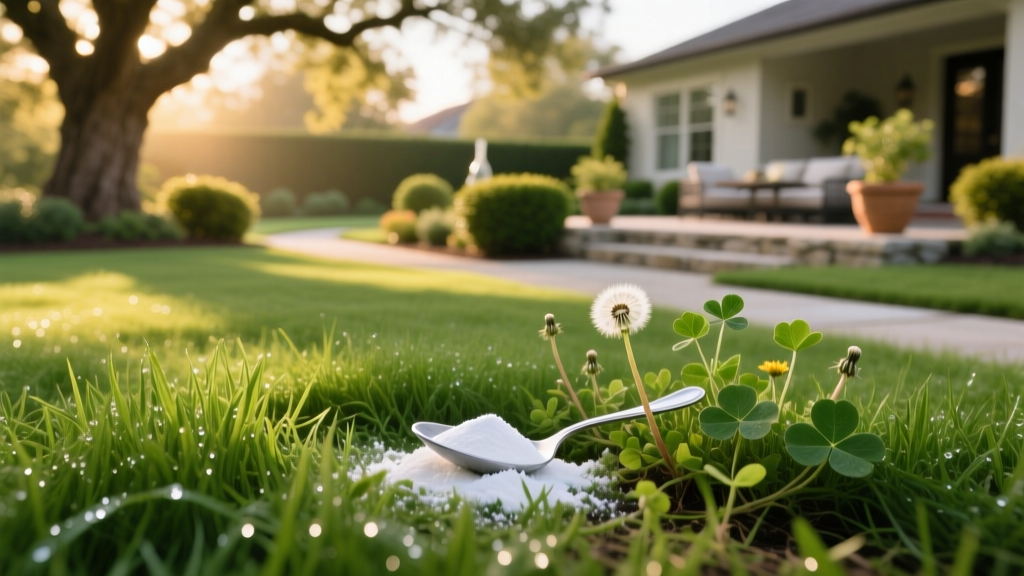
Does Baking Soda Kill Grass? The Science of DIY Sodium Weed Control
The Short Answer: Yes, But At A Severe Agronomic Cost
If you are asking, 'does baking soda kill grass?' the direct answer is yes. Baking soda (sodium bicarbonate, NaHCO3) acts as a non-selective, contact desiccant that will rapidly kill grass, broadleaf weeds, and any other plant tissue it coats. However, utilizing household baking soda as a DIY herbicide is one of the most damaging practices a homeowner can inflict on their soil ecosystem. While internet forums frequently promote sodium bicarbonate as a 'natural' weed killer for driveway cracks and lawn edges, the resulting sodium accumulation causes catastrophic, long-term degradation to soil structure and turfgrass viability.
Unlike systemic, EPA-registered herbicides that break down into inert compounds within weeks, the sodium ions left behind by baking soda do not degrade. They persist in the soil profile, actively displacing essential nutrients and destroying the physical architecture of your lawn's root zone. Before reaching for the orange box in your pantry, it is critical to understand the underlying soil chemistry that makes this DIY hack a costly mistake.
The Chemistry of Desiccation: How Sodium Bicarbonate Kills
Baking soda does not kill plants through targeted enzymatic disruption (like synthetic auxins) or amino acid synthesis inhibition (like glyphosate). Instead, it kills through osmotic stress and phytotoxicity.
- Osmotic Shock: When a high concentration of sodium bicarbonate is applied to foliage, it creates a severe osmotic gradient. The salt draws moisture directly out of the plant's epidermal cells, leading to rapid plasmolysis (cell shrinkage) and tissue desiccation.
- Stomatal Blockage: The fine powder physically clogs the stomata (pores) on the underside of grass blades, halting gas exchange and photosynthesis.
- Alkaline Burn: Sodium bicarbonate is naturally alkaline (pH of roughly 8.3 to 9 in solution). When concentrated on delicate turfgrass blades, it causes localized chemical burns, accelerating necrosis.
⚠️ The Non-Selective Reality
Because baking soda relies on physical contact and osmotic shock rather than biological pathways, it is entirely non-selective. It cannot distinguish between a dandelion and your prized Kentucky Bluegrass. Any overspray, wind drift, or accidental spill will instantly scorch your desirable turf.
Soil Physics and Cation Exchange: The Hidden Long-Term Damage
The most devastating impact of baking soda occurs below the surface. To understand why, we must look at the soil's Cation Exchange Capacity (CEC). Clay and organic matter particles in your soil carry a negative charge, acting like magnets to hold onto positively charged nutrient ions (cations) like calcium (Ca2+), magnesium (Mg2+), and potassium (K+).
Sodium (Na+), which makes up roughly 27% of baking soda by weight, is also a cation. However, sodium is highly aggressive and monovalent (carrying only a +1 charge). When you apply baking soda, the sheer volume of sodium ions floods the soil exchange sites, forcefully knocking off the vital calcium and magnesium ions. This process, known as sodification, triggers a chain reaction of soil destruction:
- Soil Dispersion: Without calcium to bind soil particles together into healthy aggregates (flocculation), the repulsive forces between clay particles take over. The soil literally disperses and collapses.
- Surface Sealing: Dispersed clay particles wash into soil pores during the next rainfall or irrigation cycle, creating a hard, impermeable crust on the surface.
- Hypoxia and Root Rot: Because water and oxygen can no longer penetrate the sealed surface, turfgrass roots suffocate. Even if the grass survives the initial foliar burn, it will drown and rot in the anaerobic environment created by the sodium.
According to turfgrass researchers at UMass Amherst Extension, elevated sodium levels severely restrict water uptake, creating 'physiological drought' where the grass dies of thirst even when the soil is wet.
DIY Baking Soda vs. Commercial Herbicides: A Data Comparison
Homeowners often turn to baking soda to save money or avoid synthetic chemicals. However, when analyzing the agronomic data, the trade-offs heavily favor modern, targeted organic and synthetic alternatives.
| Metric | Baking Soda (NaHCO3) | Iron HEDTA (Chelated Iron) | Pelargonic Acid (Organic) |
|---|---|---|---|
| Target Selectivity | Non-selective (kills all) | Selective (kills broadleaves) | Non-selective (contact burn) |
| Soil Half-Life | Permanent (does not degrade) | Weeks (becomes micronutrient) | Days (broken down by microbes) |
| Impact on Soil Structure | Destroys aggregates, causes sealing | Neutral to beneficial | Neutral |
| Primary Mode of Action | Osmotic desiccation | Cellular necrosis via iron toxicity | Cell membrane dissolution |
| Average Cost per 1,000 sq ft | $2.00 (but high remediation cost) | $12.00 - $18.00 | $15.00 - $22.00 |
As noted by Colorado State University Extension, household products like baking soda, vinegar, and bleach are unregistered pesticides. They lack the environmental safety testing, soil mobility data, and precise application rates required of commercial products, making their collateral damage highly unpredictable.
The 'Driveway Crack' Myth and Capillary Action
A common defense of baking soda is the claim: 'I only use it on weeds in my driveway cracks, far away from the lawn.' This ignores basic hydrology. When it rains, sodium is highly mobile. It dissolves instantly and migrates via surface runoff and subsurface capillary action directly into the adjacent turf root zones. Furthermore, landscape edging rarely provides a subterranean barrier deep enough to stop the lateral movement of sodium-laden water. The 'safe distance' is a myth; the salt will eventually reach your grass.
Remediation Protocol: How to Fix Baking Soda Damage
If you or a previous homeowner have already applied heavy doses of baking soda to the lawn, the soil must be actively remediated before attempting to overseed or lay new sod. You must displace the sodium and physically leach it below the root zone.
Step-by-Step Gypsum Leaching Framework
- Test the Soil: Order a laboratory soil test to measure the Sodium Adsorption Ratio (SAR) and Electrical Conductivity (EC). If SAR is above 13, remediation is mandatory.
- Apply Calcium Sulfate (Gypsum): Spread pelletized agricultural gypsum at a rate of 40 to 50 lbs per 1,000 square feet. The calcium in the gypsum will swap places with the sodium on the soil exchange sites.
- Core Aerate: Use a dual-core aerator to pull 3-inch plugs, breaking up the surface seal caused by sodium dispersion and allowing the gypsum to reach the subsoil.
- Deep Leaching Irrigation: Apply 2 to 3 inches of water over a 48-hour period (broken into cycles to prevent runoff). This flushes the newly displaced sodium sulfate salts down past the 6-inch root zone.
- Rebuild Organic Matter: Top-dress with 1/4 inch of screened compost to reintroduce microbial life and restore soil aggregation.
Frequently Asked Questions
Will baking soda kill lawn fungus?
While baking soda has mild fungistatic properties (it alters surface pH to inhibit powdery mildew spores), it is not an effective treatment for soil-borne turf diseases like Brown Patch or Dollar Spot. Applying it to the lawn for fungus control will result in severe sodium toxicity before it cures the disease.
Does baking soda kill grass permanently?
The foliar burn is not permanent—grass can regrow from the crown if the roots survive. However, the soil contamination is persistent. Until the sodium is chemically displaced with calcium and physically leached with heavy irrigation, new grass seed will fail to germinate, and existing turf will remain stunted and chlorotic.
Can I mix baking soda and vinegar for a stronger weed killer?
No. Mixing sodium bicarbonate (a base) with acetic acid (vinegar) creates a violent acid-base reaction that yields water, carbon dioxide gas, and sodium acetate. The resulting solution loses its acidic weed-killing power, and the leftover sodium acetate is highly toxic to plant roots and soil biology.

