
Lawn Care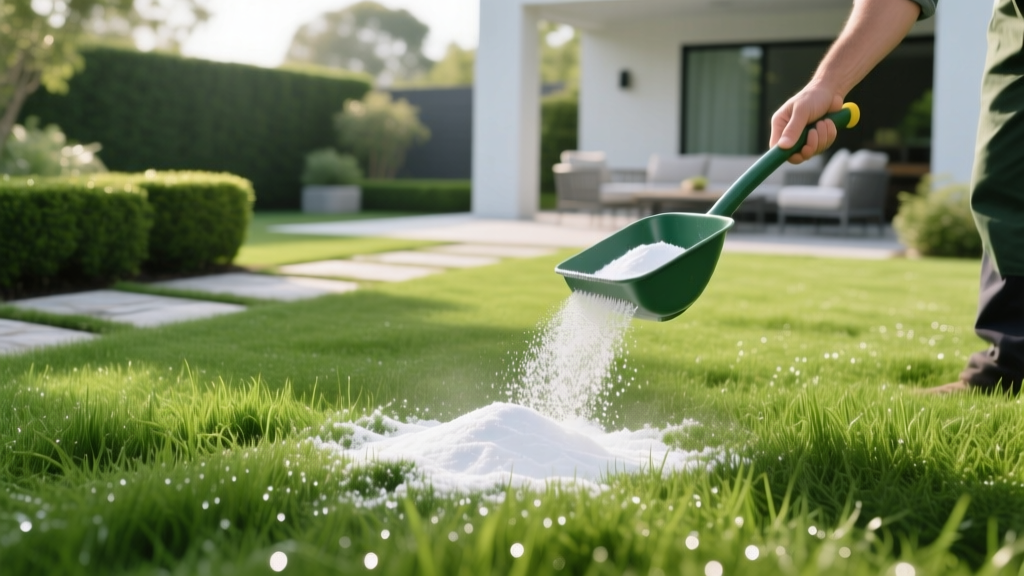
Baking Soda on Lawn: Safe Organic Treatment or Turf Killer?
The Soil Chemistry Reality: Why Sodium is Toxic to Turf
Social media platforms are flooded with viral 'hacks' claiming that sprinkling baking soda on lawn turf will eradicate weeds, cure fungal diseases, and boost green color. However, from a soil science perspective, sodium bicarbonate (NaHCO3) is a highly problematic compound for turfgrass. While it is a staple in organic kitchen cleaning and baking, applying it to your soil introduces two major threats: sodium toxicity and severe pH spikes.
⚠️ Agronomic Warning: Baking soda contains roughly 27% sodium by weight. When sodium ions (Na+) enter the soil, they displace essential calcium (Ca2+) and magnesium (Mg2+) on the soil's cation exchange sites. This process, known as deflocculation, causes clay particles to repel one another, destroying soil aggregation. The result is severe soil compaction, waterlogging, and suffocated turf roots.
Furthermore, baking soda is highly alkaline, with a pH of around 8.3. Most turfgrasses, including Kentucky Bluegrass, Bermudagrass, and Fescue, thrive in a slightly acidic soil pH between 6.0 and 7.0. Broadcasting baking soda across your lawn artificially spikes the surface pH, which chemically locks up vital micronutrients like iron and manganese. This leads to iron chlorosis—a condition where your grass turns pale yellow or white, directly contradicting the myth that baking soda makes grass greener.
Debunking the 3 Biggest Baking Soda Lawn Myths
Before reaching for the orange box in your pantry, it is critical to separate internet folklore from agronomic science. Here is what the research actually says about the most common use cases.
Myth 1: It Cures All Lawn Fungal Diseases
The Reality: Baking soda does possess mild fungistatic properties because it alters the surface pH of the leaf blade, making it temporarily inhospitable to spores. However, it is strictly a contact agent with zero systemic action. It washes off with the first rainfall or irrigation cycle. More importantly, it is completely ineffective against soil-borne turf diseases like Brown Patch (Rhizoctonia solani) or Pythium Root Rot. According to Michigan State University Extension, while baking soda can slow powdery mildew on ornamental plants, its high sodium content makes it phytotoxic (leaf-burning) to many tender grass species when applied at the concentrations required to actually kill fungal spores.
Myth 2: It Acts as a Safe, Broad-Spectrum Weed Killer
The Reality: Baking soda kills weeds via desiccation—it draws moisture out of the leaf tissue, causing it to crisp and die. This works on tiny, young annual weeds in hardscape cracks. However, it does not translocate to the roots. If you apply it to perennial lawn weeds like dandelions, bindweed, or nutsedge, the top growth will burn back, but the root system will simply push up new shoots within weeks. Meanwhile, the residual sodium poisons the surrounding desirable turf, leaving a bare, salt-affected patch that is highly susceptible to future weed invasions.
Myth 3: It Neutralizes Dog Urine Spots
The Reality: Dog urine damages lawns primarily due to high nitrogen concentration and salts, not just acidity. Adding baking soda does not neutralize the nitrogen load. In fact, adding more salts (sodium bicarbonate) to an area already saturated with urine salts exacerbates the osmotic stress on the grass roots, making the dead spot worse.
The Narrow Exception: When to Actually Use It
There is exactly one scenario where baking soda is an acceptable organic control in the landscape: spot-treating powdery mildew on non-turf ornamental plants or hardscape weeds.
- Hardscape Cracks: For weeds growing between pavers or in driveway cracks where soil health is irrelevant, a heavy dusting of baking soda will desiccate young seedlings.
- Ornamental Fungus: Mix 1 tablespoon of baking soda, 1 teaspoon of dormant horticultural oil, and 1 gallon of water. Spray on affected ornamental shrubs (like roses) in the early morning. Do not spray this mixture on your lawn.
Superior Organic Alternatives for Lawn Care
If your goal is to manage lawn disease or weeds without synthetic chemicals, modern organic turf management offers vastly superior, soil-safe alternatives. The University of California IPM program recommends specific organic compounds that provide disease control without the destructive sodium load.
| Organic Product | Best Used For | Application Rate | Estimated Cost (2026) |
|---|---|---|---|
| Potassium Bicarbonate (e.g., GreenCure Fungicide) |
Powdery mildew, leaf spot. Provides potassium instead of toxic sodium. | 1 tbsp per gallon of water | $25 per lb |
| Bacillus subtilis (e.g., Serenade Garden) |
Broad-spectrum fungal/bacterial diseases. Colonizes the root zone and leaf surface. | 2 oz per gallon of water | $18 per 32oz RTU |
| Neem Oil (e.g., Bonide Neem Oil) |
Fungus, chewing insects, and mites. Disrupts insect life cycles. | 1 oz per gallon of water | $16 per pint |
| Corn Gluten Meal (Pre-emergent) |
Organic weed prevention. Inhibits seed germination and adds 10% nitrogen. | 20 lbs per 1,000 sq ft | $45 per 25lb bag |
Emergency Remediation: Fixing Baking Soda Damage
If you have already applied heavy doses of baking soda to your lawn and are noticing yellowing, stunted growth, or water pooling on the surface, your soil structure is likely compromised by sodium accumulation. Follow this remediation protocol to save your turf:
- Apply Pelletized Gypsum (Calcium Sulfate): Gypsum provides calcium without raising the soil pH. The calcium ions will swap places with the sodium ions on the soil clay particles. Apply gypsum at a rate of 40 to 50 lbs per 1,000 square feet.
- Core Aerate: Pull 3-inch soil plugs across the affected area to physically break up the compacted, deflocculated soil crust and allow oxygen to reach the roots.
- Deep Leaching Irrigation: Water the lawn heavily, applying at least 1.5 to 2 inches of water in a single cycle (or split over two days if runoff occurs). This flushes the displaced sodium salts down below the 12-inch root zone.
- Retest Soil pH: Wait 30 days and pull a soil core sample. Send it to a local university extension lab to verify that the pH has returned to the 6.0–7.0 range before applying any further amendments.
Frequently Asked Questions
Can I mix baking soda with vinegar to kill lawn weeds?
No. Mixing sodium bicarbonate and acetic acid (vinegar) creates a violent foaming reaction that neutralizes both compounds, leaving you with water, carbon dioxide, and sodium acetate. Sodium acetate is a known herbicide that will sterilize the soil and prevent any grass from growing back in that spot for months.
Is baking soda safe for earthworms in the lawn?
Earthworms are highly sensitive to soil salinity and pH fluctuations. Heavy applications of baking soda will create an osmotic imbalance that dehydrates and kills earthworm populations, depriving your soil of their natural aeration and castings.
What is the safest organic way to treat brown patch fungus?
Brown patch thrives in humid, nitrogen-heavy environments. The safest organic approach is to reduce irrigation frequency, switch to slow-release organic fertilizers, and apply a Bacillus amyloliquefaciens biofungicide (like Companion or Serenade) which outcompetes the pathogen naturally.

