
Lawn Care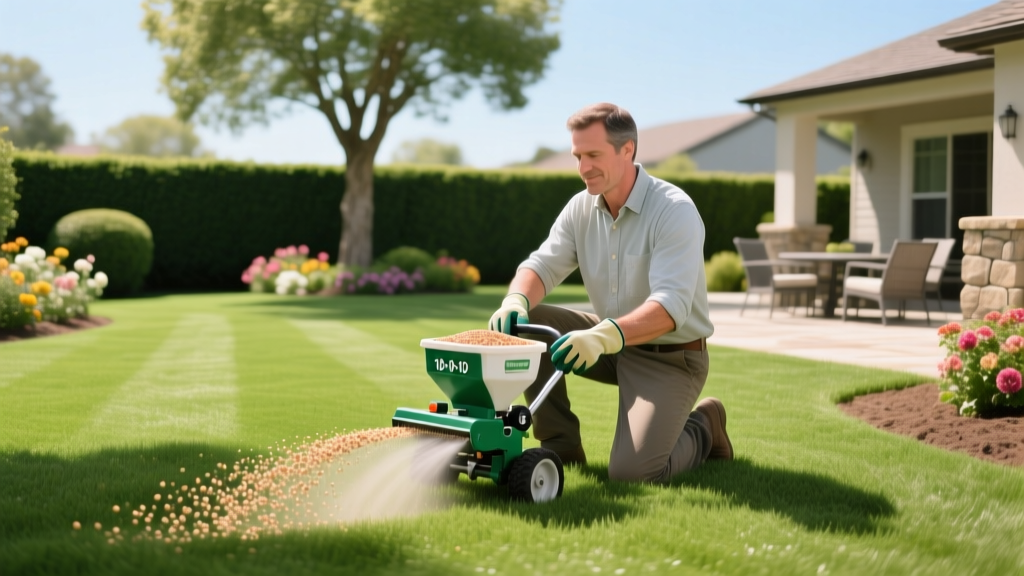
Balanced Lawn Fertilizer Guide: When 10-10-10 Actually Works
Walk into any big-box garden center, and you will inevitably see rows of bags labeled 10-10-10 or 15-15-15. Marketed as a 'balanced lawn fertilizer,' these equal-ratio blends seem like the logical, foolproof choice for homeowners. After all, if your grass needs nutrients, why not give it an equal dose of everything?
The reality of turfgrass soil chemistry tells a different story. While balanced fertilizers have specific, highly valuable use cases, applying them blindly to an established lawn can lead to nutrient lockout, excessive thatch, environmental runoff, and wasted money. This guide breaks down the exact science, economics, and regional regulations surrounding equal NPK fertilizers so you can make an informed decision for your turf.
Decoding the NPK Ratio in Balanced Fertilizers
The three numbers on a fertilizer bag represent the percentage by weight of Nitrogen (N), Phosphorus (P), and Potassium (K). In a true balanced fertilizer, these numbers are identical. Common formulations include 10-10-10, 15-15-15, and occasionally 20-20-20.
Pro Tip: The Filler Factor
A 50-pound bag of 10-10-10 contains exactly 5 pounds of Nitrogen, 5 pounds of Phosphorus, and 5 pounds of Potassium. The remaining 35 pounds (70% of the bag) consists of filler materials like sand, limestone, or clay used to ensure even distribution through your spreader. Compare this to a 30-0-5 turf blend, which delivers significantly more active nutrients per pound of product.
A 50-pound bag of 10-10-10 contains exactly 5 pounds of Nitrogen, 5 pounds of Phosphorus, and 5 pounds of Potassium. The remaining 35 pounds (70% of the bag) consists of filler materials like sand, limestone, or clay used to ensure even distribution through your spreader. Compare this to a 30-0-5 turf blend, which delivers significantly more active nutrients per pound of product.
How Equal Ratios Affect Turfgrass Physiology
- Nitrogen (N): Drives vegetative growth, chlorophyll production, and the deep green color of the grass blade.
- Phosphorus (P): Crucial for early root development, seed germination, and energy transfer (ATP) within the plant cell.
- Potassium (K): Regulates stomatal opening, improves drought tolerance, and builds cellular walls to resist disease and winter stress.
Established lawns consume nitrogen at a much higher rate than phosphorus or potassium. A mature Kentucky Bluegrass or Tall Fescue lawn typically requires 2 to 4 pounds of nitrogen per 1,000 square feet annually, but may only need 0.5 pounds of phosphorus. Applying a 10-10-10 blend to meet the nitrogen requirement forces you to over-apply phosphorus by a factor of four to eight.
The Soil Test Reality Check and Phosphorus Regulations
Before purchasing any balanced blend, you must understand the regulatory and environmental landscape of phosphorus. Because excess phosphorus binds to soil particles and eventually runs off into waterways—causing severe algal blooms and aquatic dead zones—many states have enacted strict bans on phosphorus in lawn fertilizers.
According to the Minnesota Department of Agriculture, it is illegal to apply phosphorus-containing fertilizer to established lawns unless a soil test conducted within the last 36 months explicitly indicates a deficiency. Similar laws are enforced in New York, Washington, Michigan, and parts of Florida.
'Applying a balanced 10-10-10 fertilizer to an established lawn in a phosphorus-restricted zone without a qualifying soil test is not just an agronomic mistake; it is a violation of state environmental law.'
To get a baseline, order a soil test from your local university extension office or a private lab like Waypoint Analytical. You are looking for the 'Mehlich-3' or 'Bray P1' phosphorus extraction levels. If your soil test shows 'Medium' to 'Very High' phosphorus (typically above 25 ppm), a balanced fertilizer is the wrong choice.
When a Balanced Lawn Fertilizer is the Right Choice
Despite the caveats, 10-10-10 and 15-15-15 formulations are not obsolete. They are highly effective when deployed in the correct scenarios.
1. Highly Leached Sandy Soils
In the coastal plains of the Southeast or regions with pure sandy loam, heavy rainfall leaches both phosphorus and potassium out of the root zone rapidly. Warm-season grasses like Centipedegrass and Bahiagrass growing in these soils often exhibit simultaneous P and K deficiencies. A 15-15-15 application in early spring can correct these deficits before the peak growing season.
2. New Lawn Establishment (With Caveats)
When seeding or laying sod, phosphorus is mandatory for root strike. While dedicated 'Starter Fertilizers' (usually 18-24-12) are optimized for this, a balanced 10-10-10 can serve as a budget-friendly alternative for small patch repairs where buying a specialized starter bag isn't cost-effective.
3. Multi-Purpose Property Maintenance
For homeowners managing a mix of turfgrass, ornamental shrubs, and vegetable gardens, a balanced fertilizer is an excellent 'jack-of-all-trades' product. While it may not be mathematically perfect for the lawn, it is safe and effective for perimeter shrubs and heavy-feeding annuals.
Cost and Application Rates: Balanced vs. Targeted Blends
One of the most common misconceptions is that balanced fertilizers are cheaper. While the upfront cost of a bag of 10-10-10 might be lower, the cost per active pound of nitrogen is significantly higher. Below is a cost-analysis matrix based on average 2026 retail pricing.
| Fertilizer Blend | NPK Ratio | Bag Size & Price | Coverage (at 1 lb N/1k sq ft) | Cost per 1,000 sq ft |
|---|---|---|---|---|
| Generic Balanced | 10-10-10 | 50 lbs / $35.00 | 5,000 sq ft | $7.00 |
| Premium Turf Builder | 30-0-4 | 50 lbs / $45.00 | 15,000 sq ft | $3.00 |
| Southern Starter | 18-24-12 | 50 lbs / $55.00 | 8,300 sq ft | $6.62 |
Note: To apply 1 pound of Nitrogen per 1,000 square feet using 10-10-10, you must apply 10 pounds of product per 1,000 square feet. This heavy application rate increases the physical labor of hauling and spreading.
Step-by-Step Application Protocol for Balanced Blends
If your soil test justifies the use of a balanced lawn fertilizer, follow this exact protocol to prevent fertilizer burn and ensure even nutrient uptake.
- Calculate the Exact Rate: Determine the square footage of your lawn. For 10-10-10, set your target to 10 lbs of product per 1,000 sq ft to deliver 1 lb of Nitrogen.
- Calibrate the Spreader: For a standard Scotts EdgeGuard broadcast spreader, a setting of '5' or '5.5' typically outputs the correct volume for 10-10-10 granules. Always perform a test pass on your driveway to check the spread pattern.
- Apply in a Crisscross Pattern: Apply half the required amount walking North-to-South, and the second half walking East-to-West. This eliminates striping and missed spots.
- Clear Hardscapes: Sweep any granules off driveways and sidewalks back onto the grass. Balanced fertilizers will stain concrete and wash directly into storm drains.
- Water Immediately: Apply exactly 0.25 inches of irrigation to dissolve the urea and wash the granules off the grass blades into the soil. Failure to water in 10-10-10 can result in severe leaf tip burn within 24 hours due to the high salt index of the potassium chloride (muriate of potash) used in cheaper balanced blends.
Warning: Iron Lockout
Applying excessive phosphorus through repeated use of balanced fertilizers can cause 'iron chlorosis' in high-pH soils (above 7.0). The phosphorus binds with iron in the soil, making it unavailable to the grass. If your lawn turns pale yellow despite heavy fertilization, stop using 10-10-10 and apply a chelated iron supplement (Fe-EDDHA) immediately.
Applying excessive phosphorus through repeated use of balanced fertilizers can cause 'iron chlorosis' in high-pH soils (above 7.0). The phosphorus binds with iron in the soil, making it unavailable to the grass. If your lawn turns pale yellow despite heavy fertilization, stop using 10-10-10 and apply a chelated iron supplement (Fe-EDDHA) immediately.
Common Mistakes and Edge Cases
The 'Winterizer' Misconception
Many homeowners mistakenly use 10-10-10 as a fall winterizer. Winterizers should be heavily weighted toward potassium (e.g., 0-0-20 or 8-2-24) to promote cold hardiness and root starch storage. Applying high nitrogen via a balanced blend in late fall can force tender, late-season vegetative growth that will be instantly killed by the first hard freeze, leading to snow mold outbreaks.
Using Agricultural Blends on Turf
Some rural homeowners buy 10-10-10 intended for row crops or pastures. Agricultural blends often use 100% fast-release urea and ammonium nitrate. While this provides a rapid green-up, it causes a massive flush of growth that requires frequent mowing and leaves the lawn highly susceptible to summer drought stress. Always seek out a turf-specific balanced blend that includes at least 30% to 50% slow-release nitrogen (like sulfur-coated urea or methylene urea).
Final Verdict: Should You Use It?
A balanced lawn fertilizer is a specialized tool, not a universal cure-all. If you are managing an established cool-season lawn in the North or a mature St. Augustine lawn in the South, targeted, low-phosphorus blends (like 30-0-5 or 24-2-11) are mathematically, economically, and environmentally superior. However, if you are dealing with highly leached sandy soils, establishing a new lawn from seed, or maintaining a diverse property with mixed plantings, keeping a bag of 10-10-10 or 15-15-15 in your shed is a highly practical strategy. Always let a $20 soil test dictate your $50 fertilizer purchase.

