
Lawn Care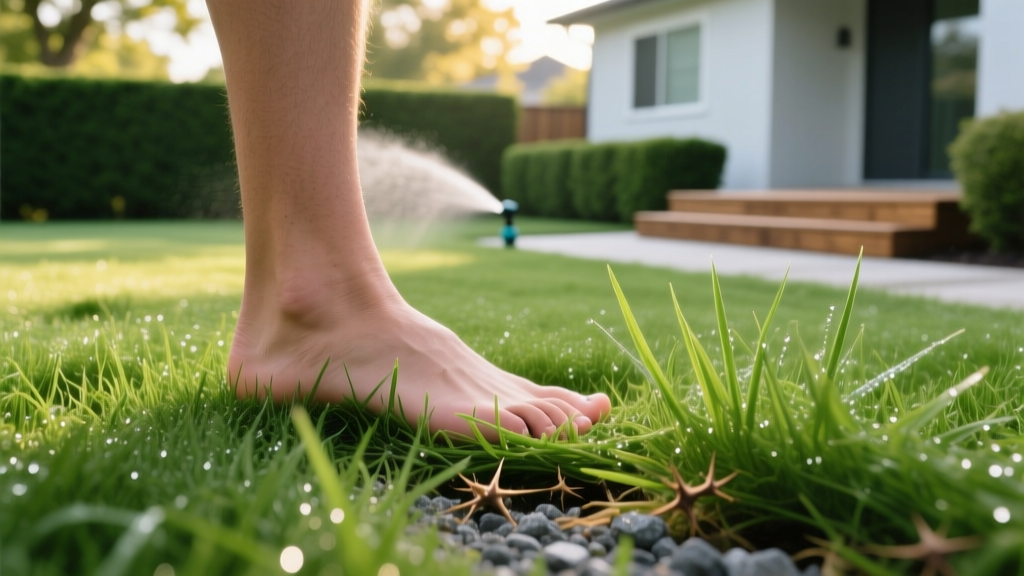
Why Walking Barefoot on Grass Hurts: Diagnosis and Rescue Fixes
The 'Barefoot Test': Why Your Lawn Fails the Touch Standard
In professional turf management, the ultimate benchmark for lawn quality isn't just visual striping or uniform color; it is the 'barefoot test.' If walking barefoot on grass causes discomfort, itching, or a burning sensation, your turf is signaling underlying agronomic or pest-related failures. A healthy lawn should feel like a dense, cool carpet. When it feels like walking on fiberglass or sandpaper, specific physiological and environmental mechanisms are at fault.
Diagnosing the exact tactile symptom is the first step toward a targeted rescue. Below is a comprehensive diagnostic matrix and rescue protocol to transform a hostile lawn back into a barefoot-friendly environment.
Symptom 1: Prickly Stubble and Micro-Lacerations
If the grass feels sharp, stiff, or scratches the soles of your feet, the issue is almost always mechanical or botanical. The turf blades have been physically altered to create rigid, needle-like tips.
Culprit A: Dull Mower Blades and Tissue Shredding
A mower blade that hasn't been sharpened in over 25 hours of runtime stops cutting and starts tearing. This shredding action crushes the grass's vascular tissue (xylem and phloem). As the damaged tip dries out in the sun, it calcifies into a hard, splinter-like point. When you step on it, these micro-spikes pierce the soft skin of your feet.
- The Fix: Sharpen your mower blades to a precise 30-degree bevel using a bench grinder or flat file. Balance the blade on a magnetic balancer to prevent spindle vibration. For a standard 1/4-acre lawn, sharpen blades every 20 hours of use (roughly every 3-4 weeks during peak spring growth).
- Cost: $15 for a basic file and balancer, or $10-$15 per blade at a local small engine shop.
Culprit B: Weed and Turf Seed Heads
During specific seasonal windows, certain grasses and weeds produce rigid seed stalks that bypass the mower deck or snap back upright immediately after cutting.
- Spring Offender: Poa annua (annual bluegrass) produces stiff, whitish seed heads from April to June that feel like plastic bristles.
- Summer Offender: Common Bermuda grass (Cynodon dactylon) produces wiry seed stalks in mid-summer that are notoriously difficult to cut cleanly.
- The Fix: For Poa annua, apply a pre-emergent like Prodiamine (Barricade) in early fall (when soil temps drop to 70°F) to prevent germination. For Bermuda seed heads, lower your mowing height slightly and increase mowing frequency to twice a week during the seed-head flush to exhaust the plant's energy reserves.
Pro Tip: Never bag your clippings to remove seed heads. The seeds are often immature and won't germinate, but removing the clippings strips your soil of vital nitrogen and organic matter. Instead, use a mulching blade to pulverize the stalks into the thatch layer.
Symptom 2: Intense Itching, Biting, and Crawling Sensations
If walking barefoot on grass results in intense itching around the ankles, calves, or between the toes within 12 to 24 hours, you are dealing with arthropod pests. The two primary culprits in North American lawns are chiggers and fire ants.
Chiggers (Trombiculidae) vs. Fire Ants (Solenopsis invicta)
Chiggers are microscopic mite larvae that wait on the tips of grass blades. When brushed by bare skin, they migrate to tight clothing areas or skin folds, injecting digestive enzymes that cause severe, localized dermatitis. Fire ants, conversely, build visible mounds and swarm aggressively when their soil habitat is vibrated by footsteps.
| Symptom Profile | Pest Culprit | Rescue Product (Active Ingredient) | Application Rate & Cost |
|---|---|---|---|
| Delayed, intense itching; red welts on ankles/toes | Chiggers | Talstar PL (Bifenthrin 0.2%) | 2.3 lbs / 1,000 sq ft. (~$55 for 25lb bag) |
| Immediate sharp pain; white pustules; visible dirt mounds | Red Imported Fire Ant | Extinguish Plus (Methoprene + Hydramethylnon) | 1.5 lbs / acre (broadcast). (~$85 for 25lb bag) |
| Flea jumps on lower legs; small clustered red bites | Cat/Dog Fleas | Permethrin-based yard sprays | Ready-to-spray hose end. (~$25 per 32oz bottle) |
According to the EPA guidelines on treating fire ant mounds, broadcast baits are significantly more effective than individual mound drenches for long-term colony elimination, as the foraging workers carry the slow-acting toxicant directly to the queen.
Symptom 3: Chemical or Fungal Burning
A burning sensation on the soles of the feet immediately upon contact with the grass indicates a chemical residue or an active, aggressive fungal pathogen exuding caustic byproducts.
Fast-Release Nitrogen Burn
If you recently applied a synthetic, fast-release fertilizer (like Urea or Ammonium Sulfate) and failed to water it in adequately, the granules sit on the grass blades. When your bare feet crush the granules against the leaf tissue, the highly concentrated salts draw moisture out of both the grass and your skin, causing a chemical burn.
- The Fix: Flush the soil immediately. Apply 1 inch of water per day for 5 consecutive days to push the excess nitrogen salts below the root zone. Switch to a slow-release, polymer-coated fertilizer like Milorganite or Scotts Turf Builder EdgeGuard Mini for future applications.
Pythium Blight (Pythium spp.)
In hot, humid conditions (nighttime temperatures above 70°F with high moisture), Pythium blight can rapidly destroy turf. The pathogen produces a greasy, slimy exudate on the grass blades. Walking barefoot through an active Pythium outbreak transfers this slimy, pathogen-rich residue to your skin, which can cause mild contact irritation and spreads the fungus to healthy areas of the lawn via your feet.
- The Fix: Apply a systemic strobilurin fungicide like Heritage G (Azoxystrobin) at a rate of 2 to 4 lbs per 1,000 sq ft. The NC State TurfFiles database on Pythium Blight notes that preventative applications are vastly superior to curative ones, as Pythium can defoliate a lawn in 48 hours under ideal conditions.
The 30-Day Barefoot Rescue Protocol
To systematically eliminate all tactile hazards and restore a soft, barefoot-friendly lawn, follow this exact 30-day sequence:
- Day 1: Mechanical Audit. Remove, sharpen, and balance your mower blades. Set your mower deck to the highest recommended height for your grass type (e.g., 3.5 inches for Tall Fescue, 1.5 inches for Zoysia) to promote deeper roots and shade out weed seed heads.
- Day 3: Pest Eradication. Apply Bifenthrin granules (Talstar PL) using a rotary spreader. Water the lawn immediately with 0.25 inches of irrigation to activate the granules into the thatch layer where chiggers and flea larvae reside.
- Day 7: Thatch Reduction. If your thatch layer exceeds 0.5 inches, rent a core aerator. Core aeration relieves soil compaction and introduces oxygen to the thatch layer, accelerating the breakdown of rigid, woody stubble left by dull mowers.
- Day 14: Nutritional Reset. Apply a liquid kelp extract (such as Simple Grow Solutions Sea Kelp) to promote cell wall thickness and turf elasticity. Thicker, healthier cell walls bend underfoot rather than snapping into sharp points.
- Day 30: The Barefoot Test. Walk the perimeter and center of the lawn barefoot. The turf should now yield softly, feel cool to the touch, and leave no residue or irritation on the skin.
Expert References and Further Reading
For ongoing turf management and to maintain a barefoot-safe environment, consult these authoritative resources:
- Penn State Extension guide on proper lawn mowing - Detailed agronomic data on mower blade angles, cutting heights, and tissue damage prevention.
- EPA guidelines on treating fire ant mounds - Federal safety and efficacy protocols for broadcast and mound-specific insecticide applications.
- NC State TurfFiles database on Pythium Blight - Comprehensive diagnostic imagery and chemical control matrices for water-mold turf pathogens.

