
Lawn Care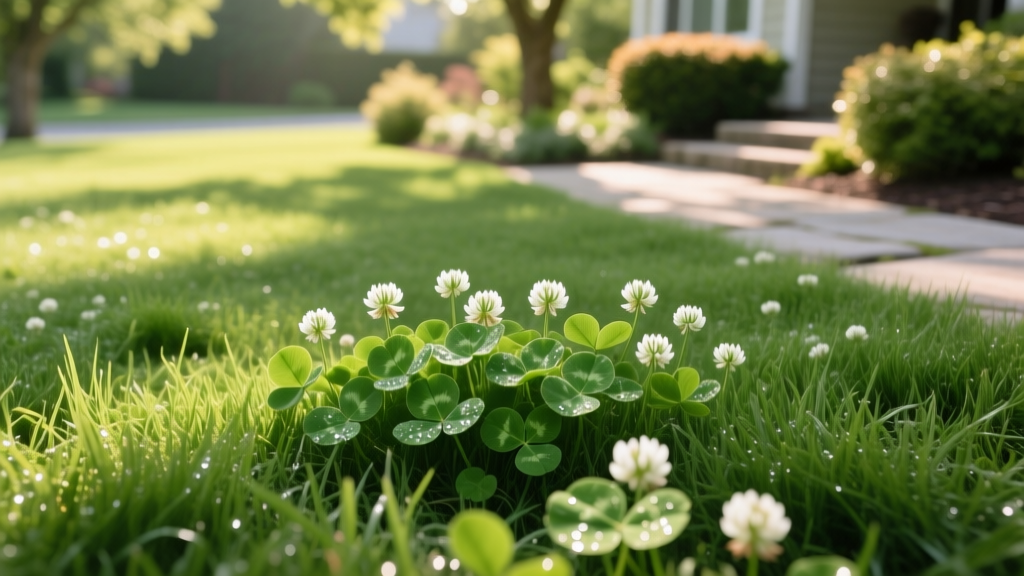
The Real Benefit of Clover: Should You Spot-Treat or Keep It?
The Paradigm Shift: Rethinking Broadleaf 'Weeds'
For decades, the standard turfgrass management protocol dictated the immediate eradication of any non-grass species. White clover (Trifolium repens) was universally targeted with broad-spectrum broadleaf herbicides. However, modern agronomic science and sustainable landscaping trends have forced a reevaluation of this approach. Before you mix up a tank of selective herbicide, it is critical to understand the ecological and economic benefit of clover in your lawn. Depending on your aesthetic goals and soil health objectives, clover may be an invaluable asset rather than a target for spot-treatment.
The Biological Engine: Nitrogen Fixation Quantified
The primary benefit of clover lies in its symbiotic relationship with Rhizobium leguminosarum bacteria. These bacteria colonize the root nodules of the clover plant, pulling atmospheric nitrogen (N2) and converting it into ammonia, a form usable by plants. According to research published by NC State Extension TurfFiles, a healthy stand of white clover can fix between 50 and 150 pounds of nitrogen per acre annually.
The Economics of Free Fertilizer
Translating this to a residential scale, a 5,000-square-foot lawn interspersed with 15% to 20% clover coverage can naturally generate 1 to 2 pounds of plant-available nitrogen per 1,000 square feet each year. Given that premium synthetic turf fertilizers (such as a 24-0-6 formulation) cost approximately $35 to $50 per 5,000 sq. ft. application, maintaining a clover blend can reduce your annual nitrogen fertilizer budget by 30% to 50%.
Ecological Insight: Beyond nitrogen fixation, clover's dense, low-growing stolon network acts as a living mulch. It shades the soil surface, reducing moisture evaporation by up to 20% during peak summer heat and suppressing the germination of more aggressive, undesirable annual weeds like crabgrass and spurge.
Spot-Treatment Decision Matrix: Eradicate vs. Tolerate
Not all lawns are suited for a clover blend. If you are managing a high-visibility Kentucky bluegrass athletic field or a formal estate lawn, uniformity is paramount. Use the following framework to decide whether to spot-treat or integrate.
| Lawn Scenario | Clover Tolerance Level | Recommended Action |
|---|---|---|
| Formal / HOA-Regulated Turf | 0% - 5% | Aggressive spot-treatment with selective herbicides. |
| Standard Suburban Fescue Lawn | 10% - 20% | Tolerate for nitrogen benefits; mow at 3 inches. |
| Shaded / Poor Soil Areas | 30% - 50% | Encourage clover; overseed with microclover to fill gaps. |
| High-Traffic Play Areas | 5% - 15% | Spot-treat if bee foraging is a safety concern. |
Precision Eradication: Spot-Treatment Protocols for Pure Turf
If your goal is a monoculture turfgrass stand and you have determined that the benefit of clover does not outweigh your aesthetic requirements, precision spot-treatment is required. Broadcasting herbicides over an entire lawn to kill scattered clover patches is economically wasteful and environmentally irresponsible.
Top Selective Herbicides for Clover Control
Clover is notoriously resilient due to its waxy leaf cuticle and extensive stolon network. Standard 2,4-D formulations often result in 'burn-down' without killing the root crown. You must use multi-active-ingredient formulations containing triclopyr or carfentrazone.
- SpeedZone Broadleaf Herbicide: Contains carfentrazone-ethyl, which disrupts cell membranes rapidly, allowing the other active ingredients (2,4-D, MCPP, dicamba) to translocate to the roots. Mixing Rate: 1.5 fl oz per 1,000 sq ft. Cost: ~$45 for a 20 oz bottle (covers ~13,000 sq ft).
- T-Zone SE Broadleaf Herbicide: The inclusion of triclopyr makes this exceptionally effective on mature, woody-stemmed clover and ground ivy. Mixing Rate: 1.2 to 1.5 fl oz per 1,000 sq ft. Cost: ~$55 for a 20 oz bottle.
- Surfactant Requirement: Always add a non-ionic surfactant (NIS) like Hi-Yield Spreader Sticker at 0.25% v/v (roughly 1/2 teaspoon per gallon of water). This breaks the surface tension of the clover leaf, increasing herbicide uptake by up to 40%.
Application Warning: Never apply ester-based broadleaf herbicides like SpeedZone when ambient temperatures exceed 85°F. Volatilization can cause the herbicide to vaporize and drift, causing severe phytotoxicity (leaf curling and necrosis) to nearby desirable ornamental shrubs and trees.
Cultivating the Eco-Lawn: Managing a Clover-Turf Blend
For homeowners embracing sustainable landscaping, University of Maryland Extension heavily endorses the integration of 'microclover' (Trifolium repens var. Pirouette). Unlike standard white clover, microclover features significantly smaller leaves, fewer flowers (reducing bee hazards for barefoot children), and a lower growth habit that blends seamlessly with turfgrass.
Seeding and Maintenance Specifications
To establish or renovate a lawn using a clover-turf blend, follow these exact parameters:
- Seed Ratio: Mix microclover seed at a rate of 3% to 5% by weight with your primary turfgrass seed (e.g., tall fescue or perennial ryegrass). Because clover seeds are tiny, 5% by weight yields an optimal spatial distribution.
- Overseeding Rate: Apply the blended seed at 5 to 7 pounds per 1,000 square feet for a standard overseeding operation.
- Mowing Height: Maintain a mowing height of 2.5 to 3.5 inches. Cutting below 2 inches will stress the turfgrass and allow the clover to form a dense mat that chokes out the grass crowns.
- Fertilization: Reduce spring nitrogen applications by 50%. A single application of 0.5 lbs of N per 1,000 sq ft in late spring is sufficient to support the grass while the clover handles the remaining nitrogen demands.
Frequently Asked Questions
Will clover take over and kill my grass entirely?
No. Clover and turfgrass have different peak growth cycles. Cool-season grasses dominate in early spring and fall, while clover thrives in the heat of mid-summer. When managed with proper mowing heights (above 2.5 inches), they exist in a symbiotic equilibrium rather than a purely competitive one.
Does clover attract bees and make the lawn unsafe?
Standard white clover produces abundant flowers that attract pollinators. If this is a safety concern, switching to microclover (Pirouette) or regularly mowing at 2.5 inches during the June flowering peak will effectively eliminate the blooms while preserving the root-level nitrogen benefits.
How do I fix soil that is too acidic for clover?
Clover requires a soil pH between 6.0 and 7.0 to support the Rhizobium bacteria. If a soil test reveals a pH below 6.0, apply pelletized calcitic lime at a rate of 50 lbs per 1,000 sq ft in the fall to raise the pH and optimize nitrogen fixation.

