
Lawn Care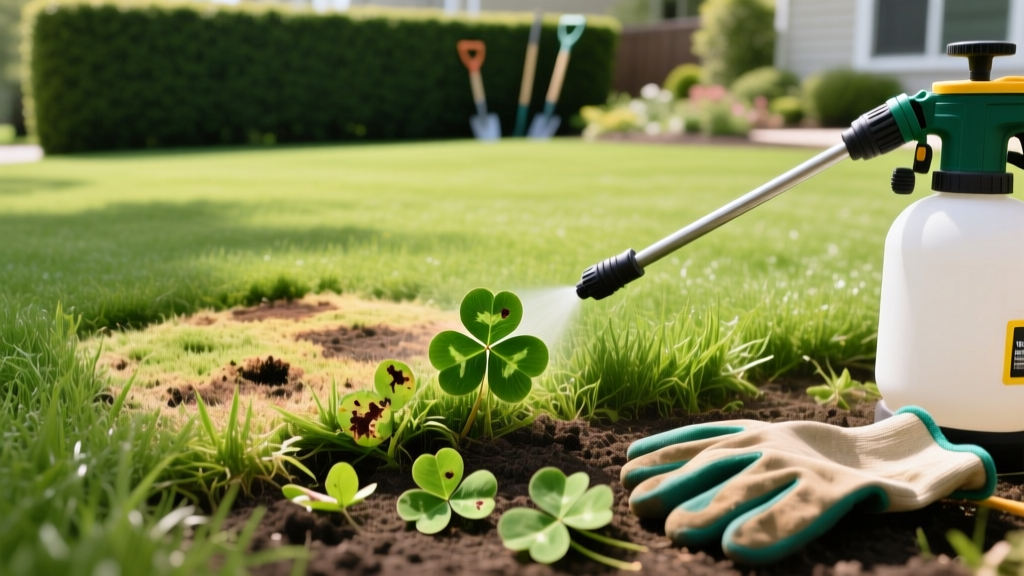
Best Clover Killer for Lawns: Spot-Treatment & Eradication Guide
White clover (Trifolium repens) is a perennial broadleaf weed that thrives in nitrogen-poor soils, making it one of the most common and frustrating invaders in residential turf. While broadcast spraying is an option for severe infestations, spot-treatment is the most efficient, cost-effective, and environmentally responsible method for managing isolated clover patches. Selecting the right clover killer for lawns requires matching the active ingredient to your specific grass type, the time of year, and your tolerance for synthetic chemicals.
The Nitrogen Connection: Clover is a legume capable of fixing atmospheric nitrogen through symbiotic bacteria in its root nodules. If clover is outcompeting your grass, it is a primary bio-indicator that your soil is nitrogen-deficient. Eradicating the weed without addressing the underlying soil fertility will only result in re-infestation within a single growing season.
Identifying Your Clover Enemy
Before mixing any herbicide, accurate identification is critical. Misidentifying the weed can lead to ineffective chemical selection. While white clover is the most prevalent, other look-alikes require different approaches.
| Species | Visual Identifiers | Growth Habit | Herbicide Susceptibility |
|---|---|---|---|
| White Clover | Three-leaflet leaves with white 'V' chevrons; spherical white/pink flowers. | Low-creeping stolons that root at nodes. | Highly susceptible to 2,4-D and Dicamba blends. |
| Red Clover | Larger leaves with fine hairs; distinct red/purple spherical flower heads. | Upright, bushy growth; short-lived perennial. | Moderate; requires higher rates of systemic herbicides. |
| Oxalis (Yellow Woodsorrel) | Heart-shaped leaflets (looks like shamrock); small yellow cup-shaped flowers. | Upright stems with explosive seed pods. | Resistant to basic 2,4-D; requires Fluroxypyr or Triclopyr. |
According to Penn State Extension, white clover's stoloniferous growth means that pulling it by hand often leaves root nodes behind, guaranteeing regrowth. Chemical spot-treatment targets the entire vascular system, ensuring the roots are destroyed.
Top Chemical Spot-Treatments for Clover
When selecting a synthetic clover killer for lawns, you must balance speed of control with turfgrass safety. Here are the industry-standard active ingredients for spot-treatment.
1. SpeedZone Broadleaf Herbicide (2,4-D Blend)
SpeedZone is a four-way emulsifiable concentrate containing 2,4-D, MCPP-p, Dicamba, and Carfentrazone-ethyl. The addition of carfentrazone provides a rapid 'burn' effect, causing clover leaves to desiccate within 24 to 48 hours, while the systemic 2,4-D and dicamba travel to the roots.
- Best For: Cool-season grasses (Kentucky Bluegrass, Fescues, Ryegrass) and Bermudagrass.
- Mix Rate: 1.5 fl oz per gallon of water (covers approx. 1,000 sq ft).
- Cost: ~$45 per pint.
- Failure Mode: Applying to St. Augustinegrass or Centipedegrass can cause severe stunting and chlorosis. Do not use on these warm-season species.
2. Syngenta Tenacity (Mesotrione 40%)
Tenacity operates via a unique mode of action (HPPD inhibition) that blocks photosynthesis, turning the clover stark white before it dies. It is highly effective against stubborn white clover and is unique because it can be used at the time of seeding for certain grasses.
- Best For: Kentucky Bluegrass, Tall Fescue, Fine Fescue, and Centipedegrass.
- Mix Rate: 1/2 teaspoon (0.5 tsp) per gallon of water.
- Mandatory Additive: You must include a Non-Ionic Surfactant (NIS) at 1 teaspoon per gallon. Without it, Tenacity's efficacy drops by over 60%.
- Cost: ~$60 for an 8 oz bottle.
- Warning: Do not apply post-emergence to Bermudagrass, Zoysiagrass, or St. Augustinegrass, as it will severely bleach and damage the turf.
Organic and Non-Toxic Alternatives
For homeowners managing lawns near waterways, vegetable gardens, or areas frequented by pets, synthetic auxin herbicides (like 2,4-D) may be undesirable. The Environmental Protection Agency (EPA) notes that minimum-risk pesticides offer viable alternatives for localized weed management.
Iron HEDTA (Chelated Iron)
Products containing Iron HEDTA (such as Fiesta or Natria Lawn Weed Control) exploit the physiological differences between broadleaf weeds and monocot grasses. Broadleaves absorb large quantities of the liquid iron, leading to oxidative stress, cellular rupture, and rapid blackening of the tissue. Grasses naturally limit iron absorption and quickly metabolize the excess.
- Application: Typically sold as a Ready-To-Use (RTU) liquid. Spray until leaves are wet, but not dripping.
- Cost: ~$25 to $35 per 32 oz RTU bottle.
- Limitation: Iron HEDTA is a contact herbicide. It rarely kills the deep taproot of mature clover on the first pass. Expect to apply 2 to 3 treatments spaced 14 days apart for complete eradication.
Temperature Warning: Never apply any liquid clover killer when ambient temperatures exceed 85°F (29°C). High heat causes synthetic herbicides to volatilize (turn into a gas), which can drift and damage nearby ornamental shrubs, vegetable gardens, or cause phytotoxicity (burning) to your own turfgrass.
The 4-Step Spot-Treatment Protocol
Successful eradication relies on application mechanics just as much as chemical selection. Follow this exact protocol for spot-treating clover patches.
- Calibrate and Mix: Use a dedicated 1-gallon or 2-gallon pump sprayer. Add half the required water, then the herbicide, then the surfactant (if using Tenacity), and finally the remaining water. Agitate gently to prevent foaming.
- Optimize the Nozzle: Adjust your sprayer nozzle to a fine mist or a narrow cone pattern. You want to coat the clover leaves evenly without creating runoff that pools on the soil surface, which wastes product and increases soil contamination.
- Time the Application: Spray during the early morning when dew has dried, or late afternoon. Ensure no rainfall is forecast for at least 24 hours. The ideal temperature window is between 65°F and 80°F, when the clover is actively photosynthesizing and pulling the herbicide into its root system.
- Execute the Follow-Up: Clover is a resilient perennial. Inspect the treated area 14 to 21 days later. If using a systemic chemical like SpeedZone or Tenacity, any surviving green tissue indicates a missed spot or an under-dosed application. Re-treat only the surviving patches at the standard mix rate.
Post-Eradication Soil Correction
Killing the clover leaves behind bare patches and the original nitrogen-deficient soil environment that invited the weed in the first place. To prevent immediate reinvasion by crabgrass or spurge, you must correct the soil profile.
- Nitrogen Application: Apply a fast-release nitrogen fertilizer (such as Urea 46-0-0) at a rate of 0.5 lbs of actual nitrogen per 1,000 square feet immediately after the clover has completely died and been raked out.
- Overseeding: For cool-season lawns, slit-seed or hand-broadcast a shade-tolerant or high-traffic grass blend matching your existing turf over the bare spots. Keep the seed moist for 14 days.
- Soil Testing: Invest in a comprehensive soil test (approx. $30 via university extension offices) every three years to monitor Phosphorus and Potassium levels, ensuring your grass remains dense enough to naturally shade out future clover seedlings.
Frequently Asked Questions
Will vinegar kill clover effectively?
Horticultural vinegar (20% to 30% acetic acid) will burn the foliage of young clover, but it is strictly a contact burn agent. It will not translocate to the roots, meaning mature white clover will simply resprout from its stolons within a week. Furthermore, high-concentration acetic acid is highly corrosive, dangerous to handle, and will lower your soil pH drastically if it pools in the turf.
How long after spraying clover killer can I mow?
Wait a minimum of 48 hours after applying a systemic herbicide like 2,4-D or Tenacity before mowing. The weed needs time to absorb the chemical through the leaves and move it down into the root crown. Mowing too soon removes the treated tissue and drastically reduces the efficacy of the spot-treatment.
Is it safe to use clover killer near vegetable gardens?
Synthetic auxin herbicides (2,4-D, Dicamba) are notorious for drifting and causing severe curling and stunting in sensitive broadleaf crops like tomatoes, peppers, and grapes. If your clover patches are within 15 feet of a vegetable garden, avoid synthetic sprays entirely and opt for manual extraction or localized applications of Iron HEDTA, which poses minimal drift risk to edible crops.

