
Lawn Care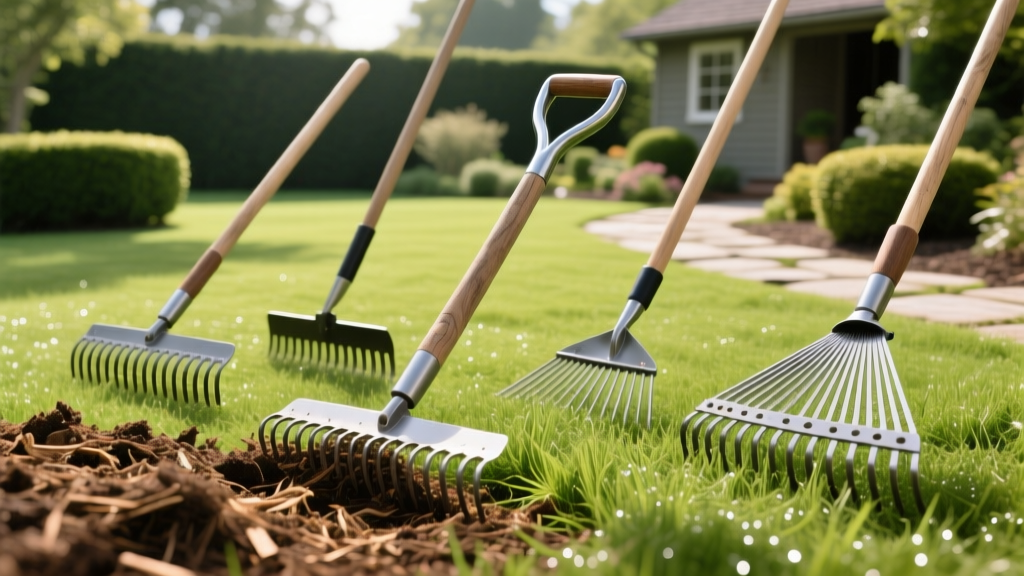
Best Mulch Rakes for Lawn Care and Landscaping 2026
Spreading mulch is one of the most impactful soil amendment practices you can perform in your landscape. A proper 2-to-3-inch layer of organic mulch regulates soil temperature, suppresses weeds, and retains critical moisture. However, the efficiency of your mulch application—and the health of your underlying soil structure—depends entirely on using the correct tool. A standard leaf rake will bend under the weight of wet hardwood, while a rigid steel garden rake can sever the shallow feeder roots of your shrubs. In this guide, we break down the exact mulch rake models, tine materials, and spreading techniques required for professional-grade lawn and garden care in 2026.
The Anatomy of a Professional Mulch Rake
Not all rakes are engineered for soil amendments. A true mulch rake balances head width, tine flexibility, and handle leverage. When evaluating a rake for moving and grading organic materials like cedar, pine bark, or compost, focus on three critical components:
- Tine Geometry: Mulch rakes feature either flat, broad tines for pushing and leveling, or curved, rounded tines for grabbing and pulling heavy, wet clumps.
- Head Width: Shrub rakes (7 to 10 inches) navigate tight perennial beds without damaging adjacent foliage. Bow rakes (14 to 18 inches) are designed for open beds and rapid distribution from a wheelbarrow.
- Handle Leverage: Fiberglass and steel handles provide the necessary rigidity for moving heavy, water-logged mulch, while hardwood offers vibration dampening for extended use.
Shrub Rakes vs. Standard Bow Rakes: A Decision Matrix
Choosing between a narrow shrub rake and a wide bow rake depends on your specific landscape architecture and the type of mulch you are applying. Use the matrix below to determine the right tool for your current project.
| Feature | Shrub Rake (7" - 10" Head) | Standard Bow Rake (14" - 18" Head) |
|---|---|---|
| Best Use Case | Tight perennial beds, around tree trunks, raised garden boxes | Open foundation beds, large borders, moving mulch from wheelbarrows |
| Mulch Type | Dry pine straw, shredded hardwood, fine compost | Heavy wet cedar, large bark nuggets, bulk topsoil amendments |
| Soil Impact | Minimal; prevents accidental root disturbance | Moderate; requires careful handling near shallow-rooted plants |
| Ergonomics | Requires more bending; slower coverage rate | Upright posture; rapid coverage of large square footage |
Matching Tine Material to Mulch Density
The material of your rake's tines dictates its lifespan and effectiveness. In 2026, manufacturers primarily offer three tine materials, each suited to specific soil amendment tasks:
1. Extruded Aluminum
Aluminum tines are lightweight and rust-proof, making them ideal for dry, lightweight amendments like pine needles or leaf mold. However, they will permanently bend if used to pry apart compacted, wet clay or heavy rubber mulch. Use aluminum strictly for fine grading and delicate shrub work.
2. Forged Carbon Steel
Steel tines offer maximum rigidity. If you are spreading heavy, wet cedar mulch or breaking up compacted compost piles, a forged steel bow rake is mandatory. The trade-off is weight and maintenance; steel requires wiping down after use to prevent oxidation.
3. Poly-Resin / Composite
Newer poly-resin tines provide a middle ground. They flex under heavy loads without bending permanently and are entirely immune to rust. They are excellent for general-purpose mulching but lack the sharp edge needed to break up hardened soil crusts.
Top-Rated Mulch Rakes for 2026
Based on field testing, durability, and ergonomic design, these three models represent the best options for homeowners and landscaping professionals this year.
Ames 7-Inch Aluminum Shrub Rake (Model 1960400)
Price: $32 - $38
Best For: Precision work around delicate perennials and tree bases.
The Ames 1960400 features a 7-inch head with 14 closely spaced aluminum tines and a 48-inch hardwood handle. Its narrow profile allows you to reach deep into dense hosta beds without snapping foliage. The hardwood handle absorbs shock, reducing wrist fatigue during detailed grading. Limitation: The aluminum tines will bend if used to move large, heavy bark nuggets.
True Temper 16-Inch Steel Bow Rake (Model 1880300)
Price: $45 - $52
Best For: Heavy-duty spreading and leveling of wet, bulk mulch.
Equipped with 16 curved, forged steel tines and a 60-inch fiberglass handle, the True Temper 1880300 is a workhorse. The curved tines easily grab heavy clumps of mulch from a wheelbarrow, while the flat top of the head bar can be flipped over to screed and level the soil amendment to a precise depth. The fiberglass handle provides excellent leverage without the snap-risk associated with cheap wooden handles.
Corona LR 3460 Extendable Shrub Rake
Price: $28 - $34
Best For: Raised beds and gardeners requiring adjustable reach.
The Corona LR 3460 solves the storage and reach problem with a telescoping steel handle that adjusts from 21 to 37 inches. Featuring 9 durable steel tines on a 7.5-inch head, it is exceptionally versatile for container gardening and tiered raised beds where standard 60-inch handles become cumbersome.
Pro-Tip: The "Pull and Flip" Technique
To achieve a perfectly level mulch bed, use the tines of your bow rake to pull and distribute the mulch from your pile. Once distributed, flip the rake 180 degrees so the tines point up. Use the flat, straight metal bar on the back of the rake head like a concrete screed to push and level the mulch to an even 2.5-inch depth.
To achieve a perfectly level mulch bed, use the tines of your bow rake to pull and distribute the mulch from your pile. Once distributed, flip the rake 180 degrees so the tines point up. Use the flat, straight metal bar on the back of the rake head like a concrete screed to push and level the mulch to an even 2.5-inch depth.
Preventing Mulch Volcanoes and Soil Compaction
Proper tool usage is only half the battle; application technique dictates plant health. A common and fatal landscaping error is "volcano mulching"—piling mulch high against the trunk of a tree. According to the University of Minnesota Extension, mulch piled against the bark traps moisture, leading to cambium rot, and invites rodent damage during winter months.
When using your shrub rake to grade mulch around trees, maintain a strict 3-inch "donut" of bare soil directly around the trunk flare. Use the narrow tines of the shrub rake to gently pull excess mulch away from the base, ensuring the root flare remains exposed and dry. Furthermore, avoid compacting the mulch layer. Penn State Extension notes that overly compacted mulch restricts oxygen flow to the soil microbiome, defeating the purpose of the amendment. Rake lightly and leave the material fluffy to promote gas exchange and water infiltration.
Tool Maintenance: Preventing Tine Corrosion
Organic mulches retain moisture and harbor organic acids that accelerate rust on carbon steel tines. To extend the life of a steel bow rake:
- Clean Immediately: Rinse the tines with a high-pressure hose nozzle after every use to remove trapped bark and soil acids.
- Dry Thoroughly: Allow the rake to air-dry in the sun; never store a wet steel rake in a closed shed.
- Apply a Protectant: At the end of the season, wipe the steel tines with a rag soaked in boiled linseed oil or a silicone-based tool spray to create a moisture barrier.
Warning: Never use a standard flexible leaf rake to spread heavy mulch. The thin wire tines will permanently warp under the lateral load, ruining the tool's tension and rendering it useless for future leaf collection.
Frequently Asked Questions
Can I use a landscaping rake for spreading mulch?
A landscaping rake (often 36 inches wide with a flat, smooth metal head) is designed for grading soil and spreading gravel. While you can use it to push mulch, it lacks the tines necessary to grab, pull, and aerate organic materials. A bow rake or shrub rake is significantly more efficient for mulch application.
How often should I refresh my mulch beds?
Organic mulches like shredded hardwood decompose and require topping up annually, typically in early spring. Before adding new mulch, use your shrub rake to lightly cultivate and break up the crust of the existing, compacted mulch layer to restore water permeability.
What is the ideal depth for mulch application?
Maintain a depth of 2 to 3 inches. Applying less than 2 inches fails to suppress weeds effectively, while exceeding 3 inches can suffocate soil oxygen exchange and cause water runoff. Use the flat back of your rake head to screed the material to this exact depth.

