
Lawn Care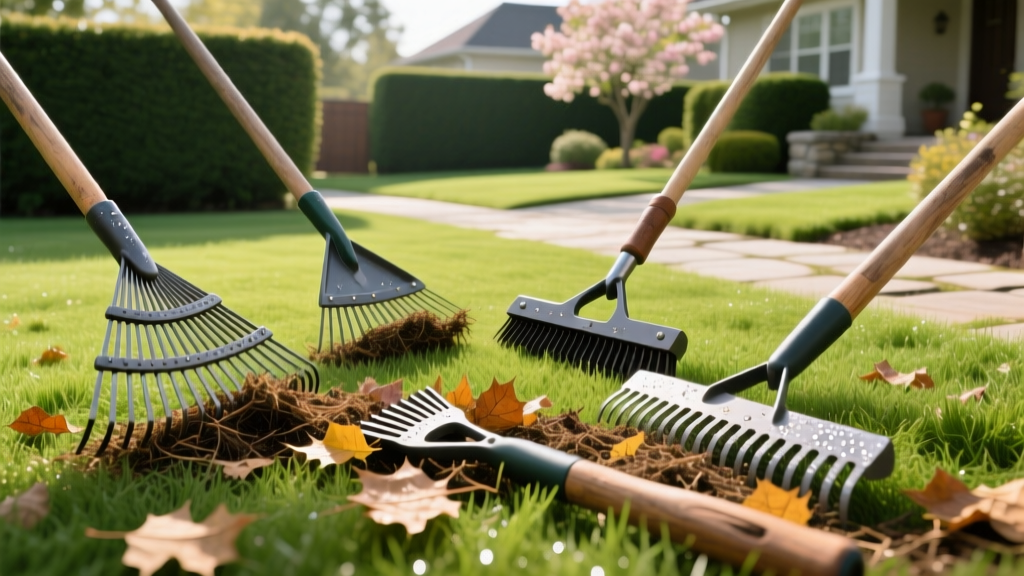
Best Rake Tools for Lawn Thatch and Leaves in 2026
Selecting the correct rake tools is one of the most critical, yet frequently overlooked, aspects of lawn equipment selection. While mowers and trimmers handle the vertical growth of your turf, rake tools manage the horizontal health: removing suffocating thatch, clearing disease-harboring debris, and grading topdressing materials. Using the wrong rake not only wastes hours of manual labor but can actively damage your turf's root zone.
This 2026 guide breaks down the engineering differences between thatch, leaf, and leveling rakes, providing specific model recommendations, material matrices, and professional maintenance protocols to maximize your equipment's lifespan.
The Anatomy of a Lawn Rake: Tines, Bows, and Handles
The effectiveness of any rake tool comes down to three structural components: tine composition, bow geometry, and handle material. Cheap, mass-produced rakes often fail because manufacturers cut costs on the resin quality of poly tines or use low-carbon steel that bends under the torque of compacted soil.
Material Matrix: Tine Composition
| Material | Best Use Case | Durability | Average Cost |
|---|---|---|---|
| UV-Stabilized Polypropylene | Leaf clearance, light debris, delicate grass blades | Moderate (Resists snapping if UV-treated) | $20 - $35 |
| Spring Steel | Thatch removal, scarifying, moss extraction | High (Flexes and returns to shape) | $35 - $55 |
| Extruded Aluminum | Leveling, topdressing, spreading gravel/sand | Very High (Rust-proof, rigid) | $75 - $120 |
| Carbon Steel | Heavy grading, moving wet soil or mulch | High (Prone to rust without maintenance) | $30 - $50 |
Selecting the Right Rake Tools for Specific Lawn Tasks
A common mistake among homeowners is attempting to use a standard flexible leaf rake for dethatching, or a rigid bow rake for leaf collection. Task-specific tools are engineered with distinct tine spacing and flex patterns.
Dethatching and Soil Aeration (Thatch Rakes)
Thatch is a layer of living and dead organic matter that accumulates between the green vegetation and the soil surface. According to UMass Extension, a thatch layer exceeding 0.5 inches restricts water penetration and harbors turf pathogens. To remove it, you need a dedicated thatch rake.
- Model Recommendation: Ames True Temper 19-Tine Thatch Rake (Approx. $38).
- Key Specs: The tines are spaced exactly 1/2 inch apart and feature a curved, knife-like leading edge. This curvature is vital; it slices through the thatch mat and pulls it upward without tearing the living grassroots.
- Technique: Pull the rake backward toward your body, penetrating no more than 1/4 inch into the soil. Never push a thatch rake forward, as this will scalp the lawn.
Leaf Clearance and Debris (Poly Leaf Rakes)
For clearing autumn leaves and post-mowing clippings, a wide-span poly rake is mandatory. The tines must be flexible enough to glide over uneven terrain without snagging on exposed roots or irrigation heads.
- Model Recommendation: Bully Tools 92324 24-Tine Poly Rake (Approx. $28).
- Key Specs: Features a 30-inch spread and a solid fiberglass handle. Ensure the poly head is explicitly labeled as 'UV-stabilized.' Standard polypropylene becomes brittle and shatters after one season of direct sun exposure.
Grading and Topdressing (Leveling Rakes)
If you are overseeding or applying a sand-compost topdressing mix to level low spots, standard bow rakes will leave streaks and ruts. Leveling rakes feature a perfectly flat bottom edge designed to drag and grade materials evenly.
- Model Recommendation: Rocklin Industry Levelhead Rake (Approx. $89).
- Key Specs: 30-inch flat-bottomed aluminum head with a 72-inch ash handle. The aluminum prevents rust when working with wet compost, and the flat edge allows you to push and pull topdressing into aeration holes seamlessly.
Ergonomics and Sizing: Preventing Back Strain
Manual raking involves repetitive twisting and pulling, which places immense shear force on the lumbar spine. The Occupational Safety and Health Administration (OSHA) emphasizes the importance of tool handle length and grip diameter in minimizing musculoskeletal disorders.
The 60-Inch Rule: For any adult over 5'8', a 54-inch handle forces a stooped posture, increasing lower back load by up to 40%. Always upgrade to a 60-inch or 72-inch handle to maintain a neutral spine angle during the pulling motion.
Furthermore, handle diameter matters. A grip that is too thick restricts blood flow to the fingers, while a grip that is too thin forces you to squeeze tighter, accelerating forearm fatigue. Look for handles with a diameter between 1.25 and 1.5 inches. If using bare wood, wrap the grip zone in self-fusing silicone tape for shock absorption.
Equipment Maintenance: Extending the Lifespan of Your Rake Tools
Rake tools are subjected to soil acidity, moisture, and physical impact. Implementing a strict maintenance protocol will easily double the lifespan of your equipment. According to turf management guidelines from Michigan State University Extension, keeping soil-removal tools clean prevents the accidental transfer of turf diseases like dollar spot or brown patch between lawn zones.
The Sand and Oil Storage Method
Steel and carbon steel rake heads will rust if left in a damp garage. Professional landscapers use a dedicated storage bucket to clean and oil the tines simultaneously.
- Take a 5-gallon bucket and fill it with 4 inches of coarse builder's sand.
- Pour 1 quart of mineral oil or boiled linseed oil into the sand and mix until it is damp, but not pooling.
- After every use, plunge the steel rake head into the sand and plunge it up and down 5 times. The sand acts as an abrasive to remove caked soil and sap, while the oil leaves a micro-thin protective barrier against oxidation.
Warning on Wood Handles: Never store ash or hickory wood handles resting on a concrete floor. Concrete wicks moisture, which will rot the wood grain at the base. Always hang rakes by their heads or store them upright. Apply a coat of boiled linseed oil to bare wood handles every spring to prevent splintering and drying.
Fiberglass and Poly Care
While fiberglass handles do not rot, the resin coating can degrade from UV exposure. Wipe down fiberglass handles with a damp cloth to remove acidic lawn fertilizers that can pit the surface. For poly rake heads, inspect the tine-to-head junction (the 'nubs') for micro-fractures. If you see white stress marks in the plastic, the rake is nearing the end of its structural integrity and should be replaced before a tine snaps off in the lawn.

