
Lawn Care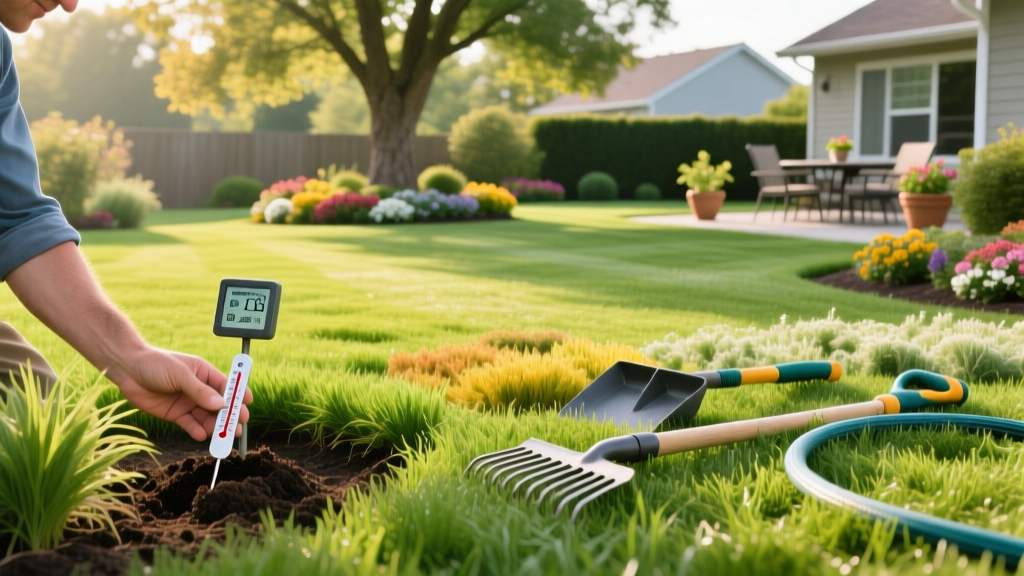
Best Time to Weed and Feed Lawn: Regional Timing & Soil Temps
The most common mistake homeowners make with lawn care is relying on calendar dates rather than environmental triggers. Searching for the best time to weed and feed lawn often yields generic advice like "apply in mid-April" or "treat around Labor Day." However, weeds do not germinate based on the calendar; they respond to soil temperature and moisture levels. Applying a weed and feed product two weeks too early wastes the pre-emergent barrier, while applying it two weeks too late allows crabgrass and broadleaf weeds to establish deep root systems that resist chemical control.
To achieve a pristine turf in 2026, you must shift from date-based scheduling to soil-temperature-based scheduling. This guide breaks down the exact physiological triggers for weed germination, regional application windows, and the specific active ingredients required for your grass type.
The Science of Soil Temperature: The Real Application Trigger
Commercial "weed and feed" products typically combine a nitrogen-rich fertilizer with post-emergent broadleaf herbicides (like 2,4-D, Dicamba, and MCPP). They rarely contain pre-emergents for crabgrass. Therefore, understanding the difference between pre-emergent timing and post-emergent timing is critical.
Expert Insight: Air Temp vs. Soil Temp
Do not use daytime air temperature as your guide. A string of 70°F spring days will not trigger weed germination if the soil at a 2-inch depth remains below 50°F. Always measure soil temperature at a 2-inch depth using a dedicated soil probe thermometer, taking the reading between 8:00 AM and 10:00 AM for the most accurate daily baseline.
Do not use daytime air temperature as your guide. A string of 70°F spring days will not trigger weed germination if the soil at a 2-inch depth remains below 50°F. Always measure soil temperature at a 2-inch depth using a dedicated soil probe thermometer, taking the reading between 8:00 AM and 10:00 AM for the most accurate daily baseline.
- 50°F - 55°F Soil Temp: The germination window for Poa annua (annual bluegrass) and the early stages of crabgrass. This is the time for pre-emergent herbicides, not standard weed and feed.
- 60°F - 65°F Soil Temp: Broadleaf weeds (dandelion, clover, chickweed) enter active vegetative growth. This is the optimal window for post-emergent weed and feed applications, as the weeds are actively pulling nutrients (and herbicides) down into their root zones.
- 85°F+ Soil Temp: Herbicide efficacy drops, and the risk of turf burn from chemical volatility spikes. Avoid weed and feed applications during peak summer heat.
Regional Calendars: When to Apply by Zone and Grass Type
The best time to weed and feed lawn varies drastically depending on whether you are managing cool-season grasses (Fescue, Kentucky Bluegrass, Ryegrass) or warm-season grasses (Bermuda, Zoysia, St. Augustine). According to turfgrass researchers at NC State University, warm-season grasses require entirely different chemical protocols to avoid damaging the turf during spring green-up.
| Region / Grass Type | Spring Window (Soil Temp) | Fall Window (Soil Temp) | Primary Target Weeds |
|---|---|---|---|
| Northeast / Midwest (Cool-Season) |
Mid-April to May (Soil hits 60°F) |
Sept to Oct (Soil drops to 65°F) |
Dandelion, Clover, Crabgrass, Henbit |
| Southeast / Deep South (Warm-Season) |
May to June (Soil hits 70°F) |
Not Recommended (Focus on pre-emergent only) |
Dollarweed, Doveweed, Chamberbitter |
| Transition Zone (Tall Fescue / Zoysia) |
Late April (Soil hits 65°F) |
Early September (Soil drops to 70°F) |
Goosegrass, Broadleaf Plantain, Nutsedge |
Product Selection: Granular vs. Liquid Efficacy
Not all weed and feed formulations are created equal. While big-box store granular products are convenient, professional-grade liquid applications offer vastly superior weed control, particularly for stubborn warm-season weeds. Penn State Extension notes that liquid herbicides provide better foliar absorption, which is critical for post-emergent control.
Top Granular Options (Best for Broadleaf + Fertilization)
- Scotts Turf Builder Weed & Feed: Contains 2,4-D and Mecoprop. Excellent for cool-season lawns targeting dandelions and clover. Cost: ~$3.50 per 1,000 sq. ft. Warning: Do not use on St. Augustine or Centipede grass, as 2,4-D will severely damage these species.
- Lesco Professional Weed & Feed (17-0-8): Features a higher concentration of Trimec (2,4-D, MCPP, Dicamba). Better suited for heavy broadleaf infestations in Fescue and Bluegrass. Cost: ~$4.20 per 1,000 sq. ft.
Top Liquid Options (Best for Targeted & Warm-Season Control)
- Celsius WG Herbicide: The gold standard for warm-season lawns (Bermuda, Zoysia, St. Augustine). It controls over 150 broadleaf weeds without harming sensitive southern grasses. Upfront cost is high (~$140 per bottle), but at 0.1 oz per 1,000 sq. ft., the cost drops to roughly $1.50 per application.
- Fahrenheit Herbicide: Ideal for cool-season grasses dealing with tough weeds like wild violet and ground ivy. Requires a non-ionic surfactant for maximum efficacy.
Crucial Timing Warning: Never apply a granular "weed and feed" product and expect it to kill crabgrass. Granular weed and feeds contain post-emergent herbicides. Crabgrass requires a pre-emergent (like Prodiamine or Dithiopyr) applied when soil temps reach 55°F. You must split these applications: pre-emergent in early spring, and weed & feed in late spring.
Step-by-Step Application Protocol for Maximum Efficacy
To ensure the active ingredients translocate to the weed roots rather than washing off or burning the turf, follow this exact protocol:
- Mow 24 Hours Prior: Cut your lawn to its normal height. Do not scalp the lawn. Removing the top growth of the weeds forces them to push out new, tender foliage that absorbs herbicide more rapidly.
- Check the Dew: If using granular weed and feed, apply in the early morning when dew is present, or lightly mist the lawn with a hose. The moisture causes the granules to stick to the broadleaf weed leaves rather than bouncing off onto the soil where they are useless.
- Calibrate the Spreader: Weigh out the exact amount of product needed for your lawn's square footage. Set your spreader to the manufacturer's recommended setting (usually between 4.0 and 6.0 for rotary spreaders) and walk at a consistent pace of 3.0 MPH.
- The 48-Hold Watering Rule: For post-emergent weed and feed, do not water the lawn for 48 hours. The herbicide needs time to absorb through the leaf cuticle. (Conversely, if you are applying a pre-emergent, you must water in 0.5 inches of irrigation immediately to activate the soil barrier).
Common Failure Modes and How to Avoid Them
Even with perfect timing, environmental factors can neutralize your herbicide. According to turf management data from the University of Missouri Extension, improper soil pH and temperature volatility are the leading causes of herbicide failure.
- Failure Mode 1: High Soil pH Tie-Up. If your soil pH is above 7.2, certain herbicides (especially those containing 2,4-D) become chemically bound to soil particles and lose efficacy. Fix: Test your soil and apply elemental sulfur to lower the pH to the 6.2–6.8 range before your spring application.
- Failure Mode 2: Dicamba Volatility. Products containing Dicamba are highly effective against tough weeds like creeping charlie. However, if applied when air temperatures exceed 85°F, Dicamba vaporizes and drifts, damaging nearby trees, shrubs, and neighbor's gardens. Fix: Restrict Dicamba applications to days where the high temperature will stay below 80°F.
- Failure Mode 3: Surfactant Omission in Liquid Sprays. Many weeds have a waxy leaf cuticle that repels water-based liquid herbicides. Fix: Always add a non-ionic surfactant (like Methylated Seed Oil) at a rate of 1-2 teaspoons per gallon of mixed liquid herbicide to break the surface tension.
Frequently Asked Questions
Can I seed my lawn and apply weed and feed at the same time?
No. The herbicides in weed and feed products do not differentiate between weed seedlings and grass seedlings. If you apply a standard weed and feed product, you must wait at least 4 weeks before seeding. If you apply a pre-emergent crabgrass preventer, you must wait 8 to 12 weeks before seeding.
How long does it take to see results after applying weed and feed?
Under optimal conditions (soil temps between 65°F and 80°F with adequate moisture), you will see the edges of broadleaf weeds begin to curl and yellow within 7 to 10 days. Complete root death and visible browning of the weed typically takes 14 to 21 days.

