
Lawn Care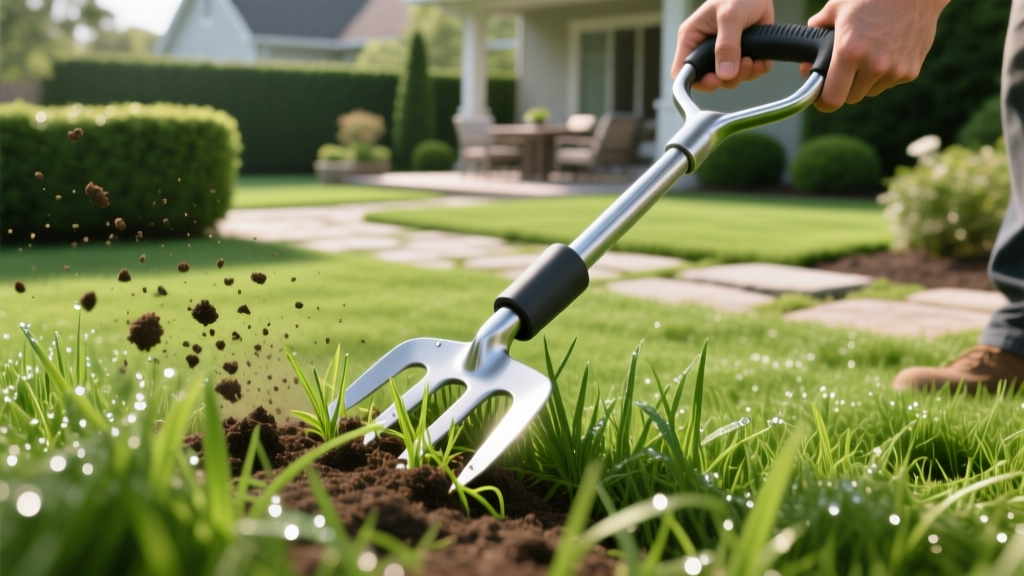
How to Choose the Best Tool to Remove Grass and Weeds
The Science of Grass Extraction: Why Tool Selection Matters
Removing unwanted grass—whether it is an invasive species like quackgrass creeping into your perennial beds, or you are clearing sod for a new hardscape—requires matching the extraction tool to the specific root architecture of the turf. The most common failure in turf removal is severing the crown while leaving the rhizomes or stolons intact. Grasses like Bermudagrass (Cynodon dactylon) and Quackgrass (Elymus repens) store massive energy reserves in underground rhizomes. If your tool fails to extract the root system below the 4-inch soil line, the weed will regenerate within 14 to 21 days.
Furthermore, soil shear strength dictates tool efficacy. Mechanical extraction tools require a Volumetric Water Content (VWC) of roughly 20% to 30%. In soil that is too dry, manual tines will bend or snap against compacted clay; in soil that is too wet, the soil structure collapses, clumping around the roots and causing the tool to slip off the crown.
Decision Matrix: Matching the Tool to the Grass Type
Use this framework to select the correct equipment based on the biological classification of the grass you are removing.
| Grass / Weed Type | Root Architecture | Max Root Depth | Recommended Tool Category |
|---|---|---|---|
| Crabgrass / Annual Bluegrass | Fibrous, shallow, no rhizomes | 2 - 4 inches | Manual Stand-up Weeders (2-claw or 4-claw) |
| Quackgrass | Deep, aggressive rhizomes | 6 - 12 inches | Manual Sod Cutters or Deep-reach Forks |
| Bermudagrass / Johnsongrass | Dense, branching rhizome networks | 8 - 24+ inches | Gas-Powered Sod Cutters + Solarization |
| Standard Turf (Fescue / Kentucky Bluegrass) | Dense fibrous mat | 4 - 6 inches | Manual or Motorized Sod Cutters |
Manual Tools for Precision Grass and Weed Removal
For targeted removal in established garden beds or small lawn patches (under 50 square feet), manual tools offer precision without destroying surrounding desirable plants.
Stand-Up Weed Pullers
The Fiskars 39 Inch Stand-Up Weeder (Model 79906935J), retailing around $42, utilizes a 4-claw stainless steel head. The four tines surround the taproot or central crown, distributing the extraction force evenly. This is highly effective for clump-forming grasses and broadleaf weeds. However, it struggles with lateral rhizomes. For deeper extraction, the Grampa's Weeder (Model 11001) at $45 uses a 2-claw V-notch design that penetrates up to 4.5 inches deep, leveraging a foot pedal to pop the root out with minimal spinal strain.
Manual Sod Cutters and Edgers
When clearing a defined 5x5 foot area of standard turf, a manual push-edger or a half-moon spade is the most cost-effective approach. The Bully Tools 92510 Half Moon Edger ($35) features a 3mm thick steel blade that slices through the fibrous mat of Kentucky Bluegrass cleanly. The technique requires cutting a grid pattern (12x12 inch squares) and using a flat spade to pry the sod up from the side, preserving the topsoil beneath.
Power Tools for Heavy-Duty Turf Removal
When removing grass for large-scale renovations (patios, pools, or full lawn replacements exceeding 200 square feet), manual labor becomes mathematically inefficient. A manual spade clears roughly 20 square feet per hour; a power sod cutter clears 500+ square feet per hour.
Motorized Sod Cutters
For professional-grade extraction, renting a walk-behind sod cutter like the Billy Goat SC1810H is the industry standard. Rental costs typically range from $90 to $120 per day at major equipment centers. These machines use a vibrating, oscillating horizontal blade set to a specific depth (usually 1.5 to 2 inches) to shear the grass roots just below the crown, leaving the valuable topsoil intact while rolling the grass up in continuous strips. This is the only viable mechanical method for clearing large areas of quackgrass without triggering massive rhizome fragmentation.
The Tiller Trap: When Power Tools Backfire
⚠️ CRITICAL WARNING: Never Till Rhizomatous Grasses
It is a common mistake to use a rotary tiller (like the Sun Joe TJ604E 16-inch Electric Tiller, $149) to break up and remove invasive grasses. While this works for annual weeds, it is disastrous for Bermudagrass and Johnsongrass. According to the University of California Statewide IPM Program, tilling chops the underground rhizomes into 1-inch to 2-inch fragments. Because each node on a rhizome contains a viable bud, a single mature plant can be mechanically cloned into dozens of new plants, turning a localized 10-foot patch into a full-yard infestation within a single growing season.
It is a common mistake to use a rotary tiller (like the Sun Joe TJ604E 16-inch Electric Tiller, $149) to break up and remove invasive grasses. While this works for annual weeds, it is disastrous for Bermudagrass and Johnsongrass. According to the University of California Statewide IPM Program, tilling chops the underground rhizomes into 1-inch to 2-inch fragments. Because each node on a rhizome contains a viable bud, a single mature plant can be mechanically cloned into dozens of new plants, turning a localized 10-foot patch into a full-yard infestation within a single growing season.
Step-by-Step Playbook: Clearing a 10x10 Invasive Grass Patch
Follow this exact sequence to permanently eradicate a 100-square-foot patch of invasive quackgrass or Bermudagrass without using synthetic herbicides.
- Hydrate the Soil Profile (Day 1): Apply exactly 1 inch of water to the target area. This raises the soil VWC to the optimal 25% threshold, reducing soil shear strength and allowing tools to penetrate deeply without snapping.
- Sever the Perimeter (Day 2): Use a sharp half-moon edger to cut a 6-inch deep trench around the entire 10x10 perimeter. This severs lateral rhizomes attempting to escape from adjacent lawn areas.
- Extract the Sod (Day 2): Using a manual sod cutter or a flat transfer spade, slice horizontally 2 inches below the soil surface. Roll the removed sod and immediately bag it. Do not compost invasive rhizomatous grass; municipal composting facilities rarely reach the sustained 160°F required to kill rhizome nodes.
- Deep Sifting (Day 3): Use a heavy-duty garden fork (not a tiller) to gently turn the top 6 inches of exposed soil. Hand-pick any visible white rhizome fragments. According to University of Minnesota Extension, even a 0.5-inch piece of quackgrass rhizome can regenerate if left in the topsoil.
- Solarization (Weeks 1-6): Cover the bare soil with 6-mil clear polyethylene sheeting, burying the edges 6 inches deep to create an airtight seal. During peak summer months, this traps solar radiation, raising the top 2 inches of soil to 140°F, effectively cooking any remaining microscopic rhizomes and weed seeds.
Frequently Asked Questions
Can I use a string trimmer to remove grass down to the dirt?
No. A string trimmer only removes the foliar tissue (the blades) above the crown. The growing point (meristem) of most grasses is located at or just below the soil surface. Trimming will result in regrowth within 5 to 7 days. You must extract or sever the crown and root system using the tools outlined above.
Is it cheaper to rent a sod cutter or hire a landscaping crew?
For areas under 500 square feet, renting a manual sod cutter or doing it by hand with a spade is more economical. A walk-behind motorized sod cutter rental costs roughly $110/day, but requires a truck to transport and significant physical strength to maneuver. Landscaping crews typically charge $1.50 to $3.00 per square foot for sod removal and haul-away, making DIY the clear financial winner for small-to-medium projects.
How do I clean my tools after removing invasive grass?
Invasive grasses and soil-borne pathogens can be transferred via tool tines. After extraction, use a wire brush to remove all caked soil, then spray the metal blades with a 10% bleach solution or 70% isopropyl alcohol. This prevents the accidental introduction of rhizome fragments or fungal pathogens into clean garden beds during your next project.

