
Lawn Care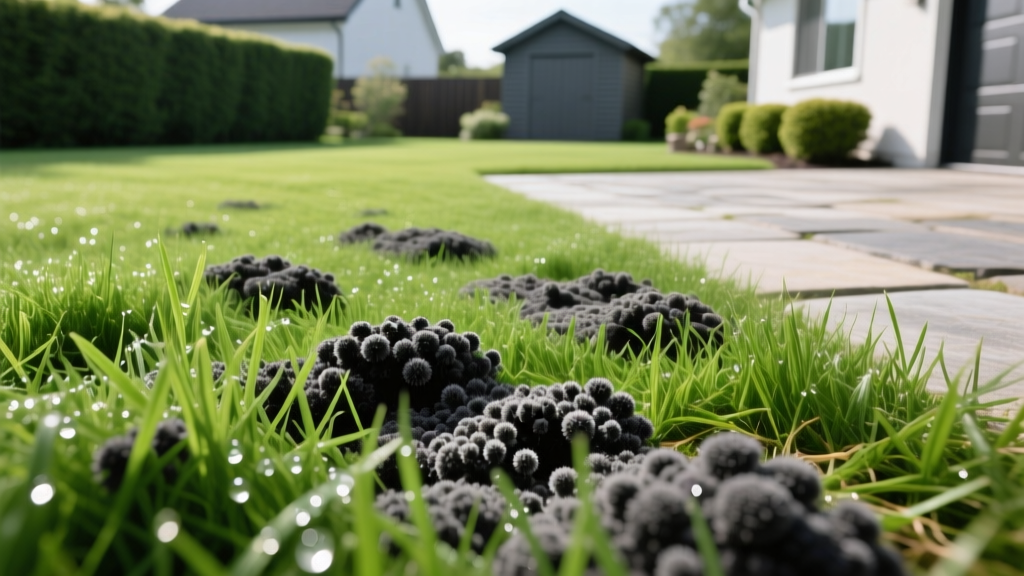
Black Mold on Lawn: Diagnosis, Causes, and Rescue Fixes
Homeowners frequently panic when they spot black mold on lawn spaces, assuming it is the same toxic Stachybotrys chartarum found in damp basements. True black mold does not grow on living turfgrass. What you are observing is one of three distinct biological phenomena: a harmless slime mold entering its spore stage, a devastating root-rotting fungus, or a cyanobacteria colony thriving in compacted soil.
Accurate diagnosis is critical. Applying a broad-spectrum fungicide to a slime mold wastes money, while ignoring take-all root rot will destroy your entire lawn within a single growing season. This guide provides exact diagnostic criteria, specific chemical interventions, and mechanical rescue fixes to restore your turf.
The Diagnostic Matrix: Identify Your 'Black Mold'
Before purchasing any treatments, match your lawn's symptoms to the matrix below. The visual texture and location of the black substance will immediately reveal the culprit.
| Organism | Visual Texture & Color | Primary Location | Seasonal Trigger |
|---|---|---|---|
| Slime Mold (Physarum) | Powdery black/brown soot on grass blades; wipes off easily. | Surface of grass blades and thatch. | Late summer/early fall after heavy rains. |
| Take-All Root Rot (G. graminis) | Roots turn jet black and brittle; blades yellow and thin. | Underground root system and crown. | Spring and fall; peaks when soil is 70-80°F. |
| Nostoc Cyanobacteria | Gelatinous, jelly-like black/green crust on the soil surface. | Bare soil patches, low-lying compacted areas. | Year-round, worsening in poorly drained zones. |
Scenario 1: Slime Mold (The Harmless Invader)
Slime molds, such as Physarum polycephalum or Fuligo septica, are not true fungi; they are amoeba-like organisms (myxomycetes) that feed on bacteria and decaying organic matter in your thatch layer. During their feeding stage, they are often bright yellow or white. However, when they enter their reproductive spore stage, they turn dark brown or jet black, resembling gunpowder or soot dusted across your grass blades.
Rescue Fix: Mechanical Removal
Because slime mold does not infect or feed on living grass tissue, chemical fungicides are entirely ineffective and unnecessary. According to the University of California Statewide IPM Program, slime molds typically disappear on their own within a few weeks as the environment dries.
- Immediate Action: Mow the lawn and collect the clippings. This physically removes the majority of the spore masses.
- Secondary Action: Use a garden hose with a high-pressure nozzle to blast the remaining spores off the grass blades and into the soil.
- Long-term Prevention: Dethatch your lawn if the thatch layer exceeds 0.5 inches. Slime molds require thick, moist thatch to thrive. A power dethatcher rental costs approximately $75-$90 per day.
Expert Insight: Do not apply nitrogen fertilizer to combat slime mold. Excess nitrogen promotes rapid, lush grass growth, which increases canopy humidity and actually creates a more favorable microclimate for future slime mold outbreaks.
Scenario 2: Take-All Root Rot (The True Killer)
If the 'black mold' is actually located on the roots of your St. Augustine, Bermudagrass, or Centipedegrass, you are dealing with Take-All Root Rot (TARR), caused by the soil-borne fungus Gaeumannomyces graminis var. graminis. Above ground, you will see irregular yellowing patches that eventually turn brown and die. Below ground, the roots will be severely stunted, blackened, and necrotic. If left untreated, TARR will kill large sections of your lawn.
Rescue Fix: Chemical and Cultural Intervention
Curative treatment for TARR requires a two-pronged approach: targeted fungicide application and soil acidification. The Texas A&M AgriLife Extension notes that TARR thrives in alkaline soils (pH above 6.5), making soil chemistry management just as important as fungicides.
- Apply a Group 11 or Group 3 Fungicide: Use a product containing Azoxystrobin (e.g., Syngenta Heritage G or Scotts DiseaseEx). As of 2026, a 30lb bag of granular Heritage G costs between $85 and $95, covering up to 15,000 square feet. Apply at the curative rate of 4 lbs per 1,000 sq ft. Water it in immediately with 0.25 inches of irrigation to move the active ingredient into the root zone.
- Rotate Active Ingredients: To prevent fungicide resistance, alternate Azoxystrobin with a Group 3 DMI fungicide like Propiconazole (e.g., Bayer Advanced Fungus Control) every 28 days during peak infection seasons (spring and fall).
- Acidify the Soil: Test your soil pH. If it is above 6.5, apply elemental sulfur at a rate of 1 to 2 lbs per 1,000 sq ft to lower the pH to the 5.5–6.0 range. A 50lb bag of elemental sulfur costs roughly $25-$30. Note that sulfur takes 3 to 6 months to fully react in the soil, so apply it well in advance of peak TARR season.
Warning: Fungicides will not resurrect dead grass. If the turf crown is completely necrotic and the roots pull up with zero resistance, the grass is dead. You must kill the fungus with Azoxystrobin, wait 14 days, and then resod or plug the affected areas with TARR-resistant cultivars like 'Palmetto' or 'Raleigh' St. Augustine.
Scenario 3: Nostoc Cyanobacteria (The Black Jelly)
Nostoc is a genus of cyanobacteria that forms thick, gelatinous, black or dark green crusts on the soil surface, usually in bare spots where the grass has already thinned out. While it looks like a toxic fungal bloom, it is actually a primitive bacteria capable of fixing atmospheric nitrogen. It thrives in heavily compacted, poorly drained soils and creates a hydrophobic (water-repellent) barrier that prevents grass seeds from germinating and water from penetrating the soil profile.
Rescue Fix: Aeration and Desiccation
You cannot simply rake Nostoc away when it is wet; it will smear and spread. You must alter the physical soil environment to make it inhospitable.
- Core Aeration: Rent a walk-behind core aerator ($70-$90/day) and punch 3-inch deep holes across the affected area. This breaks up the compaction and improves subsurface drainage, which starves the cyanobacteria of the standing moisture it requires.
- Apply Potassium Salts of Fatty Acids: Use a moss and algae killer containing potassium salts of fatty acids (e.g., Bayer Advanced Moss & Algae Killer, approx. $20 for a 32oz ready-to-spray bottle). Apply directly to the dried, crusty Nostoc patches to desiccate the colonies.
- Topdress and Overseed: Once the crust is dead and the soil is aerated, topdress the bare spots with 0.25 inches of coarse sand or compost, and overseed with a turfgrass species suited to your climate to establish a dense canopy that shades out future Nostoc growth.
Step-by-Step 30-Day Recovery Protocol
If you are dealing with a severe fungal outbreak (TARR) combined with poor soil drainage, follow this strict 30-day timeline to rescue your lawn:
- Day 1: Mow the lawn at the lowest recommended height for your grass species and bag the clippings to remove surface spores and thatch.
- Day 2: Apply Azoxystrobin granular fungicide at the curative rate. Water in with exactly 0.25 inches of water.
- Day 7: Apply elemental sulfur to begin the long-term process of lowering soil pH to 5.5.
- Day 14: Perform core aeration on compacted zones to relieve soil stress and improve root oxygenation.
- Day 28: Apply the second round of fungicide, rotating to a Propiconazole-based liquid or granular product to prevent chemical resistance.
- Day 30: Resume standard irrigation practices, switching to deep, infrequent watering (1 inch per week, applied in 1-2 sessions) to encourage deep root growth and dry out the thatch layer between waterings.
Frequently Asked Questions
Can black mold on my lawn make my pets sick?
Slime molds and Nostoc cyanobacteria are generally non-toxic to dogs and cats, though ingestion of large amounts of Nostoc can cause mild gastrointestinal upset due to its bacterial load. However, Take-All Root Rot is a plant pathogen and poses zero risk to mammalian health. The primary danger to pets comes from the chemical fungicides used to treat TARR; keep pets off the lawn until Azoxystrobin granules have been fully watered in and the grass blades are dry.
Why does the black substance return every time it rains?
If the black substance reappears after rain, you are likely dealing with slime mold spores or Nostoc rehydrating. Nostoc can survive in a dried, crusty state for months, but the moment it absorbs moisture, it swells back into a gelatinous jelly. Permanent removal requires fixing the underlying soil compaction and drainage issues via aeration and topdressing.
Is it safe to compost grass clippings infected with Take-All Root Rot?
No. The Gaeumannomyces graminis fungus can survive in organic debris if the compost pile does not reach sustained temperatures of at least 140°F to 160°F. Since most home compost bins fail to maintain these thermophilic temperatures, bag the clippings and send them to municipal green waste facilities, which utilize industrial hot-composting methods that successfully destroy turf pathogens.

