
Lawn Care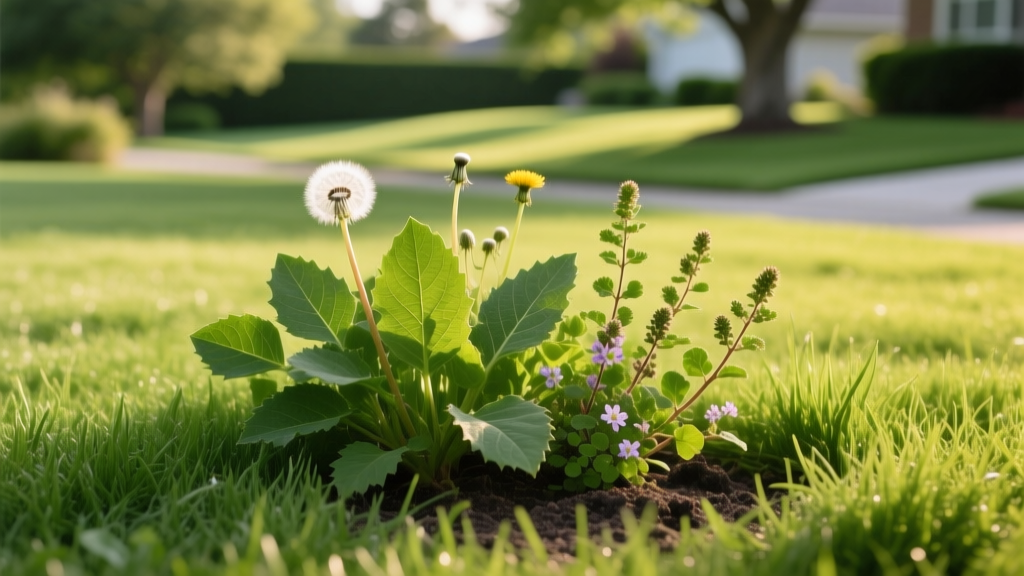
Spot-Treatment Guide for Common Broad-Leaved Weeds in Lawns
The Case for Precision Spot-Treatment
Broadcast spraying your entire lawn to eliminate a few dozen weeds is an inefficient use of chemicals, money, and time. More importantly, it unnecessarily disrupts the soil microbiome and increases the risk of herbicide runoff. Spot-treating broad-leaved weeds targets the exact point of infestation, reducing chemical volume by up to 90% compared to blanket applications. This guide provides a professional-grade framework for identifying, mixing, and applying spot-treatments to the most stubborn dicot invaders in your turf.
Identifying the Top 4 Broad-Leaved Culprits
Effective treatment begins with accurate identification. Broad-leaved weeds (dicots) have distinct physiological differences from turfgrasses (monocots), which is why selective herbicides can kill the weed while leaving the grass unharmed. According to the University of Minnesota Extension, proper identification dictates the active ingredient required for complete root eradication.
- Dandelion (Taraxacum officinale): Features a deep, brittle taproot (up to 10 inches deep) and a basal rosette of deeply lobed leaves. If the taproot snaps during manual removal, the weed will regenerate.
- Broadleaf Plantain (Plantago major): Thrives in highly compacted soils. Identified by wide, oval leaves with distinct parallel veins and a central, rat-tail-like seed spike.
- White Clover (Trifolium repens): Spreads via above-ground stolons. Features trifoliate (three-leaflet) leaves often marked with a white "V" chevron. Highly resistant to single-ingredient herbicides.
- Creeping Charlie (Glechoma hederacea): A mint-family invader with scalloped leaf edges and a pungent, minty odor when crushed. Spreads aggressively through shaded, moist lawn areas.
The Spot-Treatment Decision Matrix
Selecting the wrong active ingredient results in top-kill (leaves die, roots survive). Use this matrix to match the weed species with the correct chemical profile and estimated cost for residential spot-treatment.
| Weed Species | Primary Root Structure | Best Active Ingredient Blend | Recommended Product | Approx. Cost (2026) |
|---|---|---|---|---|
| Dandelion | Deep Taproot | 2,4-D + Dicamba | PBI Gordon SpeedZone | $28 / 20 oz |
| Broadleaf Plantain | Fibrous / Shallow | 2,4-D + MCPP | Ortho WeedClear | $15 / 32 oz |
| White Clover | Stolons / Creeping | Triclopyr + Dicamba | Tzone Broadleaf Killer | $35 / 16 oz |
| Creeping Charlie | Rhizomes / Nodes | Triclopyr + 2,4-D | PBI Gordon SpeedZone | $28 / 20 oz |
Step-by-Step Liquid Spot-Spraying Protocol
Professional applicators do not guess their mix ratios. Follow this exact protocol to ensure the herbicide penetrates the waxy cuticle of the broad-leaved weeds without causing phytotoxicity to your turf.
Step 1: Equipment Calibration
Use a dedicated 1-gallon or 2-gallon poly pump sprayer. Fit the wand with a flat-fan nozzle (such as a TeeJet 8002VS) rather than a cone nozzle. Flat-fan nozzles produce uniform droplet sizes that reduce drift. Pump the sprayer to exactly 30 PSI; higher pressures create fine mist droplets that can drift onto desirable ornamental plants.
Step 2: The Mixing Order (WALES Protocol)
Always add chemicals in the correct order to prevent them from binding together and clogging your filter screen. Use the WALES acronym: Wettable powders, Agitate, Liquid flowables, Emulsifiable concentrates, Surfactants. For standard liquid concentrates like SpeedZone, fill the tank halfway with water, add the herbicide, agitate, and then add the surfactant.
Pro-Tip: The Surfactant Multiplier
Broad-leaved weeds like plantain and dandelion have hydrophobic (water-repelling) waxy cuticles. Adding a Non-Ionic Surfactant (NIS) at a rate of 0.25% v/v (roughly 1 teaspoon per gallon of mixed solution) breaks the surface tension, allowing the herbicide to spread flat across the leaf and absorb in minutes rather than beading up and rolling off. A pint of Southern Ag Surfactant costs about $15 and will treat hundreds of gallons of solution.
Step 3: Application and Weather Constraints
Spray the weed until the leaves are visibly wet but not dripping. Create a 2-inch "halo" spray around the base of the weed to catch any low-lying stolons. Check three weather variables before pulling the trigger:
- Temperature: Must be between 60°F and 85°F. Above 85°F, ester-based herbicides can volatilize (turn into a gas) and drift, severely damaging nearby trees and shrubs.
- Wind: Must be under 5 MPH. Use a piece of tissue paper on a stick to gauge wind direction; always spray with the wind at your back.
- Rainfastness: Ensure no rain is forecasted for at least 24 hours. While some modern formulations claim 2-hour rainfastness, 24 hours guarantees full systemic translocation down to the taproot.
Organic and Non-Chemical Spot Alternatives
For homeowners managing lawns near waterways, vegetable gardens, or areas where pets roam freely, synthetic auxin herbicides may not be ideal. The most effective organic alternative for broad-leaved weeds is Chelated Iron (FeHEDTA). Products like Fiesta Turf Weed Killer (approx. $45 per gallon) utilize iron to induce lethal oxidative stress in dicots (broad-leaved weeds). Monocots (turfgrass) can process the excess iron, often resulting in a temporary, harmless dark-green color boost to the grass.
Application Rules for FeHEDTA:
- Apply at a heavy rate of 3 to 5 fl oz per 1,000 sq ft.
- Do not mow for 3 days before and 3 days after application.
- A single application will only burn back the foliage. You must apply a second treatment exactly 21 to 28 days later to kill the regenerating root system.
According to research published by Penn State Extension, while horticultural vinegar (20% acetic acid) is frequently touted as an organic weed killer, it is strictly a contact burn-down agent. It destroys the leaf tissue of broad-leaved weeds within hours but leaves the root system entirely intact, guaranteeing rapid regrowth and severely acidifying your topsoil in the process.
Post-Treatment Lawn Recovery
Once the broad-leaved weeds succumb to the spot-treatment (usually 10 to 14 days for synthetic, 21 days for organic), they leave behind bare soil patches. Leaving these patches bare invites new weed seeds to germinate. Rake out the dead weed debris, loosen the top 1/2 inch of soil with a hand cultivator, and overseed immediately.
For cool-season lawns, use a blend of Tall Fescue and Kentucky Bluegrass seeded at a rate of 4 to 6 lbs per 1,000 sq ft for patch repair. For warm-season lawns (like Bermuda or Zoysia), spot-repair is best achieved by plugging or sprigging rather than seeding, as warm-season grass seeds have notoriously low germination rates in small, isolated patches. Keep the patched areas consistently moist for 14 days to ensure establishment before resuming standard mowing heights.
Frequently Asked Questions
Why did my broad-leaved weeds twist and curl but not die?
This "epinasty" (twisting) response means the herbicide successfully entered the plant and disrupted its growth hormones, but the dose was too low to reach and kill the root. This usually happens when spraying during drought conditions when the weed's stomata are closed to conserve water. Always spot-treat weeds when they are actively growing and well-hydrated.
Can I use a weed-and-feed product instead of spot-spraying?
Weed-and-feed granules are highly inefficient for spot-treatment. They require the granules to physically stick to the wet leaves of the broad-leaved weeds to be effective. If the grass is dry, the granules fall to the soil and act only as fertilizer, failing to kill the weed. Liquid spot-spraying is vastly superior for targeted control.

