
Lawn Care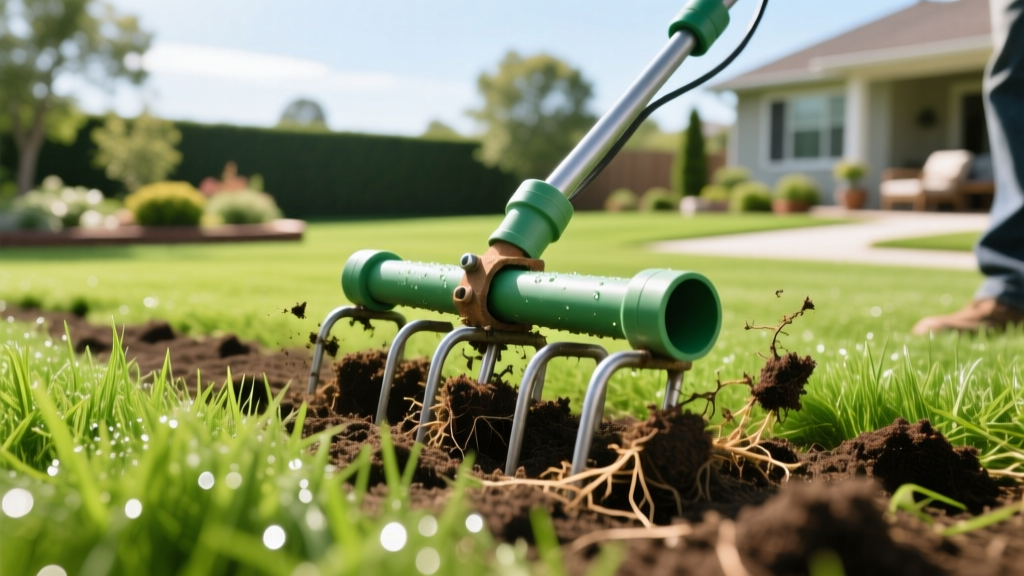
Build a Homemade Lawn Aerator for Organic Soil Recovery
Why Organic Lawns Need Physical Aeration
Soil compaction is the silent killer of organic lawns. When soil bulk density exceeds 1.4 g/cm³, pore space collapses, restricting oxygen flow to the root zone. In conventional lawn care, managers often rely on chemical wetting agents and synthetic surfactants (like ammonium lauryl sulfate) to temporarily mask compaction symptoms by reducing water surface tension. However, these chemical shortcuts strip soil lipids and disrupt the mycorrhizal fungi networks essential for organic nutrient cycling.
For homeowners committed to organic and chemical-free lawn care, physical core aeration is non-negotiable. By physically extracting soil plugs, you restore macroporosity, allowing aerobic bacteria to thrive and break down organic matter into plant-available nutrients. Building a homemade lawn aerator allows you to achieve professional-grade core extraction without the $4,000+ price tag of commercial walk-behind machines, provided you use the correct metallurgy and engineering principles.
Organic Insight: According to Penn State Extension, core aeration reduces soil compaction and improves water infiltration, which is critical for organic lawns that rely on deep root systems to access natural soil nutrients rather than shallow synthetic fertilizers.
Spike vs. Core: Choosing the Right Aeration Method
Not all aeration is created equal. While spike aerators (solid tines that poke holes) are easier to build, they actually worsen compaction in heavy clay soils by pushing soil outward and downward, creating a hardened glaze around the hole. Core aerators remove physical plugs, creating space for soil expansion and organic topdressing integration.
| Aeration Type | Mechanism | Effect on Clay Soil | Organic Compatibility |
|---|---|---|---|
| Spike Aerator | Solid tines pierce soil | Increases lateral compaction | Poor (restricts microbial oxygen) |
| Core (Plug) Aerator | Hollow tines extract soil | Relieves compaction, creates voids | Excellent (allows compost integration) |
| Liquid Aerator | Surfactants reduce water tension | No physical compaction relief | Poor (disrupts soil food web) |
Step-by-Step: Building a Heavy-Duty DIY Core Aerator
To build a manual core aerator that can penetrate dense, compacted soils without bending, you must abandon PVC or thin-walled aluminum. Schedule 40 galvanized steel is the standard for durability. As of 2026, material costs for this build average between $65 and $85 at major hardware suppliers.
Materials and Tools Required
- 10-foot length of 3/4-inch Schedule 40 galvanized steel pipe (approx. $18)
- 1.5-inch x 1.5-inch steel square tubing, cut to 12 inches (base frame)
- Four heavy-duty galvanized saddle clamps (U-bolts) sized for 3/4-inch pipe
- 48-inch fiberglass shovel handle with a D-grip
- Four 3/8-inch x 3-inch carriage bolts with nylon-insert locknuts
- Angle grinder with a metal cutting wheel and a flap disc
- Drill press or handheld drill with a 1/4-inch cobalt drill bit
Construction Steps
- Cut the Tines: Use the angle grinder to cut three 5-inch lengths from the 3/4-inch Schedule 40 pipe. These will be your coring tines.
- Bevel the Cutting Edge: Grind the bottom exterior edge of each tine at a 45-degree angle using the flap disc. This creates a sharp cutting lip that slices through turf roots cleanly rather than tearing them.
- Drill Vacuum Relief Holes: This is the most critical, often-missed step. Drill a 1/4-inch hole exactly 1 inch from the top of each tine. Why? Wet clay creates a vacuum seal inside hollow pipes. The relief hole breaks the vacuum, ensuring the soil plug ejects automatically on the next plunge.
- Mount the Tines: Space the three tines exactly 3.5 inches apart along the 12-inch steel square tubing base. Secure them using the saddle clamps and U-bolts. Tighten with a socket wrench until the tines are completely rigid.
- Attach the Handle: Drill two 3/8-inch holes through the center of the steel base and the bottom of the fiberglass shovel handle. Secure with carriage bolts and nylon-insert locknuts to prevent vibration loosening during use.
Safety Warning: Never use standard zinc-plated hardware store bolts for the handle attachment. The sheer force required to push 3/4-inch steel pipes into compacted soil can snap low-grade bolts. Always use Grade 5 or Grade 8 hardened steel carriage bolts.
Integrating Aeration with Organic Topdressing
Pulling cores is only half the organic compaction fix. The voids left behind must be filled with biologically active organic matter to prevent the holes from simply collapsing back in. According to University of Nebraska-Lincoln Turfgrass Science, combining aeration with topdressing significantly accelerates thatch decomposition and improves soil structure.
The Organic Topdressing Matrix
For an organic lawn, avoid peat moss (which is hydrophobic when dry and ecologically unsustainable) and sand (which can create a concrete-like layer when mixed with native clay). Instead, use this OMRI-listed blend:
- 60% Screened Compost: Provides humus and slow-release micronutrients. Ensure it is screened to 1/4-inch or smaller to fall into the aeration holes.
- 20% Biochar (Charged): Acts as a permanent porous scaffold for soil microbes and retains moisture. Must be pre-charged with compost tea to avoid tying up soil nitrogen.
- 20% Earthworm Castings: Introduces beneficial nematodes and mycorrhizal spores directly into the root zone.
Application Rate: Apply a 1/4-inch layer of this blend across the lawn immediately after aerating. This requires approximately 0.75 cubic yards of material per 1,000 square feet. Use a stiff-bristled push broom to aggressively work the mixture down into the aeration holes.
Timing Your Aeration by Soil Temperature
Calendar dates are useless for lawn care; soil temperature dictates biological readiness. Aerate when the grass is actively growing and can rapidly heal the physical trauma of coring.
- Cool-Season Grasses (Kentucky Bluegrass, Tall Fescue, Perennial Ryegrass): Aerate in early fall when soil temperatures at a 2-inch depth consistently read between 55°F and 65°F. This coincides with peak root growth and minimizes weed seed germination in the open holes.
- Warm-Season Grasses (Bermuda, Zoysia, Centipede): Aerate in late spring to early summer when 2-inch soil temperatures reach 70°F to 75°F. Avoid aerating warm-season grasses in the fall, as the open holes invite winter annual weeds and cold-temperature root damage.
Troubleshooting Common DIY Aerator Failures
Even a perfectly built homemade lawn aerator can fail if operational variables are ignored. Here is how to troubleshoot the most common edge cases encountered in the field:
1. Tines Penetrate but Do Not Extract Plugs
Cause: The soil is too dry, causing it to crumble inside the pipe rather than forming a cohesive plug, or the vacuum relief holes are clogged with mud. Fix: Irrigate the lawn deeply 24 hours before aerating. The soil should be moist but not saturated. If the relief holes are clogged, clear them with a 1/4-inch drill bit or a stiff wire.
2. Extreme Physical Fatigue During Pushing
Cause: Soil bulk density is too high for manual downward force, or the cutting bevels on the tines have dulled. Fix: Add a 15-pound steel barbell plate to the top of the base frame using U-bolts to increase downward mass. Alternatively, attach a 2x4 wooden crossbar to the main handle shaft to allow two people to push and step on the tool simultaneously.
3. Tines Bend Upon Hitting Subsurface Rocks
Cause: Hitting shallow limestone or granite deposits common in glacial soils. Fix: Schedule 40 pipe will dent before it snaps. If a tine bends, cut it off with the angle grinder and replace it. To prevent this, probe the lawn with a 1/2-inch rebar rod before aerating to map and mark shallow rocks with landscaping flags.
'Physical soil disruption through core aeration is the cornerstone of organic turf management. Without macropores, the aerobic soil food web suffocates, rendering even the highest quality organic fertilizers entirely useless.' — Soil Biology Primer, USDA NRCS
Building your own core aerator requires an afternoon of fabrication, but it yields a lifetime tool that keeps your organic lawn breathing, draining, and thriving without a single drop of synthetic chemistry.

