
Lawn Care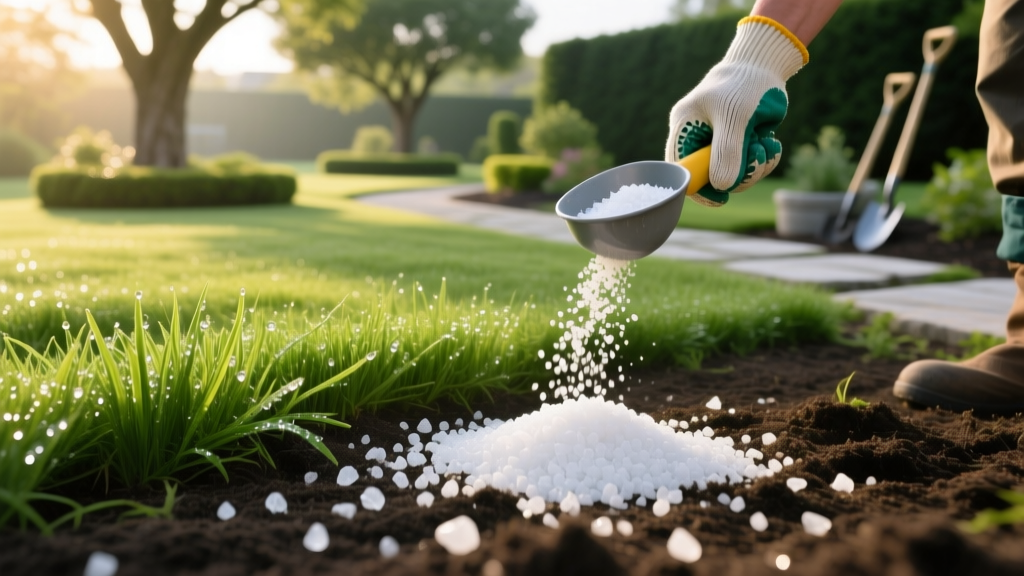
Calcitic Lime for Lawns: When, Why, and How to Apply It
The Chemistry of Calcitic Lime: What Makes It Different?
When turfgrass struggles with nutrient lockout, shallow rooting, and increased susceptibility to fungal pathogens, soil acidity is often the culprit. While many homeowners reach for generic 'garden lime,' understanding the specific chemical composition of your amendment is critical. Calcitic lime for lawns is primarily composed of calcium carbonate (CaCO3), typically containing 90% or more calcium carbonate and very little magnesium. This distinguishes it from dolomitic lime, which contains significant amounts of magnesium carbonate (MgCO3).
The primary agronomic purpose of calcitic lime is twofold: it neutralizes soil acidity (raising the pH) and supplies bioavailable calcium. Calcium plays a vital structural role in turfgrass cell walls and, crucially, acts as a flocculating agent in clay-heavy soils. By binding with negatively charged clay particles, calcium causes them to clump together, improving soil porosity, drainage, and oxygen exchange at the root zone.
The Base Saturation Sweet Spot
According to the Albrecht-Kinsey model of soil fertility, ideal soil base saturation should consist of approximately 65% to 75% calcium and 10% to 15% magnesium. If your soil test reveals a calcium base saturation below 60% alongside a low pH, calcitic lime is the precise amendment required to restore both pH and structural balance without overdosing the soil with magnesium.
Diagnosing Your Soil: When Calcitic Lime is the Right Choice
Never apply calcitic lime based on visual symptoms alone. Yellowing turf can indicate acidic soil, but it can also signal nitrogen deficiency, iron chlorosis, or poor drainage. You must rely on a comprehensive soil test that measures both water pH and buffer pH, alongside a Cation Exchange Capacity (CEC) analysis.
Water pH tells you the current acidity of the soil solution, but it does not tell you how much lime is needed to change it. Buffer pH measures the soil's reserve acidity (the hydrogen ions bound to soil colloids). Soils with high clay content or high organic matter have a high buffering capacity, meaning they require significantly more lime to shift the pH than sandy soils do. As noted by UMass Amherst Extension, applying lime without a buffer pH reading often results in severe under-application or dangerous over-application.
Calcitic vs. Dolomitic Lime Decision Matrix
Choosing between calcitic and dolomitic lime depends entirely on the calcium-to-magnesium (Ca:Mg) ratio extracted from your Mehlich-3 or Ammonium Acetate soil test.
| Soil Test Indicator | Recommended Amendment | Why? |
|---|---|---|
| Low pH, Low Ca, Normal/High Mg | Calcitic Lime | Raises pH and adds Ca without causing Mg-induced potassium lockout. |
| Low pH, Normal Ca, Low Mg | Dolomitic Lime | Raises pH while addressing a specific magnesium deficiency. |
| Low pH, Low Ca, Low Mg | Blend or Alternating | Apply calcitic first for structure, follow with dolomitic in subsequent seasons. |
| Normal pH (6.2-6.8), Low Ca | Gypsum (Calcium Sulfate) | Adds calcium and improves flocculation without altering soil pH. |
Selecting the Right Product Form and Mesh Size
The physical form and particle size of calcitic lime dictate how quickly it will react in your soil. The reactivity is measured by the Effective Calcium Carbonate Equivalent (ECCE) and the particle size distribution (mesh size).
- Pulverized Calcitic Lime: This is a fine, dusty powder. Look for products where 90% to 100% passes through a 100-mesh screen. Because of the massive surface area, pulverized lime reacts within 4 to 8 weeks. However, it is difficult to apply with standard rotary spreaders and poses an inhalation hazard during application.
- Pelletized Calcitic Lime: Pulverized lime bound with a water-soluble binder into uniform, dust-free granules (typically 2mm to 4mm in diameter). Brands like Jonathan Green and Espoma formulate pelletized lime specifically for rotary spreaders. While easier to apply, pelletized lime requires heavy irrigation or rainfall to dissolve the binder before the core particles can react with the soil, delaying effectiveness by 2 to 4 weeks compared to raw powder.
- Granular / Prilled Lime: Often sold as 'fast-acting' micro-nutrient lime. These are highly porous and break down rapidly upon contact with moisture, offering a middle ground between pulverized speed and pelletized convenience.
Step-by-Step Application Protocol and Rates
According to guidelines published by NC State Extension, the maximum safe application rate for any lime product is 50 pounds per 1,000 square feet in a single application. Applying more than this can cause a rapid pH spike that locks out essential micronutrients like iron, manganese, and zinc, leading to severe chlorosis.
1. Calculate Your Total Requirement
Check your soil test's 'Buffer pH' recommendation. If the test recommends 80 lbs per 1,000 sq ft, you must split this into two applications of 40 lbs each, spaced 3 to 4 months apart.
2. Prepare the Turf
Mow your lawn slightly lower than your standard maintenance height and perform a core aeration if the soil is compacted. Core aeration creates direct channels for the lime to bypass the thatch layer and reach the root zone, accelerating the neutralization process.
3. Calibrate and Apply
If using pelletized calcitic lime, set your broadcast spreader to the manufacturer's recommended setting (usually between 4 and 6 on a Scotts rotary spreader for standard 40lb bags). Apply the lime in a crisscross pattern—half the rate walking North-South, and the other half walking East-West—to ensure uniform coverage and prevent striping.
4. Water and Incorporate
Immediately follow the application with 0.25 to 0.5 inches of irrigation. This washes the lime off the grass blades (preventing foliar burn) and begins the dissolution process. For pulverized lime, watering is mandatory to settle the dust into the soil profile.
Warning: The Over-Liming Risk
Applying calcitic lime to soils that already have a pH above 6.5 or a high calcium base saturation can induce phosphorus tie-up and iron deficiency. If your soil pH is above 7.0, do not apply any form of lime. Instead, use elemental sulfur or acidifying fertilizers like ammonium sulfate to lower the pH.
Timing and Seasonal Considerations
The optimal window for applying calcitic lime for lawns is early to mid-fall. During autumn, turfgrass is actively expanding its root system, and the winter freeze-thaw cycles, combined with natural precipitation, help physically incorporate the lime into the top 2 to 3 inches of the soil profile. By the time spring green-up occurs, the soil pH will have stabilized, allowing the grass to maximize its uptake of spring nitrogen fertilizers.
If you miss the fall window, early spring is the secondary option. However, avoid applying lime simultaneously with high-nitrogen, acidic fertilizers or pre-emergent herbicides, as extreme pH shifts can degrade the active ingredients in certain weed control products. Always separate lime and herbicide applications by at least 14 days.

