
Lawn Care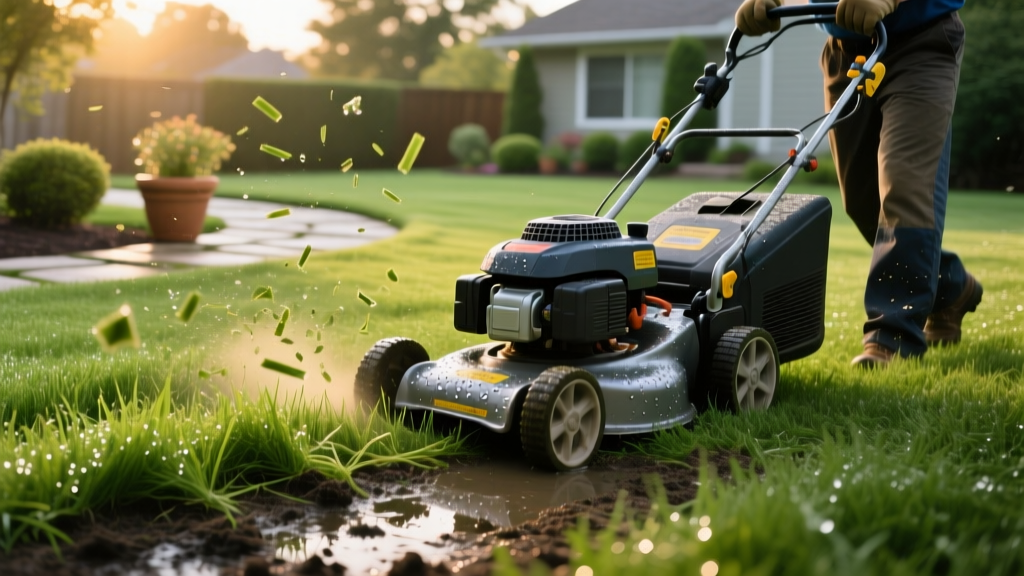
Can Lawn Mowers Cut Wet Grass? Risks, Mower Types & Turf Damage
The Direct Answer: Mechanical Capability vs. Agronomic Reality
When homeowners ask, "can lawn mowers cut wet grass," the answer requires splitting mechanical capability from agronomic viability. Mechanically, a modern 190cc gas engine or a 56V brushless electric motor possesses more than enough torque to spin a blade through damp foliage. Agronomically and aerodynamically, however, the cutting chamber fails. Mowing wet grass fundamentally alters the physics of the cut, transforms the mower deck into a composting chamber, and turns your turf into a vector for fungal pathogens.
According to turfgrass management guidelines from Penn State Extension, moisture on the leaf surface increases the weight of the grass blade and induces surface tension, causing the blades to clump and bend rather than stand erect. This guide breaks down the exact mechanical failures, disease risks, and soil compaction metrics involved, alongside an emergency protocol if you are forced to mow before a storm.
⚠️ Electrical Safety Warning: If you are asking whether electric lawn mowers can cut wet grass, the answer is a hard no. Using a corded electric mower on wet turf poses a severe electrocution hazard. Even battery-powered (cordless) mowers risk short-circuiting their battery management systems (BMS) if water ingress breaches the deck seals, voiding warranties and risking lithium thermal events.
The Aerodynamics of the Cut: Why Moisture Ruins the Slice
A clean cut relies on blade tip speed and vacuum lift. A standard 21-inch rotary mower blade spinning at 3,000 RPM generates a tip speed of roughly 18,800 feet per minute (FPM). This speed, combined with the airfoil shape of the blade, creates a vacuum that stands the grass blade upright before the sharpened edge slices it.
When grass is wet, the added mass of the water (grass is already 75% water; surface moisture pushes this higher) and the matting effect defeat the vacuum lift. Instead of slicing, the blade strikes a heavy, bent target. The result is a ragged tear. Torn grass tips lose moisture rapidly, turning brown within 48 hours and giving the entire lawn a dull, whitish cast.
The "Tear vs. Slice" Identification Test
- Clean Slice: The tip of the grass blade is flat and even. The cut edge is smooth to the touch.
- Ragged Tear: The tip looks like a frayed paintbrush. Vertical white or brown striations run down the top 1/4 inch of the blade.
Mower Deck Dynamics: How Different Machines Handle Moisture
Not all mowers react to moisture equally. The cutting mechanism dictates how severely the machine will struggle and how much damage it will inflict on the turf.
| Mower Type | Wet Grass Performance | Primary Failure Mode |
|---|---|---|
| Rotary (Standard) | Poor | Deck clogging; clumping; severe tearing due to loss of vacuum lift. |
| Reel (Cylinder) | Very Poor | Wet grass bends away from the bedknife; causes severe matting and uneven scalping. |
| Hover (Air Cushion) | Moderate | Maintains some lift via air cushion, but wet clippings still adhere to the underside. |
| Flail | Good | Knives chop through heavy mass easily, but leaves a highly ragged aesthetic finish. |
Agronomic Fallout: Fungal Vectors and Soil Shear Strength
The damage extends far beyond the grass blade. Mowing saturated turf triggers cascading failures in the soil profile and the lawn's immune system.
The Disease Multiplier Effect
Torn grass blades leak cellular sap, which serves as a primary food source for fungal spores. Furthermore, the mower wheels and deck act as mechanical vectors. As the mower moves through wet turf, it picks up spores of Rhizoctonia solani (Brown Patch) and Sclerotinia homoeocarpa (Dollar Spot) and physically injects them into the fresh, jagged wounds of the torn grass. Research from University of Missouri Extension confirms that mowing wet turf drastically accelerates the spread of foliar diseases across the entire yard.
Soil Compaction and Rutting Metrics
Soil shear strength drops precipitously when pore spaces are filled with water. A standard 50-pound self-propelled push mower exerts roughly 8 to 12 PSI (pounds per square inch) on the soil surface. On dry, loamy soil, this is easily supported. On saturated clay loam, that same PSI exceeds the soil's bearing capacity, causing the drive wheels to sink 1 to 2 inches into the turf. This rutting crushes the grass crowns, severs shallow rhizomes, and creates anaerobic trenches that kill the root zone.
The Emergency Protocol: Mitigating Damage When You Must Mow
If a severe storm is approaching and the grass has grown past 5 inches, you may be forced to mow damp turf. Follow this strict mitigation protocol to minimize mechanical and agronomic damage.
- Drag the Turf First: Run a weighted drag mat or a stiff push-broom across the lawn to physically knock standing dew and surface water off the grass blades.
- Sharpen to a 30-Degree Bevel: A dull blade tears dry grass; it shreds wet grass. Ensure your rotary blade is sharpened to a precise 30-degree cutting angle to maximize slicing efficiency.
- Raise the Deck 0.5 Inches: If your target height is 3.0 inches, raise the deck to 3.5 inches. Cutting less surface area reduces the volume of wet clippings entering the deck, preventing clogs.
- Reduce Ground Speed to 2.5 MPH: Slowing down gives the blade more time to process the heavy, wet clippings and allows the deck baffles to eject the material before it accumulates.
- Half-Pass Overlap: Overlap your mowing passes by 50%. This ensures the mower is only processing half a deck's width of new grass on each pass, drastically reducing the load on the engine and the deck's airflow dynamics.
- Scrape the Deck Immediately: Wet clippings are highly acidic and will corrode steel decks within 48 hours. Use a wooden scraper (not metal, to preserve the deck's anti-corrosion coating) to clean the underside immediately after mowing.
Frequently Asked Questions
Will morning dew ruin my mower?
Light morning dew will not mechanically damage a gas-powered mower, but it will cause clumping if you are mulching. Wait until the sun has burned off the dew, usually by 10:00 AM, for optimal mulching performance.
Can I use a mulching blade on wet grass?
No. Mulching blades rely on recirculating clippings under the deck to cut them multiple times. Wet grass will immediately form a heavy, sodden mat under the deck, choking the blade and stalling the engine. Always use a high-lift blade and side-discharge when forced to mow damp turf.
Summary Takeaway: While the engine of a lawn mower can physically spin a blade through wet grass, the aerodynamic failure of the deck and the severe agronomic risks to the turf make it a practice to avoid. Preserve your soil structure, prevent fungal outbreaks, and protect your mower's undercarriage by waiting for the turf to dry.

