
Lawn Care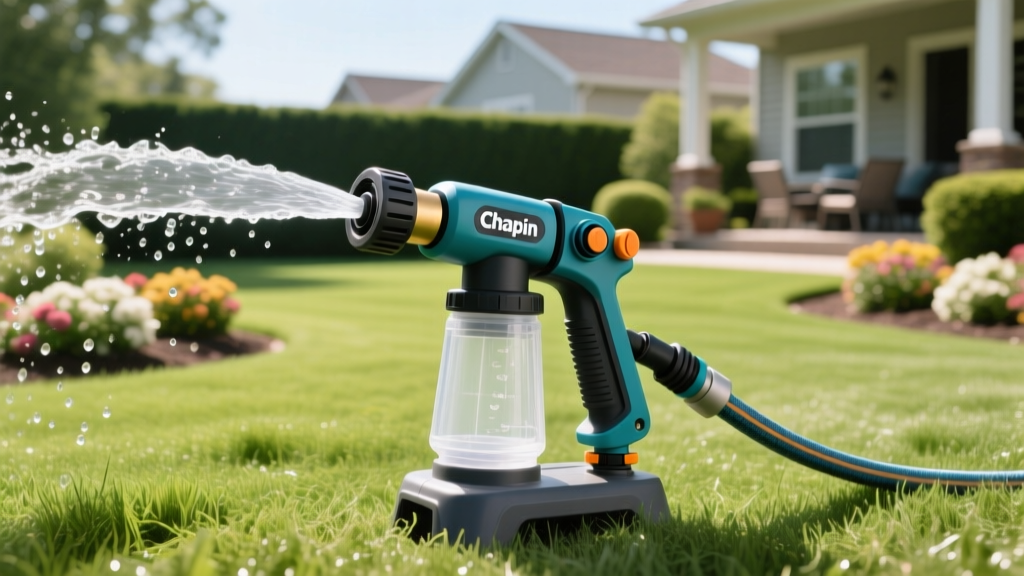
Chapin Wet/Dry Hose End Sprayer: Calibration and Setup Guide
The Mechanics of the Chapin Wet/Dry Siphon System
Applying liquid fertilizers, herbicides, and water-soluble powders requires precise dilution to prevent turf burn and chemical waste. The Chapin Wet/Dry Hose End Sprayer (commonly Model 6005) utilizes a venturi-effect siphon mechanism. As municipal water flows through the sprayer nozzle, it creates a localized vacuum that pulls concentrate up the siphon tube. The adjustable dial restricts the siphon tube aperture, metering the exact ounces of chemical drawn per gallon of water output.
Unlike standard liquid-only models, the 'Wet/Dry' designation indicates a wider siphon tube base and an integrated mesh filter. This design allows the sprayer to draw up water-soluble granules and wettable powders—such as iron supplements or powdered fungicides—without immediate clogging. As of early 2026, the Chapin 6005 retails between $18 and $24, making it a highly cost-effective alternative to motorized backpack sprayers for lawns under 5,000 square feet.
Wet vs. Dry Formulation Limits: The 'Dry' function strictly applies to water-soluble powders and granules. Never use this sprayer for standard granular fertilizers (like Milorganite or standard Scotts Turf Builder) or non-soluble pre-emergents. These will not dissolve, will clog the mesh filter, and will permanently jam the internal mixing valve.
Bridging the Calibration Gap: Label vs. Dial
The most common failure point for homeowners using hose-end sprayers is misunderstanding the difference between the chemical label's application rate and the sprayer dial's output rate. Chemical labels dictate application in ounces per 1,000 square feet. The Chapin dial is calibrated in ounces per gallon of water. These are not interchangeable metrics.
To correctly calibrate the Chapin Wet/Dry sprayer, you must determine your specific water delivery rate. According to Penn State Extension, water pressure and nozzle flow rate dictate coverage. Follow this exact framework to find your dial setting:
Step 1: Measure Your Delivery Rate
- Measure a 100-square-foot test area on your lawn (e.g., 10 ft x 10 ft).
- Fill the Chapin sprayer bottle with plain water. Do not attach chemical.
- Set the dial to the highest setting (e.g., 8 oz) to allow maximum unrestricted flow.
- Spray the 100-square-foot area at your normal walking pace, keeping the nozzle 3 feet above the ground.
- Measure the remaining water in the bottle to determine how many ounces (or gallons) were used to cover 100 sq ft.
- Multiply that number by 10 to find your Gallons per 1,000 sq ft delivery rate.
Step 2: Calculate the Dial Setting
Use this formula to set the Chapin dial:
(Ounces required per 1,000 sq ft) ÷ (Gallons delivered per 1,000 sq ft) = Dial Setting (oz/gal)
Real-World Example: Your liquid herbicide label requires 1.5 oz per 1,000 sq ft. Your Step 1 test revealed you deliver 2 gallons of water per 1,000 sq ft at your normal walking pace.
1.5 ÷ 2 = 0.75.
Set the Chapin dial to the closest available marker (e.g., 1 oz/gal) and slightly increase your walking speed to compensate for the marginally higher output.
The 'Jar Test' Verification Protocol
Before applying active chemicals, verify your mathematical calibration with a physical jar test. The EPA's pesticide calibration guidelines emphasize physical verification to prevent environmental runoff and turf phytotoxicity.
- Preparation: Fill the Chapin 20oz bottle with exactly 16 oz of plain water.
- Execution: Set the dial to your calculated setting (e.g., 2 oz/gal). Spray into an empty, clear 1-gallon glass jar until the Chapin bottle is completely empty.
- Verification: If the dial is set to 2 oz/gal, the 16 oz bottle should empty in exactly 8 gallons of total water output. If the jar overflows before the bottle empties, your water pressure is too high, or the internal anti-siphon valve is bypassing. Adjust your walking speed or install a pressure-reducing washer at the hose spigot.
Applying Water-Soluble Granules (Dry Mode Setup)
When applying water-soluble powders (like chelated iron or soluble humic acid), the physical dynamics of the siphon change. Powders require aggressive agitation to remain in suspension.
| Feature | Liquid Concentrates | Water-Soluble Powders |
|---|---|---|
| Pre-Mixing | Not required; pour directly into bottle. | Mandatory; dissolve in warm water before adding to bottle. |
| Agitation | Minimal; siphon action is sufficient. | High; shake bottle every 2-3 minutes during application. |
| Filter Maintenance | Rinse with clean water post-use. | Remove mesh filter and scrub with a brush to prevent crystallization. |
| Min Water Pressure | 40 PSI | 50 PSI (required to lift heavier suspended particles) |
Warning: Temperature Constraints
Water-soluble powders crystallize rapidly in cold water. If your municipal water supply is below 55°F (common in early spring), pre-dissolve the powder in a bucket of 80°F water before transferring it to the Chapin bottle. Cold-water siphoning will result in undissolved granules clogging the sprayer nozzle mid-application.
Water-soluble powders crystallize rapidly in cold water. If your municipal water supply is below 55°F (common in early spring), pre-dissolve the powder in a bucket of 80°F water before transferring it to the Chapin bottle. Cold-water siphoning will result in undissolved granules clogging the sprayer nozzle mid-application.
Common Failure Modes and Troubleshooting
Hose-end sprayers operate under harsh conditions. Here are the specific mechanical failures associated with the Chapin Wet/Dry model and how to resolve them:
1. Surging or 'Spitting' Spray Pattern
Cause: The anti-siphon valve (the small rubber flap at the top of the sprayer head) is stuck open, allowing air to enter the mixing chamber and breaking the venturi vacuum. Alternatively, your hose water pressure is fluctuating below 40 PSI.
Fix: Disconnect the sprayer, locate the rubber anti-siphon flap near the hose connection, and clean it with a cotton swab and white vinegar to remove mineral scale. Ensure your home's spigot is fully opened to maximize static pressure.
2. Chemical Not Pulling Up (Siphon Loss)
Cause: An air leak at the hose thread connection or a clogged siphon tube mesh.
Fix: Replace the standard rubber hose washer with a high-quality silicone O-ring. Standard rubber washers compress and degrade under high PSI, allowing microscopic air leaks that destroy the vacuum required for siphoning. If the mesh at the bottom of the siphon tube is clogged with dried chemical, soak the entire siphon tube in warm water and dish soap for 30 minutes.
3. Dial Sticking or Hard to Turn
Cause: Granular residue or hard water calcium buildup inside the metering valve.
Fix: Do not force the dial, as the internal plastic gearing will strip. Submerge the sprayer head (without the bottle) in a 50/50 mix of hot water and white vinegar for one hour to dissolve calcium deposits. Lubricate the dial O-ring with a single drop of food-grade silicone grease.
Integration with Seasonal Irrigation Schedules
The efficacy of the chemicals applied via the Chapin sprayer is entirely dependent on your subsequent irrigation schedule. Mismanaging post-application watering will neutralize the product or cause turf burn.
- Systemic Herbicides & Grub Control: Products like Imidacloprid or Trimec require watering-in to reach the root zone or soil surface. Apply the Chapin sprayer mixture, then run your automatic irrigation system for exactly 15-20 minutes (delivering roughly 1/4 inch of water) within 24 hours of application.
- Contact Herbicides: Broadleaf killers like 2,4-D must adhere to the leaf tissue. Do not water the lawn for at least 48 hours after application. If rain is in the forecast within 24 hours, delay the application.
- Liquid Fertilizers (Nitrogen/Iron): Foliar liquid fertilizers are absorbed through the grass blades. Apply in the early morning when stomata are open, and delay irrigation until the evening to allow maximum absorption time.
End-of-Season Winterization
Freezing temperatures will crack the Chapin 6005's internal plastic mixing chamber if water is left inside. After your final fall application, fill the bottle with clean water, set the dial to the highest setting, and spray until empty. Detach the siphon tube, dry all components, and store the sprayer indoors above 40°F. Proper winterization ensures the internal metering seals remain pliable for the next spring's pre-emergent applications.

