
Lawn Care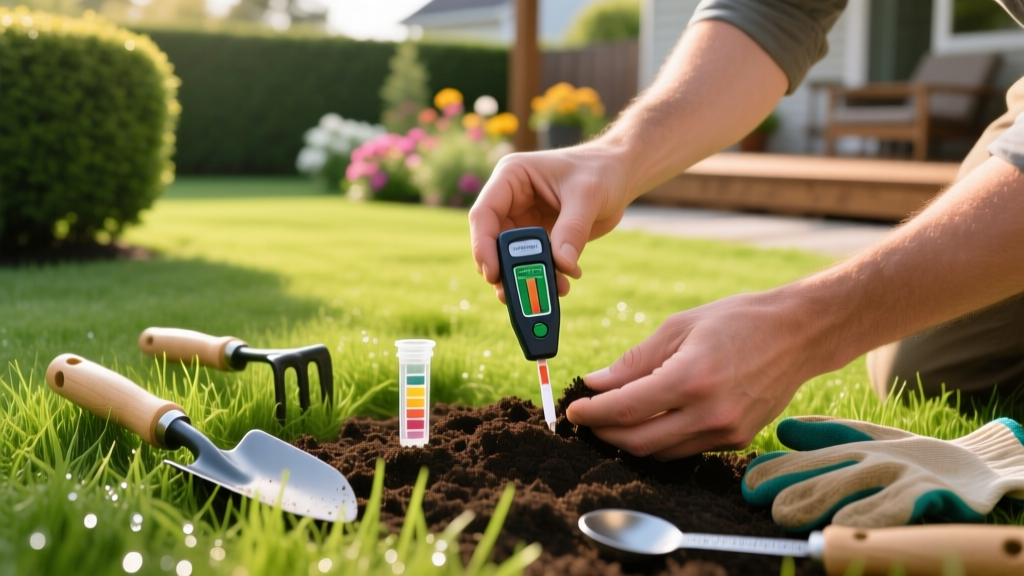
How to Check Soil pH for Lawns: Testing Kits and Amendment Math
Applying premium compost, aerating, and overseeding are wasted efforts if your soil chemistry is locked. Nutrient availability in turfgrass is entirely dictated by hydrogen ion concentration, commonly known as pH. Before you order bulk mulch or broadcast fertilizer, you must check soil pH to establish a baseline. This guide breaks down the exact testing methodologies, the hidden chemistry of organic amendments, and the precise mathematical formulas required to correct acidic or alkaline lawns.
The Chemistry of Mulch Breakdown and Soil pH
Many homeowners overlook how surface amendments alter subsurface chemistry over time. When you apply arborist wood chips, pine bark, or shredded hardwood mulch to garden beds adjacent to your lawn, the decomposition process releases organic acids. As lignin and cellulose break down via fungal networks, they produce humic and fulvic acids. Over a 3-to-5-year period, this continuous acidification can drop the pH of adjacent turf zones by 0.5 to 1.0 full units.
According to the USDA NRCS Soil Health Guidelines, maintaining optimal biological activity requires a stable pH. If your soil drops below 5.5, essential macronutrients like phosphorus and potassium bind to aluminum and iron, becoming completely unavailable to grassroots. Conversely, if your pH exceeds 7.5, micronutrients like iron and manganese lock up, resulting in severe interveinal chlorosis (yellowing) in warm-season grasses like Zoysia and Bermuda.
Buffer pH vs. Active pH: The Hidden Metric
When you check soil pH using an at-home kit, you are only measuring active pH—the current hydrogen ion concentration in the soil water solution. However, professional labs measure a second, far more critical metric: Buffer pH.
Buffer pH measures your soil's Cation Exchange Capacity (CEC) and its resistance to change. A heavy clay soil with a high CEC might have an active pH of 5.5 and a buffer pH of 6.8, meaning it requires massive amounts of lime to shift the needle. A sandy soil with the exact same active pH of 5.5 might have a buffer pH of 5.6, requiring only a fraction of the lime. If you skip lab testing and guess your amendment rates based solely on active pH, you will inevitably over-apply or under-apply your amendments.
Comparing the Best Methods to Check Soil pH
The market is flooded with testing options, but they vary wildly in accuracy and utility. Below is a comparison of the three primary methods used by turf professionals and serious homeowners.
| Testing Method | Specific Brand / Model | Avg. Price | Accuracy | Best Use Case |
|---|---|---|---|---|
| Chemical Dye Kit | Luster Leaf 1601 Rapitest | $14 - $18 | ± 0.5 pH | Quick seasonal spot-checks; identifying severe extremes. |
| Mail-In Lab Test | MySoil Professional Kit | $29 - $35 | ± 0.1 pH (Includes Buffer pH & CEC) | Baseline amendment planning; precise lime/sulfur calculations. |
| Digital Probe Meter | Bluelab pH Pen | $120 - $135 | ± 0.1 pH | Commercial turf managers; high-frequency slurry testing. |
For 90% of residential lawn renovations, the MySoil Professional Kit offers the highest return on investment. As noted by the UMass Amherst Soil Testing Lab, mail-in lab tests utilize calibrated glass electrodes and standardized buffer solutions that at-home chemical dyes simply cannot replicate.
Step-by-Step: Extracting a Representative Core Sample
The most common failure point when checking soil pH is poor sampling technique. Testing the top half-inch of soil will yield skewed results due to surface mulch, thatch, and recent fertilizer applications. Follow this protocol for an accurate composite sample:
- Use the Right Tool: Use a stainless steel soil probe or a clean spade. Avoid galvanized steel tools, as the zinc coating can leach into the sample and alter laboratory readings.
- Map a 'W' Pattern: Walk your lawn in a 'W' shape. Stop at 5 to 7 distinct points across the property, avoiding high-traffic paths, pet urination zones, and the immediate edges of concrete driveways (which leach calcium and artificially raise pH).
- Extract at Root Depth: Push your probe down to a depth of 3 to 4 inches for cool-season grasses (Fescue, Kentucky Bluegrass) and 4 to 6 inches for warm-season grasses (Bermuda, Zoysia).
- Create a Composite Mix: Place all 5 to 7 cores into a clean plastic bucket. Break the clods apart, remove any stones, thatch, or earthworms, and mix the soil thoroughly.
- Prepare the Slurry (For Digital/Chemical Kits): If using a Bluelab pen or Luster Leaf kit, mix your composite soil with distilled water (never tap water, as municipal water has its own buffering agents) at a 1:1 ratio by volume. Let it sit for 15 minutes before inserting the probe.
Amendment Math: Calculating Lime and Sulfur Rates
Once you check soil pH and receive your results, you must calculate the exact amendment rate. According to Penn State Extension, the ideal pH range for cool-season turf is 6.2 to 6.8, while warm-season turf thrives between 5.8 and 6.5.
Raising pH (Applying Lime)
To raise soil pH, you will apply agricultural lime. Always choose pelletized calcitic lime (calcium carbonate) unless your soil test specifically shows a magnesium deficiency, in which case you should use dolomitic lime. Pelletized lime is processed to break down faster than raw powdered limestone, though it still takes 6 to 12 months to fully react in the soil profile.
| Current Soil Texture | Target pH Increase | Pelletized Lime Required (per 1,000 sq ft) |
|---|---|---|
| Sandy Loam | + 0.5 units | 25 - 30 lbs |
| Loam | + 0.5 units | 40 - 50 lbs |
| Heavy Clay | + 0.5 units | 60 - 80 lbs |
Critical Warning: Never apply more than 50 lbs of lime per 1,000 square feet in a single application. If your soil requires a massive pH shift (e.g., from 4.5 to 6.5), split the application into two treatments spaced six months apart (Spring and Fall). Over-liming causes iron chlorosis and locks up phosphorus.
Lowering pH (Applying Elemental Sulfur)
Lowering pH is significantly more difficult and biologically demanding than raising it. You must use elemental sulfur (not aluminum sulfate, which can cause aluminum toxicity in turf roots). Elemental sulfur relies on Thiobacillus bacteria in the soil to oxidize the sulfur into sulfuric acid. Because this is a biological process, it only works when soil temperatures are consistently above 55°F.
- Sandy Soil: Requires roughly 10 lbs of elemental sulfur per 1,000 sq ft to lower pH by 1.0 unit.
- Clay Soil: Requires up to 20 lbs of elemental sulfur per 1,000 sq ft to lower pH by 1.0 unit.
Apply sulfur in the early spring before the summer heat stress sets in, and water it in immediately to prevent the prills from sitting on the surface where they can oxidize into a gas rather than entering the soil profile.
Troubleshooting Common pH Testing Errors
My at-home kit says 7.0, but my grass is yellowing. Why?
At-home chemical dye kits struggle to differentiate between neutral (7.0) and slightly alkaline (7.5) soils due to color blindness and lighting variances. If you have high-pH indicators (like clover taking over, or yellowing Bermuda grass), trust the visual symptoms and order a mail-in lab test to check for hidden micronutrient lockups.
I applied lime three months ago, but my pH hasn't changed.
Limestone is a slow-acting rock dust. It requires physical incorporation (via core aeration) and moisture to break down. If you broadcasted lime on top of a thick thatch layer in July, it hasn't reached the soil matrix. Always pair lime applications with fall core aeration to physically drag the pellets into the root zone.

