
Lawn Care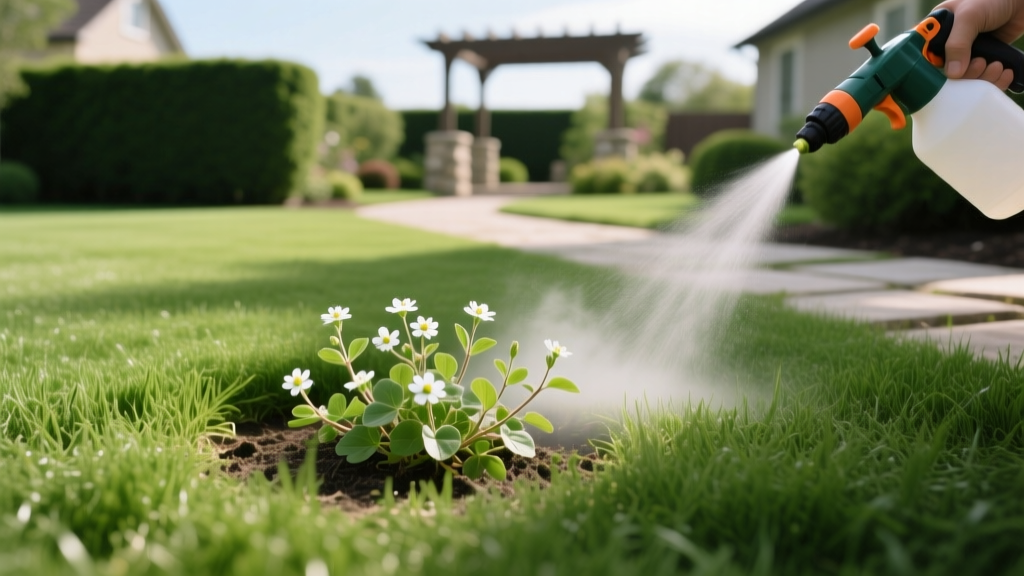
How to Spot-Treat and Eradicate Chickweed in Lawn Grass
The Winter Annual Threat: Why Chickweed Invades
Finding chickweed in lawn turf is one of the most common frustrations for homeowners managing cool-season and transitional zone grasses. Unlike summer annuals that germinate in spring, common chickweed (Stellaria media) is a winter annual. It germinates in early fall when soil temperatures drop below 70°F, overwinters as a mature rosette, and explodes into a dense, mat-forming canopy by early spring. By the time most homeowners notice the small white star-shaped flowers, the weed has already established a deep taproot and begun dropping thousands of seeds into the soil profile.
Eradicating this weed requires more than a generic broadcast spray. Successful elimination hinges on precise botanical identification, calculated pre-emergent timing, and the selection of specialized post-emergent herbicide chemistries that remain active in cool spring temperatures.
Botanical Profiling: The Stem Hair Test
Before mixing any chemicals, confirm which species you are dealing with. Misidentification leads to herbicide failure.
- Common Chickweed (Stellaria media): Features a distinct single line of hairs running down one side of the stem, which alternates sides at each leaf node. Leaves are smooth and pointed. Highly susceptible to 3-way herbicides.
- Mouse-ear Chickweed (Cerastium fontanum): Covered in dense, fuzzy hairs all over the stem and leaves. Forms thicker, tighter mats. Significantly more resistant to standard herbicides and often requires higher rates of carfentrazone or triclopyr.
The Pre-Emergent Window: Timing and Chemistry
The most cost-effective way to manage chickweed is preventing it from germinating in September and October. According to turfgrass researchers at Penn State Extension, pre-emergent applications must be timed to soil temperature, not calendar dates.
Active Ingredient Selection
For chickweed specifically, Dithiopyr (found in Dimension 2EW) outperforms Prodiamine (Barricade) because Dithiopyr offers early post-emergent control. If chickweed seeds germinate slightly earlier than expected, Dithiopyr will kill the young seedling, whereas Prodiamine will fail once the root has emerged from the seed coat.
| Active Ingredient | Application Rate (per 1,000 sq ft) | Soil Temp Threshold | 2026 Est. Cost |
|---|---|---|---|
| Dithiopyr (Dimension 2EW) | 0.3 - 0.5 fl oz | Apply at 50°F - 55°F (2-inch depth) | ~$150 / gallon |
| Prodiamine (Barricade 65 WDG) | 0.18 - 0.23 oz (dry) | Apply before 55°F soil temp | ~$95 / lb |
| Isoxaben (Gallery 75 DF) | 0.66 - 1.33 oz (dry) | Apply at 50°F - 60°F | ~$220 / 2 lb |
Pro Tip: Water in pre-emergents with exactly 0.5 inches of irrigation within 48 hours to move the chemical into the top 1-inch of the soil profile where chickweed seeds reside.
Post-Emergent Spot-Treatment Protocols
If chickweed has already established in your lawn by March or April, spot-treatment is required. The primary failure mode for DIY chickweed treatment is using herbicides that require high heat to translocate effectively. Standard 2,4-D formulations become sluggish when daytime temperatures drop below 65°F.
The Carfentrazone Advantage
To achieve rapid burn-down in cool spring weather, you must use a herbicide containing Carfentrazone-ethyl. Products like SpeedZone Broadleaf Herbicide combine carfentrazone with 2,4-D, MCPP-p, and dicamba. Carfentrazone is a PPO inhibitor that disrupts cell membranes, causing visible necrosis on chickweed leaves within 24 hours, even when temperatures are as low as 55°F. The NC State TurfFiles database notes that this rapid burndown prevents the weed from maturing and dropping its spring seed crop.
Herbicide Safety by Grass Type
- Cool-Season Grasses (Fescue, Kentucky Bluegrass, Ryegrass): SpeedZone (Carfentrazone + 3-way) is highly safe. Apply at 1.5 to 2.0 fl oz per 1,000 sq ft.
- Warm-Season Grasses (Bermuda, Zoysia): SpeedZone is safe on dormant or fully greened-out Bermuda, but can cause temporary yellowing on St. Augustine and Centipede. For St. Augustine, use Atrazine or Metsulfuron-methyl (Manor) instead, applying at 0.06 oz per 1,000 sq ft.
Step-by-Step Spot-Spraying Execution
Proper mixing and application technique dictate whether the herbicide kills the root or merely burns the top growth. Follow this exact protocol for spot-treating chickweed patches.
- Calibrate the Water Volume: For spot treatment, you need enough water to cover the weed without runoff. Mix your herbicide at a rate of 1.5 to 2.0 gallons of water per 1,000 sq ft. Do not use a hose-end sprayer; they are too inaccurate for broadleaf herbicides and risk killing desirable turf.
- Add the Surfactant: Chickweed leaves have a slightly waxy cuticle. Add a Methylated Seed Oil (MSO) or a high-quality Non-Ionic Surfactant (NIS) at a rate of 0.25% v/v (roughly 1/2 teaspoon per gallon of water). This breaks the surface tension and forces the chemical into the plant tissue.
- Select the Correct Nozzle: Swap out the adjustable cone nozzle on your pump sprayer for a Flat-Fan nozzle (such as a TeeJet XR11002). Flat-fan nozzles produce uniform droplets that stick to the broad leaves of the chickweed rather than bouncing off onto the soil.
- Apply During Optimal Conditions: Spray when daytime highs are between 65°F and 80°F, and wind speeds are under 5 mph. Avoid spraying if rain is forecast within 24 hours.
- The 'Mist and Move' Technique: Do not drench the weed until it drips. Apply a fine, even mist until the leaves are uniformly wet. Once the plant is saturated, additional herbicide simply drips to the soil where it is rendered useless.
Warning: The Seed Bank Reality
A single mature chickweed plant can produce up to 15,000 seeds, and these seeds can remain viable in the soil for up to 10 years. Even if your spot-treatment is 100% effective this spring, you will likely see a flush of new chickweed next year from the existing seed bank. Commit to a multi-year pre-emergent strategy to exhaust the seed reserve.
Cultural Defenses: Starving the Chickweed
Herbicides are a reactive measure. Chickweed thrives in specific environmental conditions: compacted soil, low mowing heights, and excessive winter moisture. Modifying these variables creates an environment where turfgrass outcompetes the weed.
Mowing Height Adjustments
Chickweed requires high light intensity at the soil surface to trigger seed germination. By maintaining your cool-season turf at a minimum height of 3.5 to 4.0 inches during the fall and early spring, you shade the soil profile, reducing chickweed germination rates by up to 80%. Never scalp your lawn in the fall to 'clean it up'—this is an open invitation for winter annual weeds.
Alleviating Soil Compaction
Chickweed tolerates compacted, poorly drained soils much better than Kentucky Bluegrass or Tall Fescue. If you notice chickweed clustering in high-traffic areas or along driveway edges, the soil is likely compacted. Perform core aeration in the early fall (late August to mid-September) immediately before your pre-emergent application. Note: Aerating after applying a pre-emergent will break the chemical barrier and allow chickweed seeds to germinate in the aeration holes.
Expert Troubleshooting & Failure Modes
"I sprayed the chickweed, the leaves turned black and died, but it came back two weeks later."
This is the classic symptom of spraying mature chickweed without a systemic active ingredient, or spraying when temperatures were too cold for translocation. The carfentrazone burned the top growth (contact action), but the 2,4-D and dicamba failed to move down into the taproot due to cold-induced metabolic slowdown. Wait for a warm spell (above 65°F) and re-treat the regrowth, or use a shovel to manually extract the taproot.
Eliminating chickweed in lawn environments is a test of patience and precision. By combining fall pre-emergent barriers with targeted, surfactant-enhanced spring spot-treatments, you can systematically deplete the seed bank and restore a dense, weed-free turf canopy.

