
Lawn Care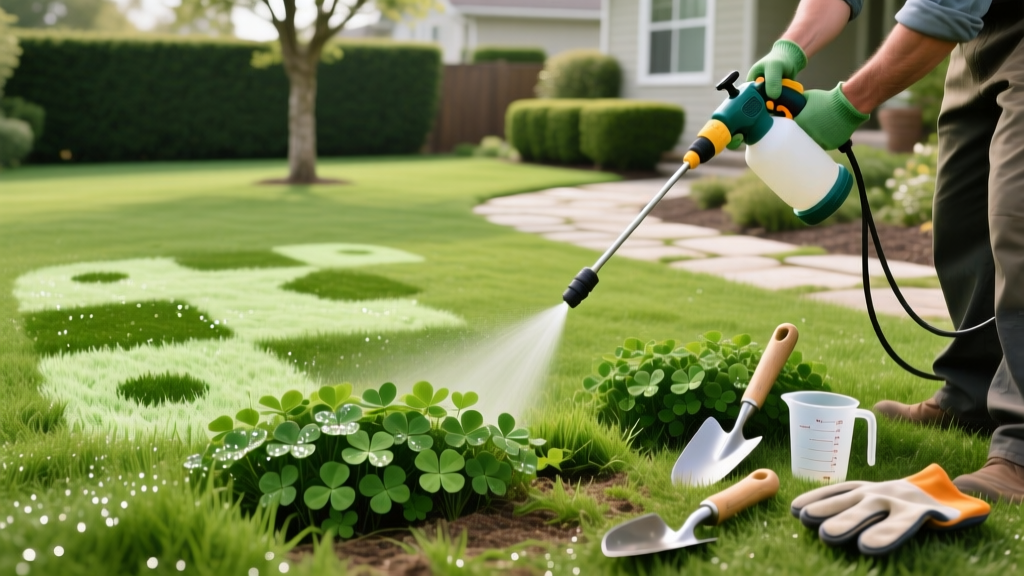
How to Clear a Clover Yard: Spot-Treatment and Control Guide
Transforming a clover yard back into a dense, uniform turfgrass canopy requires more than just broadcast spraying. Clover (Trifolium species) is a resilient, stoloniferous legume that thrives in the exact conditions that cause turfgrass to fail: low soil nitrogen, high compaction, and acidic pH. Because clover spreads via above-ground creeping stems (stolons) and deep taproots, blanket applications of non-selective herbicides often result in massive dead zones that invite worse weeds like crabgrass or prostrate spurge.
This guide details the precise spot-treatment protocols, chemical and organic product selections, and post-eradication soil rehabilitation steps required to eliminate clover without destroying your existing lawn.
Why Your Lawn Turned Into a Clover Yard
Clover does not invade healthy, vigorously growing turf. It acts as a biological indicator of soil imbalance. Understanding the underlying failure modes is critical; otherwise, the clover will return within six months of treatment.
The Nitrogen-Fixation Advantage
Clover hosts Rhizobium bacteria in its root nodules, allowing it to pull nitrogen directly from the atmosphere and convert it into usable plant food. While your turfgrass starves in soil testing below 2.0 lbs of available nitrogen per 1,000 square feet, clover synthesizes its own. Furthermore, clover tolerates soil compaction pressures exceeding 200 PSI, which restricts turfgrass root respiration and water infiltration.
Identifying the Culprit: Clover Species Matrix
Accurate identification dictates your herbicide selection and application timing. While white clover is the most common offender, hop and red clover require slightly different management approaches due to their life cycles and growth habits.
| Species | Botanical Name | Key Identifiers | Life Cycle & Habit |
|---|---|---|---|
| White Clover | Trifolium repens | Trifoliate leaves with white 'V' crescent markings; white/pinkish spherical flower heads. | Perennial. Creeping stolons root at nodes. Highly drought tolerant. |
| Hop Clover | Trifolium campestre | Small, bright yellow flower heads resembling miniature hops; leaves lack white crescents. | Summer annual. Upright to semi-prostrate. Thrives in low-fertility, dry soils. |
| Red Clover | Trifolium pratense | Larger leaves with fine hairs; prominent magenta/red flower heads; deep taproot. | Short-lived perennial. Bunch-type growth (no stolons). Prefers cooler, moist climates. |
For authoritative identification and regional distribution maps, the University of California Statewide Integrated Pest Management Program provides excellent visual guides for differentiating Trifolium species in turf environments.
The Spot-Treatment Protocol: Step-by-Step Eradication
Spot-treating a clover yard minimizes chemical usage, reduces environmental impact, and preserves the surrounding turfgrass canopy. The goal is to coat the clover foliage thoroughly without causing runoff or drift onto desirable grass.
Phase 1: Preparation and Equipment Setup
- Mow the Lawn: Cut your turfgrass to its recommended height (e.g., 2.5 to 3.5 inches for tall fescue). Wait 48 hours before applying herbicide to allow the clover leaves to expand and maximize surface area for chemical absorption.
- Calibrate the Sprayer: Use a 1-gallon or 2-gallon handheld pump sprayer. Swap the standard fan-tip nozzle for a TeeJet XR11002 flat fan nozzle. This delivers a precise, low-volume pin stream that prevents drift.
- Pressurize Correctly: Pump the sprayer to exactly 15–20 PSI. Higher pressures atomize the droplets, creating a fine mist that will drift onto and burn your desirable turf.
Phase 2: Selective Herbicide Formulation (Chemical)
For severe clover infestations, a multi-active-ingredient selective broadleaf herbicide is required. Single-active-ingredient products (like basic 2,4-D) often fail against mature white clover due to its robust cuticle and stolon network.
Recommended Chemical Formulation: SpeedZone Broadleaf Herbicide
Active Ingredients: 2,4-D, MCPP-p, Dicamba, and Carfentrazone-ethyl.
Why it works: Carfentrazone acts as a rapid desiccant (burning the waxy leaf cuticle within 24 hours), which forces the systemic hormones (2,4-D and Dicamba) into the plant's vascular system to kill the taproot and stolons.
Mix Rate: 1.5 fl oz of SpeedZone per 1 gallon of water per 1,000 sq ft.
Cost: Approximately $48 per pint (yields over 10 gallons of mixed solution, covering roughly 10,000 sq ft).
Critical Additive: You must add a non-ionic surfactant (NIS) to the tank. Clover leaves are heavily waxed. Add 0.25% v/v of an alkylpolyglucoside-based surfactant (roughly 1/3 teaspoon per gallon). Without this, the herbicide will bead up and roll off the leaf.
Phase 3: Organic and Non-Selective Alternatives
If you maintain an organic lawn or are treating clover in landscape beds where selective herbicides are unsafe, use Iron HEDTA (Chelated Iron). Products like Fiesta Turf Weed Killer exploit the difference in how broadleaf plants and grasses metabolize iron.
- Mechanism: Iron HEDTA causes rapid oxidative stress and cellular necrosis in broadleaf weeds, while turfgrass safely sequesters the excess iron (turning it a temporary dark green).
- Application Rule: Iron HEDTA is a contact herbicide, not systemic. It will burn the top growth of the clover but leave the taproot intact. You must apply two treatments spaced exactly 21 days apart to exhaust the root's energy reserves.
- Temperature Warning: Do not apply Iron HEDTA when ambient temperatures exceed 80°F, or you risk severe phytotoxicity (burning) to your turfgrass.
For more on organic and cultural weed management strategies, the University of Minnesota Extension offers comprehensive guidelines on reducing broadleaf weeds without synthetic chemicals.
Post-Treatment Soil Rehabilitation
Killing the clover is only 50% of the battle. If you do not alter the soil environment, clover seeds (which can remain viable in the soil seedbank for up to 30 years) will germinate in the newly opened spaces.
1. Core Aeration and Topdressing
Three weeks after your final herbicide application, perform core aeration. Use a mechanical aerator to pull 3-inch deep plugs, relieving the compaction that favored the clover. Immediately topdress with 1/4 inch of screened compost to introduce microbial activity and improve soil structure.
2. Nitrogen Loading
Clover starved your lawn of nitrogen. Reclaim the soil fertility by applying a high-nitrogen, slow-release fertilizer. Look for a formulation like 32-0-10 with methylene urea or polymer-coated sulfur-coated urea (PCSCU). Apply at a rate that delivers exactly 1.0 lb of actual nitrogen per 1,000 square feet. This rapid surge in soil nitrogen will force the turfgrass to aggressively tiller and fill in the voids left by the dead clover.
3. Overseeding Bare Patches
If the clover patches were larger than 12 inches in diameter, the dead stolons will leave bare dirt. Rake out the dead organic matter, expose the soil, and overseed with a turfgrass cultivar matched to your existing lawn. Keep the seed moist with light, daily irrigation for 14 days until germination is complete.
Clover Yard Eradication FAQ
Will household 5% white vinegar kill clover?
No. Standard 5% acetic acid kitchen vinegar is too weak to penetrate the waxy cuticle of mature white clover. It may burn the very tips of young seedlings, but it will not kill the root. To use vinegar as a non-selective contact burn-down, you must purchase 20% to 30% horticultural acetic acid. However, this will also kill any turfgrass it touches, making it unsuitable for spot-treating clover intertwined with your lawn.
Can I just pull the clover out by hand?
Hand-pulling white clover is highly ineffective for large infestations. White clover spreads via stolons that root at every node. If you pull the plant and leave even a 1-inch fragment of a rooted node in the soil, it will regenerate a new plant within two weeks. Hand-pulling is only viable for isolated, single-plant invasions where you can use a weeding knife to extract the entire taproot.
How long does it take for SpeedZone to kill clover?
When mixed with a non-ionic surfactant, the Carfentrazone in SpeedZone will cause visible wilting and browning (desiccation) of the clover leaves within 24 to 48 hours. However, the complete systemic death of the taproot and stolon network takes 14 to 21 days. Do not reapply the herbicide if the plant still looks partially alive at day 10; allow the systemic active ingredients time to translocate to the roots.

