
Lawn Care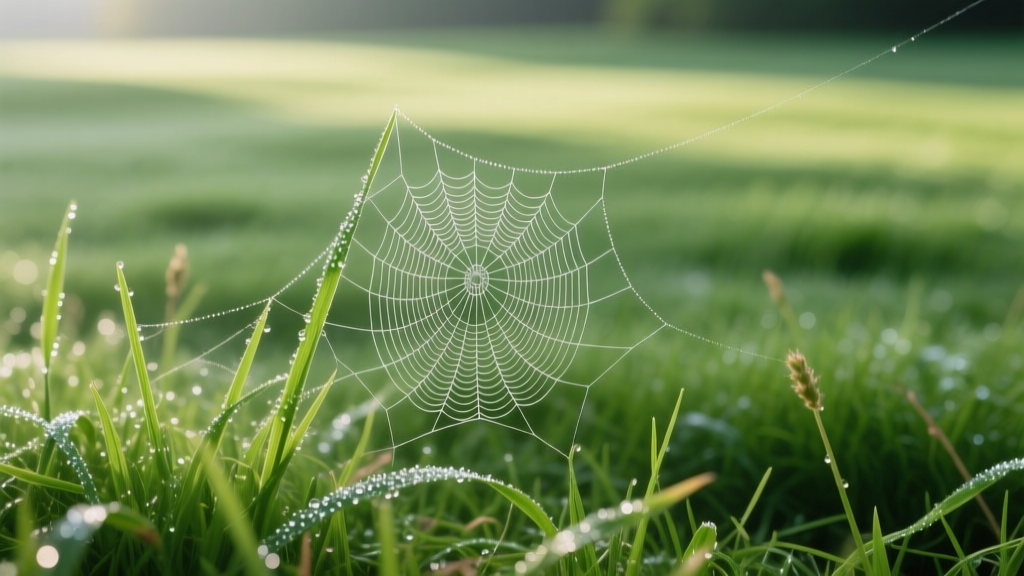
Cobwebs on Grass: Step-by-Step Diagnosis and Treatment Guide
The 'Cobweb' Illusion: Fungus vs. Arachnids
When homeowners spot silver, web-like structures clinging to their turf at dawn, the immediate assumption is a spider infestation. However, in professional turfgrass management, these 'cobwebs on grass' are almost always mycelium—the vegetative root network of a destructive fungal pathogen. This cottony, web-like growth is the hallmark morning sign of Clarireedia jacksonii (the pathogen responsible for Dollar Spot) or Pythium aphanidermatum (Pythium Blight). As the sun rises and burns off the morning dew, the mycelium vanishes, leaving behind bleached, hourglass-shaped lesions on the grass blades. True spider webs, conversely, persist throughout the day and do not cause tissue necrosis.
Diagnostic Matrix: Identifying the Web Source
Accurate identification dictates your entire maintenance protocol. Applying a fungicide to a harmless funnel-weaver spider web is a waste of chemicals, while ignoring fungal mycelium will result in severe turf loss within 72 hours.
| Feature | Dollar Spot Fungus | Pythium Blight | Actual Spider Webs |
|---|---|---|---|
| Visibility Window | Early morning (dawn to 9 AM) | Night and early morning | Visible all day, prominent at dusk |
| Web Texture | Cottony, dense, mat-like | Slimy, greasy, cobweb-like | Dry, intricate, geometric or funnel-shaped |
| Turf Damage | Silver-dollar-sized bleached patches | Rapid, irregular brown/black rot | None (grass remains healthy) |
| Temperature Trigger | 59°F to 88°F with high humidity | 85°F+ (day) and 68°F+ (night) | Year-round, peaks in late summer |
Step-by-Step Fungal Eradication Protocol
If your diagnostic test confirms fungal mycelium, you must implement a multi-phase cultural and chemical intervention. Fungi like Dollar Spot thrive in specific microclimates; altering that environment is the only permanent fix.
Phase 1: Canopy Moisture Management
Fungal spores require continuous leaf wetness for 12 to 14 hours to germinate and infect turf tissue. Your first procedural step is to mechanically remove morning dew.
- Dew Whipping (6:00 AM - 8:00 AM): Use a fiberglass dew whip or simply drag a lightweight garden hose across the lawn. This physically breaks the water tension and knocks the mycelium off the leaf blades.
- Irrigation Auditing: Never water between 4:00 PM and 4:00 AM. Program your smart controller (e.g., Rachio 3 or Hunter Hydrawise) to water deeply between 5:00 AM and 7:00 AM. This ensures the grass dries rapidly once the sun rises.
- Canopy Airflow: Prune lower branches of surrounding trees to allow morning sunlight to penetrate the turf canopy, reducing the dew-drying window by up to 3 hours.
Phase 2: Nutrient and Soil Correction
Clarireedia jacksonii is an opportunistic pathogen that aggressively attacks nitrogen-deficient turf. Starving your lawn of nutrients to 'prevent fungus' actually accelerates Dollar Spot.
- Nitrogen Application: Apply 0.5 to 1.0 lbs of Nitrogen per 1,000 square feet using a slow-release granular fertilizer. Products like Milorganite (approx. $22 per 32lb bag) or Lesco 15-0-15 provide steady nutrient uptake without the rapid flush of vulnerable new growth caused by synthetic urea.
- Thatch Reduction: Fungal spores overwinter in the thatch layer. If your thatch exceeds 0.5 inches, perform mechanical dethatching (power raking) in the early fall. Core aeration should follow to relieve soil compaction and improve drainage.
Phase 3: Targeted Chemical Intervention
When cultural practices fail to halt the spread, or when environmental humidity remains above 90% for consecutive weeks, chemical intervention is required. According to NC State TurfFiles, rotating active ingredients is critical to prevent pathogen resistance.
2026 Fungicide Rotation Strategy:
Application 1 (Contact): Chlorothalonil (e.g., Daconil) at 3.2 oz per 1,000 sq ft. Cost: ~$15. Stays on the leaf surface to kill existing mycelium.
Application 2 (Systemic - 14 days later): Azoxystrobin (e.g., Scotts DiseaseEX Granular) at 2.8 lbs per 1,000 sq ft. Cost: ~$28. Absorbed by the plant to protect new growth from the inside.
Application 3 (Systemic - 28 days later): Propiconazole (e.g., BioAdvanced Fungus Control) to target a different cellular pathway.
Application 1 (Contact): Chlorothalonil (e.g., Daconil) at 3.2 oz per 1,000 sq ft. Cost: ~$15. Stays on the leaf surface to kill existing mycelium.
Application 2 (Systemic - 14 days later): Azoxystrobin (e.g., Scotts DiseaseEX Granular) at 2.8 lbs per 1,000 sq ft. Cost: ~$28. Absorbed by the plant to protect new growth from the inside.
Application 3 (Systemic - 28 days later): Propiconazole (e.g., BioAdvanced Fungus Control) to target a different cellular pathway.
Managing Beneficial Arachnid Webs
If your diagnostic test confirmed actual spider silk, you are likely dealing with grass spiders (Agelenopsis species). These are highly beneficial predators that consume lawn-destroying pests like chinch bugs, armyworms, and grubs. According to the University of Minnesota Extension, preserving these arachnids is a cornerstone of integrated pest management (IPM).
"Grass spiders are natural biological control agents. Their funnel webs on the turf surface indicate a healthy, pesticide-free ecosystem. Eradicating them removes your lawn's primary defense against herbivorous insects."
If the webs are aesthetically bothersome during outdoor events, do not use insecticides. Instead, use a lawn sweeper attachment on your riding mower to physically disrupt the webs, or reduce outdoor security lighting at night, which attracts the phototactic insects that draw spiders to your yard in the first place.
Troubleshooting Edge Cases
Sometimes, the 'cobweb' appearance presents atypically. Address these specific failure modes if your primary protocol stalls:
- Red Thread Confusion: If the 'webs' look more like pinkish-red gelatinous threads binding the grass blades together, you are dealing with Red Thread (Laetisaria fuciformis). This requires a targeted application of potassium chloride rather than standard nitrogen.
- Snow Mold Resurgence: In early spring, gray or pink cobweb-like masses appearing in circular patches are Snow Mold remnants from winter snow cover. Rake the affected areas vigorously with a flex-tine rake to break up the crust and allow the soil to warm.
- Fungicide Lockout: If you applied Azoxystrobin but the mycelium persists, your soil pH may be above 7.5, which reduces the systemic mobility of strobilurin fungicides. Test your soil and apply elemental sulfur to lower the pH to the optimal 6.2–6.8 range for turfgrass nutrient and chemical uptake.

