
Lawn Care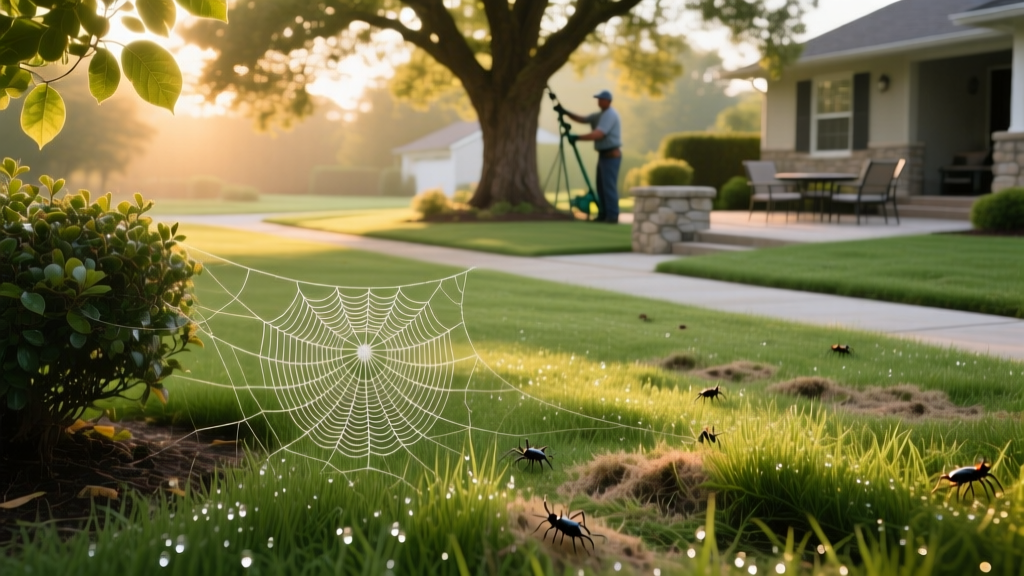
Cobwebs on Lawn: Step-by-Step Diagnosis and Treatment Guide
Understanding the 'Cobweb' Phenomenon on Turfgrass
Homeowners frequently report spotting 'cobwebs on lawn' surfaces during late summer and early autumn mornings. While actual spider webs catching morning dew are harmless ecological indicators, the vast majority of these dense, web-like structures are fungal mycelium—the vegetative threads of destructive turfgrass pathogens. Misidentifying aggressive fungal mycelium as harmless spider webs can lead to severe, irreversible turf loss within 48 to 72 hours under optimal disease conditions. The two primary culprits masquerading as lawn cobwebs are Clarireedia jacksonii (Dollar Spot) and Pythium aphanidermatum (Pythium Blight). This step-by-step maintenance protocol outlines how to accurately diagnose the source of the webbing and execute targeted cultural and chemical interventions to save your turf.
The Diagnostic Matrix: Spider Webs vs. Fungal Mycelium
Before applying any treatments, you must confirm the biological origin of the webbing. Use this diagnostic matrix to identify the specific organism occupying your lawn canopy.
| Feature | Harmless Spider Webs | Dollar Spot Mycelium | Pythium Blight Mycelium | Slime Mold |
|---|---|---|---|---|
| Structure | Elevated, anchored to tall grass tips, irregular geometry | Flat against canopy, fine white threads, spiderweb-like | Dense, cottony masses, thick and matted | Crusty, powdery, grayish-black or yellowish spore masses |
| Turf Damage | None | 1-3 inch sunken patches, straw-colored lesions with reddish-brown margins | Rapid wilting, greasy/water-soaked leaves, irregular smoky-gray patches | No leaf necrosis, easily wipes off blade |
| Environmental Trigger | Overgrown turf, evening insect activity | High humidity, low soil nitrogen, prolonged dew | Hot days (85°F+), warm nights (70°F+), saturated soils | Heavy mulch, excessive thatch, high humidity |
| Time of Visibility | Morning and evening | Early morning (dawn to 9:00 AM) | Early morning and late evening | Morning, dries to powder by midday |
Step 1: Immediate Moisture Triage and Dew Removal
Fungal mycelium requires continuous leaf wetness to infect turf tissue. Dollar spot requires 10 to 14 hours of continuous moisture, while Pythium blight can infect in as little as 6 to 8 hours under high heat. Your first maintenance procedure is to physically disrupt this moisture cycle.
- Dew Whipping: Between 5:00 AM and 6:30 AM, drag a fiberglass dew whip, a bamboo pole, or a specialized drag mat across the lawn canopy. This physically breaks the surface tension of the dew and shatters the delicate mycelial threads before they can penetrate the leaf stomata.
- Irrigation Auditing: Access your smart irrigation controller and restrict watering windows strictly between 4:00 AM and 5:30 AM. Watering in the late evening extends the leaf wetness period into the next morning, creating a 14-hour incubation window for fungal spores. Never irrigate in the late afternoon.
- Canopy Airflow: Prune lower branches of surrounding trees and shrubs to allow morning sunlight to penetrate the turf canopy and accelerate dew evaporation.
Step 2: Targeted Fungicide Protocols
If diagnostic signs confirm Dollar Spot or Pythium Blight, cultural controls alone will not stop an active outbreak. You must deploy targeted fungicides based on the specific pathogen's FRAC (Fungicide Resistance Action Committee) group susceptibility.
Dollar Spot Intervention Protocol
Dollar Spot (Clarireedia jacksonii) is highly responsive to specific systemic fungicides. According to NC State Extension turfgrass pathology guidelines, curative applications must be made immediately upon observing the first mycelial threads.
- Active Ingredient: Azoxystrobin (FRAC Group 11) or Fluxapyroxad (FRAC Group 7).
- Product Example: Heritage SC (Azoxystrobin 22.9%) or Xzemplar (Fluxapyroxad).
- Application Rate: 0.4 oz of Heritage SC per 1,000 square feet, mixed in 2 gallons of water to ensure thorough canopy penetration.
- Cost Estimate: Approximately $45 to $65 per 10,000 square feet for professional-grade concentrates.
Pythium Blight Intervention Protocol
Pythium is an oomycete (water mold), not a true fungus. It is naturally resistant to many standard fungicides. Applying a FRAC Group 11 product to Pythium will fail completely and waste your budget.
- Active Ingredient: Metalaxyl (FRAC Group 4) or Cyazofamid (FRAC Group 21).
- Product Example: Subdue MAXX (Metalaxyl) or Segway (Cyazofamid).
- Application Rate: 1.0 oz of Subdue MAXX per 1,000 square feet. Water in immediately with 1/8 inch of irrigation to move the active ingredient into the root zone and crown.
- Cost Estimate: $70 to $95 per 10,000 square feet.
⚠️ CRITICAL RESISTANCE WARNING: Never apply the same FRAC code more than twice consecutively. Fungal populations adapt rapidly. Rotate between contact fungicides (like Chlorothalonil, FRAC Group M5) and systemic options to prevent chemical resistance from rendering your treatments useless.
Step 3: Long-Term Cultural and Nutritional Adjustments
Chemical treatments are temporary bandages. Permanent resolution requires altering the turf microenvironment to make it inhospitable to mycelial growth.
Nitrogen Management for Dollar Spot
Dollar Spot aggressively exploits nitrogen-deficient turfgrass. If your lawn is exhibiting cobweb-like mycelium, test your soil. If nitrogen levels are low, apply a quick-release, water-soluble nitrogen (WSN) source such as ammonium sulfate at a rate of 0.25 to 0.5 lbs of actual nitrogen per 1,000 square feet. This stimulates rapid leaf growth, allowing the turf to outpace the fungal infection and recover damaged tissue.
Thatch Reduction and Core Aeration
A thatch layer exceeding 0.5 inches acts as a sponge, holding moisture against the turf crown and harboring fungal sclerotia (survival structures). Rent a walk-behind core aerator in early fall (for cool-season grasses) or late spring (for warm-season grasses) to extract 3-inch soil plugs. This relieves compaction, improves drainage, and introduces oxygen to the soil profile, which suppresses anaerobic pathogens like Pythium.
"Microclimates created by poor drainage and excessive thatch are the primary drivers of recurrent mycelial outbreaks. Homeowners who focus solely on fungicides without addressing soil hydrology will find themselves trapped in an endless, expensive chemical cycle." — Turfgrass Pathology Review, University of Massachusetts Extension (UMass Extension)
Troubleshooting Edge Cases: Slime Molds
If the 'cobwebs' appear thick, crusty, and resemble grayish-black or yellowish powder rather than fine threads, you are likely dealing with a slime mold (such as Fuligo septica, commonly called dog vomit slime mold). While visually alarming, slime molds do not parasitize turfgrass; they merely feed on decaying organic matter in the thatch layer.
- Action Required: No chemical treatment is necessary. Simply use a garden hose with a high-pressure nozzle to blast the spore masses off the grass blades, or break them up with a stiff rake.
- Prevention: Reduce irrigation frequency and dethatch the lawn to remove the decaying organic matter the slime mold uses as a food source.
Accurate diagnosis is the cornerstone of effective lawn maintenance. By distinguishing between harmless spider activity and aggressive fungal mycelium, and by executing precise moisture, chemical, and nutritional protocols, you can eliminate 'cobwebs' and restore a dense, healthy turf canopy.

