
Lawn Care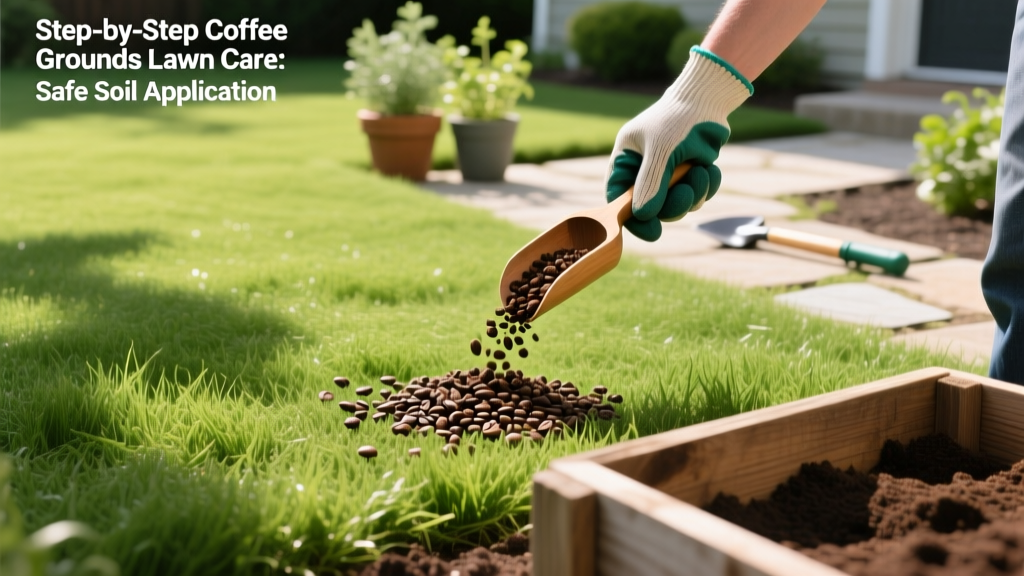
Step-by-Step Coffee Grounds Lawn Care: Safe Soil Application
The Reality of Coffee Grounds in Turfgrass Management
The internet is saturated with claims that dumping your morning coffee filter directly onto the lawn will result in a lush, dark-green carpet. In professional turfgrass management, this practice is a fast track to hydrophobic soil crusts, fungal outbreaks, and nitrogen starvation. However, when processed and applied correctly, spent coffee grounds are an exceptional, free source of stable organic matter that improves soil cation exchange capacity (CEC) and promotes earthworm activity.
To use coffee grounds effectively, you must understand their actual chemical profile. The brewing process extracts the highly soluble acids and caffeine into your cup. What remains in the filter is largely insoluble fiber, complex proteins, and trace minerals. According to Penn State Extension, spent coffee grounds are not a high-nitrogen fertilizer; they are a slow-release soil conditioner with a carbon-to-nitrogen (C:N) ratio of roughly 20:1 to 24:1.
⚠️ Critical Warning: Never apply wet, fresh coffee grounds directly to your lawn. The high moisture content and fine particle size will compact into a thick, impermeable layer that repels water and suffocates grass roots. Furthermore, residual caffeine (averaging 4.8 mg per gram in spent grounds) exhibits allelopathic properties, meaning it can actively inhibit seed germination if applied to newly overseeded lawns.
Chemical Profile: Fresh vs. Spent Coffee Grounds
Understanding the difference between unbrewed and spent grounds is vital for calculating your lawn's nutrient inputs. Below is a comparative analysis of their soil impacts.
| Metric | Fresh (Unbrewed) Grounds | Spent (Brewed) Grounds |
|---|---|---|
| pH Level | 5.0 - 5.5 (Highly Acidic) | 6.5 - 6.8 (Near Neutral) |
| Nitrogen Content | ~2.0% (Plant Available) | ~2.0% (Bound in Complex Proteins) |
| C:N Ratio | 20:1 | 24:1 (Requires microbial breakdown) |
| Caffeine Residue | High (Phytotoxic to seeds) | Low to Moderate (Still allelopathic) |
| Best Lawn Use | None (Too acidic/toxic) | Compost additive or liquid extract |
Step 1: Sourcing, Drying, and Pathogen Control
Moisture is the enemy of stored coffee grounds. Wet grounds will develop Aspergillus and Penicillium mold within 48 hours at room temperature. If you are collecting grounds from a local café or your own kitchen, immediate dehydration is mandatory.
- Collection: Gather spent grounds and spread them immediately onto aluminum baking sheets. Do not pile them in a bucket, as the center of the pile will begin anaerobic decomposition and produce foul-smelling volatile organic compounds (VOCs).
- Thermal Drying: Place the baking sheets in an oven set to 200°F (93°C) for 45 to 60 minutes. This step achieves two goals: it reduces moisture content below 10% for safe storage, and the sustained heat kills lingering fungal spores and fruit fly eggs.
- Storage: Once completely dry and crumbly, transfer the grounds to a breathable burlap sack or a plastic bin with drilled ventilation holes. Store in a dry, shaded area. Properly dried grounds can be stored for up to six months without degrading.
Step 2: Preparing the Grounds for Turf Application
You have two primary pathways for introducing coffee grounds into your lawn care program: aerobic composting integration or brewing a liquid soil drench. Direct top-dressing is only recommended for heavily compacted, clay-dominant soils and must be done sparingly.
Method A: Aerobic Composting Integration (Recommended)
Because spent grounds have a C:N ratio of 24:1, they are technically considered a "green" (nitrogen-rich) composting ingredient, despite their brown color. However, they lack the structural bulk required for proper compost aeration.
- The Ratio: Mix 1 part dried coffee grounds with 4 parts carbon-heavy "browns" (shredded dry leaves, untreated cardboard, or pine straw) and 1 part high-nitrogen "greens" (grass clippings or vegetable scraps).
- Thermal Target: Maintain the compost pile moisture at 50% (feels like a wrung-out sponge). Turn the pile every 5 days to maintain an internal temperature between 130°F and 150°F. This thermophilic phase breaks down the residual caffeine and unlocks the bound nitrogen.
- Maturation: After 60 to 90 days, the grounds will be fully integrated into a stable, earthy-smelling humus ready for lawn top-dressing.
Method B: Brewing a Liquid Soil Drench
If you need to deliver organic matter and micronutrients directly to the root zone without waiting for compost, a liquid extract bypasses the thatch layer.
- Combine 2 cups of dried, spent coffee grounds with 5 gallons of non-chlorinated water (rainwater or dechlorinated tap water) in a large bucket.
- Add 1 tablespoon of unsulfured blackstrap molasses. The molasses provides simple sugars that feed the indigenous soil bacteria, accelerating the breakdown of the coffee compounds in the water.
- Stir vigorously and let the mixture steep for 24 to 36 hours. Do not exceed 48 hours, or the solution will turn anaerobic and smell like sulfur.
- Strain the liquid through a 200-mesh filter bag to prevent clogging your pump sprayer.
Step 3: Application Rates and Seasonal Timing
Applying organic amendments at the wrong time of year can lead to nutrient runoff or winter turf diseases. Follow these specific parameters based on your grass type.
✓ Cool-Season Grasses (Kentucky Bluegrass, Fescue, Ryegrass):
Apply composted coffee grounds or liquid drench in early Fall (September). This coincides with peak root growth and carbohydrate storage. Apply the liquid drench at a rate of 1 gallon per 1,000 square feet. If using finished compost, top-dress at a depth of 1/8 inch (approx. 40 lbs per 1,000 sq ft).
Apply composted coffee grounds or liquid drench in early Fall (September). This coincides with peak root growth and carbohydrate storage. Apply the liquid drench at a rate of 1 gallon per 1,000 square feet. If using finished compost, top-dress at a depth of 1/8 inch (approx. 40 lbs per 1,000 sq ft).
✓ Warm-Season Grasses (Bermuda, Zoysia, St. Augustine):
Apply during late Spring (May) just after the grass has fully greened up and exited winter dormancy. Avoid fall applications, as the slow-release nitrogen can delay dormancy and increase susceptibility to frost damage.
Apply during late Spring (May) just after the grass has fully greened up and exited winter dormancy. Avoid fall applications, as the slow-release nitrogen can delay dormancy and increase susceptibility to frost damage.
Troubleshooting Common Coffee Ground Lawn Issues
Even with careful preparation, environmental variables can cause issues. Use this diagnostic framework to correct problems in the field.
| Symptom | Probable Cause | Corrective Action |
|---|---|---|
| White, fuzzy mold on soil surface | Grounds applied wet or too thickly, creating a hydrophobic crust. | Rake the area vigorously to break the crust. Core aerate to restore oxygen flow to the root zone. |
| Grass blades turning pale yellow | Nitrogen tie-up. Uncomposted grounds are drawing soil nitrogen to fuel microbial decomposition. | Apply a fast-acting liquid synthetic nitrogen (e.g., 20-0-0 urea) at 0.5 lbs per 1,000 sq ft to bridge the gap. |
| Poor seed germination in overseeded areas | Caffeine allelopathy inhibiting radicle emergence. | Stop using coffee extracts on new seed. Wait until the turf has been mowed at least three times before resuming. |
| Excessive earthworm casting (mounds) | Coffee grounds heavily attract Lumbricus terrestris (nightcrawlers). | This is actually beneficial for soil aeration. Simply drag a stiff-tined lawn rake over the mounds to distribute the nutrient-rich castings. |
Expert Verdict: Do Coffee Grounds Replace Traditional Fertilizer?
No. Coffee grounds should be viewed strictly as a soil conditioner and organic matter amendment, not a primary macronutrient fertilizer. A standard 50 lb bag of 32-0-4 synthetic lawn fertilizer costs roughly $35 and delivers 16 lbs of immediately available nitrogen. To get that same amount of immediately available nitrogen from spent coffee grounds, you would need to apply thousands of pounds of material, which would smother your turf and destroy the soil structure.
However, as a supplemental practice, integrating EPA-recommended composting methods with your daily coffee waste provides a sustainable, zero-cost way to increase your soil's water retention capacity. In sandy soils, the added humus from composted coffee grounds can increase moisture retention by up to 15%, reducing your summer irrigation costs. Use them to build the soil ecosystem, but rely on targeted, soil-test-driven fertilizers to feed the grass plant itself.

