
Lawn Care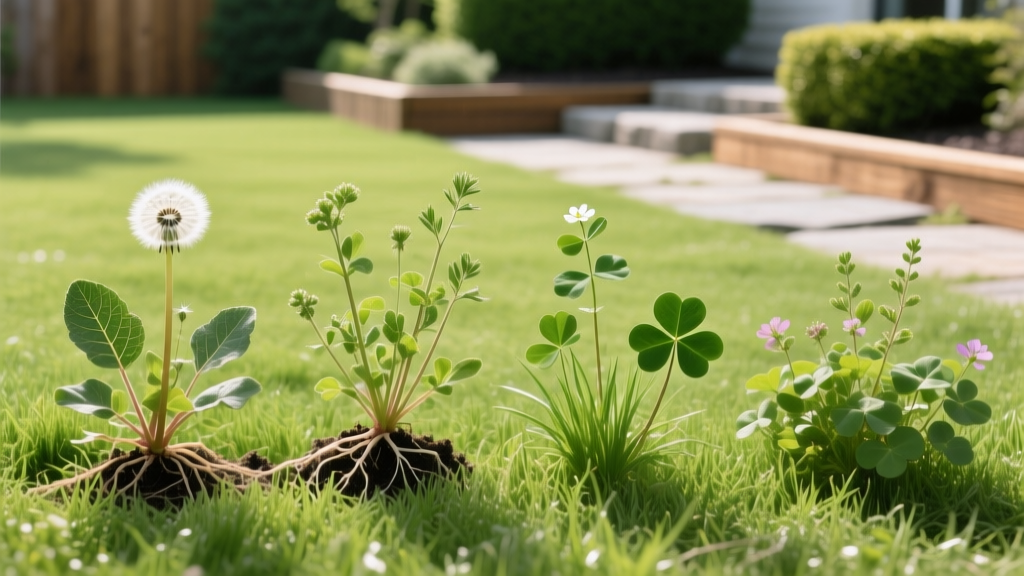
Common Types of Weeds With Names: Visual Lawn Identification Guide
The Financial Cost of Weed Misidentification
Applying the wrong herbicide to your lawn does not just waste your weekend; it actively damages your turf and drains your wallet. A single bottle of specialty post-emergent herbicide costs between $35 and $85 in 2026. If you mistake a sedge for a grassy weed and treat it with Quinclorac, the sedge will thrive while you inadvertently stunt your desirable turfgrass. Accurate identification is the foundational step of any integrated pest management (IPM) program.
According to turfgrass research from Penn State Extension, lawn weeds are categorized into three distinct botanical families: grassy weeds, broadleaf weeds, and sedges. Each family requires a completely different mode of action for chemical control. This guide breaks down the most common types of weeds with names, exact morphological identifiers, and the specific active ingredients required to eradicate them.
Grassy Weeds: The Turf Mimics
Grassy weeds are monocots, meaning they share the same parallel-vein leaf structure and fibrous root systems as your actual lawn. Because they are botanically similar to cool-season and warm-season turfgrasses, selective herbicide control is notoriously difficult.
1. Crabgrass (Digitaria sanguinalis)
Crabgrass is an annual summer weed that germinates when soil temperatures at a 1-inch depth reach 55°F for three consecutive days. It features a prostrate growth habit, meaning it hugs the ground and radiates outward from a central hub, eventually choking out surrounding fescue or Kentucky bluegrass.
- Key ID Feature: The ligule (the membrane where the leaf meets the stem) is tall, membranous, and jagged. The leaf blades are noticeably wider and lighter green than surrounding turf.
- Pre-Emergent Control: Prodiamine (Barricade) applied at 0.4 oz per 1,000 sq ft before soil temps hit 55°F.
- Post-Emergent Control: Quinclorac. Note that Quinclorac can cause temporary yellowing in certain St. Augustinegrass cultivars.
2. Annual Bluegrass (Poa annua)
Unlike crabgrass, Poa annua is a cool-season weed that germinates in late summer when soil temperatures drop below 70°F. It produces unsightly white seed heads in early spring, even when mowed at 2 inches.
- Key ID Feature: The leaf tip is distinctly 'boat-shaped' (prow-shaped), and the lower leaf sheath is flattened rather than rounded.
- Pre-Emergent Control: Dithiopyr (Dimension) applied in late August. Dithiopyr offers both pre-emergent and early post-emergent root pruning capabilities.
- Post-Emergent Control: Ethofumesate for cool-season lawns; Bispyribac-sodium (Velocity) for warm-season bermudagrass.
Timing Warning: Pre-emergent herbicides create a chemical barrier in the top 1 inch of soil. If you core aerate your lawn after applying a pre-emergent, you will break this barrier and render the application useless. Always aerate before your pre-emergent window opens.
Broadleaf Weeds: The Obvious Intruders
Broadleaf weeds are dicots. They feature net-like vein patterns, wider leaves, and often produce showy flowers. Because they are botanically distant from turfgrasses, selective systemic herbicides can easily target them without harming your lawn.
3. Dandelion (Taraxacum officinale)
The dandelion is a perennial broadleaf weed with a deep, fleshy taproot that can extend 10 to 15 inches into compacted soil. If the taproot snaps during manual removal, the weed will regenerate within weeks.
- Key ID Feature: Deeply lobed, jagged leaves that form a basal rosette, and a hollow, milky sap-filled flower stalk.
- Post-Emergent Control: A three-way herbicide blend containing 2,4-D, Mecoprop-p (MCPP), and Dicamba. Apply when daytime temperatures are between 65°F and 85°F to prevent herbicide volatilization (drift).
4. White Clover (Trifolium repens)
Clover is a perennial legume that thrives in nitrogen-deficient soils. It spreads via above-ground creeping stems called stolons. According to the University of California IPM, clover is often an indicator of poor soil fertility rather than just a random invader.
- Key ID Feature: Trifoliate leaves (three leaflets) often featuring a white, V-shaped watermark. Small, spherical white or pinkish flower heads.
- Post-Emergent Control: Triclopyr is highly effective on clover. Products combining Triclopyr with 2,4-D and Dicamba (such as SpeedZone) provide rapid browning within 48 hours.
Sedges: The Triangle-Stemmed Nightmares
Sedges are neither grasses nor broadleaves. They belong to the Cyperaceae family and thrive in poorly drained, compacted, or consistently wet soils. Standard grass and broadleaf herbicides have zero efficacy on sedges.
5. Yellow Nutsedge (Cyperus esculentus)
Yellow nutsedge is a perennial that reproduces primarily through underground tubers (nutlets). A single plant can produce hundreds of tubers in one season, which remain viable in the soil for up to three years. Pulling the plant by hand usually snaps the stem, leaving the tubers behind to sprout new shoots.
- Key ID Feature: 'Sedges have edges.' Roll the lower stem between your thumb and index finger; if it feels distinctly triangular, it is a sedge. The leaves are arranged in sets of three (grass leaves are in sets of two).
- Post-Emergent Control: Halosulfuron-methyl (SedgeHammer). This active ingredient halts cell division in the sedge without harming most established turfgrasses. Expect to pay around $18 for a 1.33 oz pouch, which treats up to 1,000 sq ft.
Weed Identification and Chemical Control Matrix
| Weed Name | Category | Primary ID Feature | Active Ingredient | Est. Cost / 1k sq ft |
|---|---|---|---|---|
| Crabgrass | Grassy | Jagged membranous ligule | Prodiamine (Pre) / Quinclorac (Post) | $0.08 (Pre) |
| Poa Annua | Grassy | Boat-shaped leaf tip | Dithiopyr (Pre) / Ethofumesate (Post) | $0.12 (Pre) |
| Dandelion | Broadleaf | Deep taproot, basal rosette | 2,4-D + MCPP + Dicamba | $0.05 |
| White Clover | Broadleaf | Three leaflets, white V-mark | Triclopyr | $0.07 |
| Yellow Nutsedge | Sedge | Triangular stem, underground tubers | Halosulfuron-methyl | $0.18 |
Diagnostic Decision Tree: What is Growing in Your Lawn?
When you encounter an unknown weed, follow this physical diagnostic sequence to determine its family before purchasing chemicals:
- Examine the Leaf Width: If the leaf is wide (greater than 1/4 inch) with a net-like vein structure, it is a broadleaf weed.
- Check the Veins: If the leaf is narrow with parallel veins, proceed to step 3.
- Roll the Stem: Pinch the base of the stem and roll it between your fingers. If it rolls smoothly and feels round, it is a grassy weed.
- Feel for Edges: If the stem feels distinctly triangular or ridged, it is a sedge.
The Role of Soil Health in Weed Suppression
Chemical control is only a temporary bandage. Weeds are opportunistic indicators of environmental stress. A dense, aggressive turfgrass canopy is the ultimate pre-emergent. If your soil pH is below 6.0, your turfgrass cannot uptake applied nitrogen, leaving the ecological niche open for acid-tolerant weeds like plantain and sorrel. Conduct a baseline soil test via a university extension lab every two years, and apply pulverized agricultural lime at a rate of 40 lbs per 1,000 sq ft for every 0.5 pH point deficit.
'The best herbicide on the market is a thick, healthy stand of turfgrass. Weeds do not invade healthy lawns; they occupy the voids left by poor agronomic practices.' — Dr. James Brosnan, Turfgrass Weed Science.
Frequently Asked Questions
Can I mix pre-emergent and post-emergent herbicides in the same sprayer?
Yes, but with strict caveats. You can tank-mix a liquid pre-emergent (like Prodiamine) with a post-emergent (like 2,4-D) to save time. However, you must add a non-ionic surfactant (NIS) at 0.25% v/v to ensure the post-emergent sticks to the broadleaf foliage. Be aware that the pre-emergent requires immediate irrigation (0.5 inches of water) to move into the soil profile, while the post-emergent requires 24 to 48 hours of dry weather to be absorbed through the leaves. Plan your application when a light rain is forecasted exactly 36 hours after spraying.
Why did my weed die but come back three weeks later?
This is a classic symptom of treating a perennial weed with a contact herbicide instead of a systemic one. Contact herbicides burn off the top growth, but the root system remains intact. Always verify that your active ingredient is labeled as 'systemic' or 'translocated,' meaning the plant will pull the chemical down into the root crown and rhizomes, ensuring total eradication.

