
Lawn Care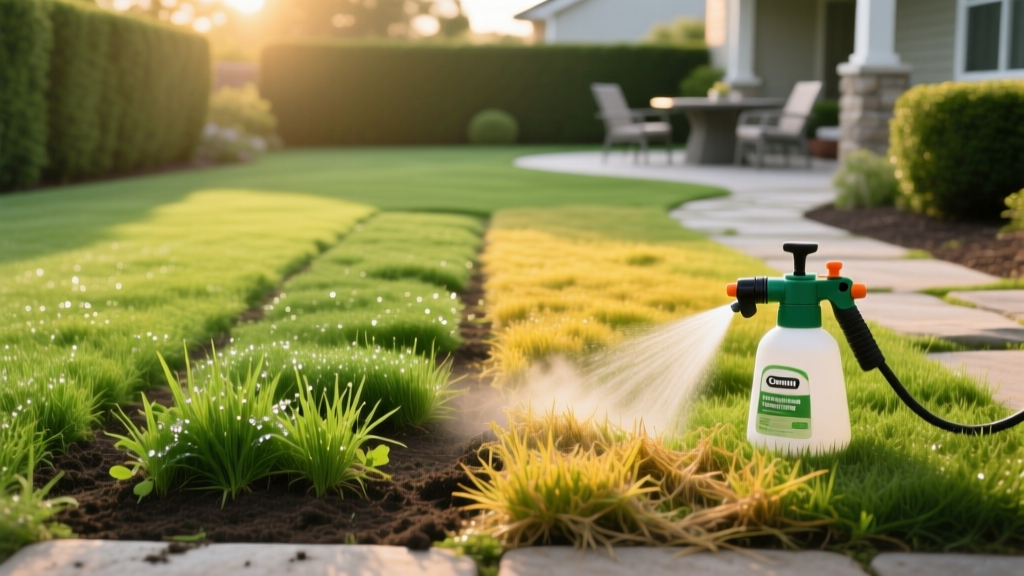
Compare and Save Weed and Grass Killer: Spot-Treatment Guide
The Economics and Efficacy of Generic Glyphosate for Lawn Renovation
When managing aggressive, deep-rooted perennial weeds in an established lawn, broadcast spraying is not an option. You need surgical precision. Compare and Save Weed and Grass Killer is a 41% glyphosate concentrate that has become a staple for turf managers and serious DIYers who need a cost-effective, non-selective systemic herbicide for targeted spot-treatments. Unlike ready-to-use (RTU) formulations that cost upwards of $15 per gallon and contain less than 2% active ingredient, this concentrate allows you to customize dilution rates based on the specific weed species and its growth stage.
However, because glyphosate is non-selective, it will indiscriminately kill your desirable turfgrass upon contact. This guide details the exact physiological action, precise mixing mathematics, and drift-mitigation protocols required to use this product safely on a living lawn without causing collateral turf damage.
⚠️ CRITICAL TURF WARNING: Compare and Save Weed and Grass Killer contains 41% glyphosate and is non-selective. It does not distinguish between a dandelion and your Kentucky Bluegrass. It must only be used for hardscape edging, driveway cracks, or highly controlled spot-treatments (like wick-wiping) on living lawns. Broadcast application will result in total lawn death.
Physiological Action: How 41% Glyphosate Eradicates Weeds
To effectively spot-treat, you must understand how the active ingredient moves through the plant. Glyphosate works by inhibiting the EPSP synthase enzyme, which is responsible for producing essential aromatic amino acids required for plant growth. According to the Cornell Pesticide Management Education Program, once absorbed through the foliar cuticle, the herbicide translocates through the phloem down to the root crown and rhizomes.
This systemic action is why Compare and Save is highly effective against perennial grassy weeds like Quackgrass and Dallisgrass, which reproduce via deep underground rhizomes. Contact herbicides (like diquat) only burn the top growth, allowing these weeds to regenerate in weeks. Glyphosate ensures the entire root system starves and necrotizes, typically showing yellowing (chlorosis) in 3 to 5 days and complete tissue death in 10 to 14 days.
Target Weed Species & Custom Dilution Matrix
The most common failure mode for DIYers is using a single, blanket dilution rate for all weeds. Tough perennials and waxy-leafed broadleaves require higher concentrations and the addition of a non-ionic surfactant (NIS) to break surface tension. Below is the precise mixing matrix for a standard 1-gallon pump sprayer.
| Target Weed Species | Weed Type | Concentrate per Gallon | Surfactant Required? |
|---|---|---|---|
| Crabgrass & Annual Bluegrass | Annual Grass | 1.5 oz (44 ml) | No (included in formula) |
| Dandelion, Clover, Thistle | Broadleaf Perennial | 2.5 oz (74 ml) | Optional (improves speed) |
| Dallisgrass & Quackgrass | Perennial Grass | 3.0 oz (89 ml) | Yes (0.25% v/v NIS) |
| Wild Violet & Plantain | Waxy Broadleaf | 4.0 oz (118 ml) | Yes (Mandatory for cuticle penetration) |
| Yellow Nutsedge | Sedge | 3.0 oz (89 ml) | Yes (Note: May require 2nd app at 14 days) |
Drift-Free Application Protocols for Living Lawns
Applying a 41% glyphosate concentrate near desirable turf requires physical barriers or targeted transfer methods. Wind drift or splashing from a standard fan-nozzle sprayer will leave distinct, dead yellow streaks across your lawn. Utilize one of the following professional spot-treatment methods:
Method 1: The Wick Applicator (Best for Grassy Weeds)
Because glyphosate is non-selective, wick wiping is the safest way to treat tall grassy weeds (like Dallisgrass or Johnsongrass) that have grown above the canopy of your desirable, lower-mowed turf.
- Mow the Lawn: Mow your desirable turf to its lowest recommended height. Wait 3 days to allow the target weeds to grow 2 to 3 inches above the turf canopy.
- Prepare the Wick: Saturate a commercial rope-wick applicator or a simple sponge-on-a-stick with a slightly stronger mixture (3 oz per gallon).
- Physical Transfer: Walk the lawn and physically wipe the sponge only on the leaves of the target weeds that protrude above the good grass. The herbicide transfers via contact, eliminating spray drift entirely.
Method 2: Shielded Cone Spraying (Best for Broadleaves & Edges)
For low-growing broadleaf weeds or when treating weeds near landscape bed borders, use a sprayer equipped with a plastic spray shield cone.
- Reduce pump pressure to the minimum required to atomize the liquid (usually 20-25 PSI). High pressure creates micro-droplets that bounce off the shield and drift onto turf.
- Keep the shield cone flush against the soil surface, completely engulfing the target weed.
- Apply a brief 1-second burst to wet the foliage to the point of runoff, but avoid pooling the chemical on the soil surface.
Cost Analysis: Concentrate vs. Ready-To-Use (RTU)
As of 2026, the retail price for a 1-gallon jug of Compare and Save 41% concentrate hovers around $28 to $34. While the upfront cost is higher than a $7 bottle of RTU weed killer, the mathematical advantage is staggering for homeowners managing large properties or extensive hardscape edging.
The Dilution Math (Cost Per Gallon of Spray)
- Concentrate Yield: At a standard 2.5 oz per gallon rate, one 128 oz jug yields 51.2 gallons of finished spray.
- Cost Per Gallon: $32.00 ÷ 51.2 gallons = $0.62 per gallon of mixed herbicide.
- RTU Comparison: Pre-mixed RTU glyphosate products cost roughly $8.00 to $12.00 per gallon.
- Total Savings: You save over 90% per gallon of applied product, paying only for the active ingredient rather than shipping water.
Environmental Safety, Soil Binding, and Runoff
A common concern with spot-treating lawns is the residual effect on the soil and future overseeding plans. The U.S. Environmental Protection Agency (EPA) notes that glyphosate binds tightly to soil particles upon contact, rendering it biologically inactive to roots. It is broken down by soil microbes into aminomethylphosphonic acid (AMPA) and carbon dioxide.
Because it has no soil residual activity, you can safely overseed or lay sod in a spot-treated area just 7 to 14 days after application, once the target weeds have completely necrotized. To prevent runoff, never apply Compare and Save if rainfall is expected within 6 hours. While the label claims rainfastness in 2 hours, university turfgrass extension trials, such as those documented by the University of Minnesota Extension, recommend a 6-hour dry window for maximum translocation into the root system before the chemical can be washed off the leaf cuticle.
Troubleshooting Common Failure Modes
If your spot-treatments are failing and weeds are returning, evaluate these three common application errors:
| Symptom | Root Cause | Corrective Action |
|---|---|---|
| Weed turns yellow but regenerates after 3 weeks. | Mowing too soon after application. | Wait a minimum of 7 days before mowing to allow phloem translocation to the rhizomes. |
| Herbicide beads up and rolls off waxy leaves (e.g., Plantain). | Lack of surfactant; high surface tension. | Add 0.25% v/v Non-Ionic Surfactant (NIS) to the tank mix to break the cuticle barrier. |
| Weed shows no signs of chlorosis after 10 days. | Hard water tie-up or drought stress. | Add 1 oz of ammonium sulfate (AMS) per gallon to soften the water. Avoid spraying during drought when plant stomata are closed. |
Final Verdict for Turf Management
Compare and Save Weed and Grass Killer remains an indispensable tool for the 2026 lawn care season, provided it is treated with the respect a 41% non-selective concentrate demands. By abandoning broadcast spraying in favor of wick-wiping and shielded cone applications, you can eradicate deep-rooted perennial grasses and stubborn broadleaves for pennies on the dollar compared to commercial RTU alternatives. Always prioritize precise measurement, respect the rainfast window, and allow the systemic chemistry the time it needs to eradicate the root crown entirely.

