
Lawn Care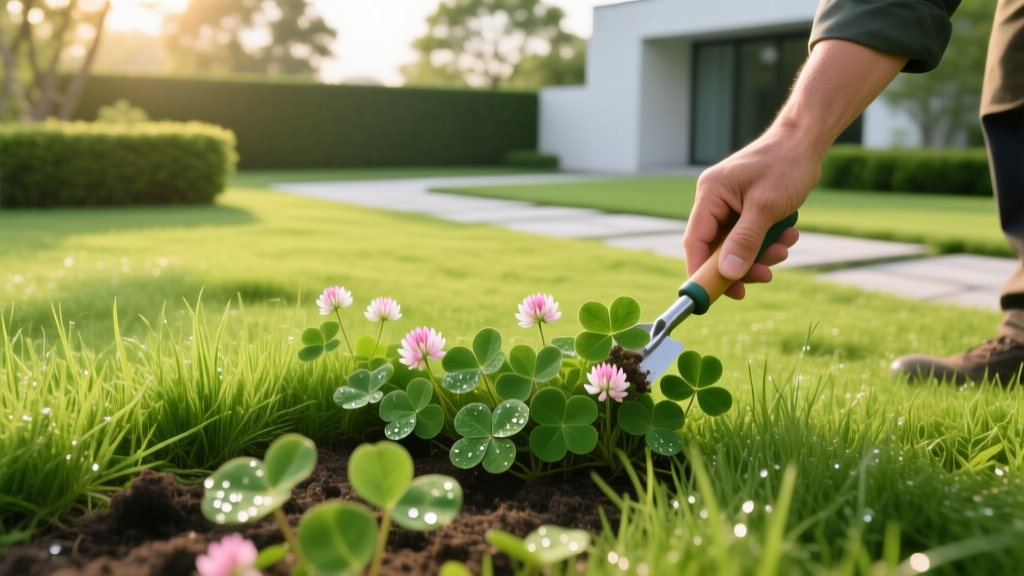
How to Control Clover in Lawn Without Killing Grass
Diagnosing the Clover Invasion: Soil and Mowing Factors
White clover (Trifolium repens) is a perennial broadleaf weed that thrives in environments where turfgrass is biologically stressed. According to the USDA Plants Database, this species is highly adaptable, but its primary competitive advantage lies in its root system. Clover forms a symbiotic relationship with Rhizobium bacteria in its root nodules, allowing it to fix atmospheric nitrogen. When your lawn's soil is nitrogen-deficient, clover synthesizes its own fertilizer while your turfgrass starves.
Before reaching for herbicides, you must address the environmental triggers that allowed the clover to establish. Clover proliferates in compacted soils with low mowing heights. Mowing below 2.5 inches removes the turfgrass canopy, exposing the soil surface to sunlight and allowing clover's low-growing stolons to photosynthesize unimpeded. Furthermore, clover prefers a soil pH between 6.0 and 7.0; if your soil is highly acidic (below 5.5), turfgrass struggles while certain clover varieties persist.
Diagnostic Checklist Before Treatment:
- Perform a soil test to verify nitrogen levels and pH.
- Check for soil compaction using a 6-inch soil probe; if you cannot easily push it into the ground, aeration is required.
- Measure your mowing height. Raise the mower deck to a minimum of 3.0 inches for cool-season grasses.
Selective Chemical Spot-Treatments: Active Ingredients
When spot-treating clover, the goal is to use selective systemic herbicides that translocate through the clover's stolon network and taproot without causing phytotoxicity to surrounding turf. Broad-spectrum herbicides like glyphosate will kill the clover but will also leave dead patches in your lawn. Instead, rely on synthetic auxins and HPPD inhibitors.
The Holy Trinity: 2,4-D, Quinclorac, and Dicamba
For most residential lawns, a three-way herbicide blend is the most cost-effective and reliable spot-treatment. Products like Ortho WeedClear for Lawns (typically $14.99 for a 20oz ready-to-spray bottle) combine these three active ingredients. Quinclorac is particularly devastating to clover because it mimics plant growth hormones, causing the weed to grow itself to death through uncontrolled cellular division. When spot-treating, apply the product directly to the clover leaves until wet, but avoid runoff into the surrounding soil.
Mesotrione (HPPD Inhibitors) for Cool-Season Grasses
If you manage Kentucky Bluegrass, Tall Fescue, or Perennial Ryegrass, Mesotrione (sold commercially as Syngenta Tenacity, approx. $60 for 8oz) is a highly effective alternative. Mesotrione inhibits the HPPD enzyme, preventing the clover from producing carotenoids, which leads to rapid chlorophyll destruction. The clover will turn stark white within 5 to 7 days before dying. Warning: Mesotrione is not safe for Bermudagrass, Zoysiagrass, or Centipedegrass, as it will severely bleach warm-season turf.
| Active Ingredient | Turfgrass Safety | Spot-Treatment Rate | Avg. Cost (2026) |
|---|---|---|---|
| Quinclorac + Dicamba + 2,4-D | Safe for most cool & warm-season grasses | Ready-to-use spray to wet | $15 / 20oz |
| Mesotrione (Tenacity) | Cool-season ONLY (Toxic to Bermuda/Zoysia) | 1 tsp per gallon + 0.25% NIS | $60 / 8oz |
| Fluroxypyr | Safe for most cool & warm-season grasses | 0.5 oz per gallon of water | $45 / 16oz |
Crucial Application Rules: Surfactants and Volatilization
Herbicide failure is rarely due to the chemical itself; it is almost always a result of poor application mechanics. Clover leaves are coated in a waxy cuticle that repels water-based sprays. If you are mixing a concentrated herbicide like Tenacity or Fluroxypyr, you must add a Non-Ionic Surfactant (NIS) or Methylated Seed Oil (MSO) at a rate of 1 to 2 teaspoons per gallon. This breaks the surface tension, allowing the chemical to penetrate the leaf tissue.
Temperature dictates formulation choice. According to EPA pesticide safety guidelines, environmental conditions heavily influence herbicide behavior. If daytime temperatures exceed 85°F, avoid ester formulations of 2,4-D, as they will volatilize (turn into a gas) and drift onto desirable ornamental plants. During the heat of summer, switch to amine formulations or rely on Mesotrione, which remains stable at higher temperatures.
Organic and Mechanical Eradication Frameworks
For homeowners managing organic lawns or those with pets and children who frequently play on the turf, synthetic auxins may be undesirable. Organic clover control requires a combination of mechanical extraction and biological outcompetition.
The Iron HEDTA Alternative
Chelated iron, specifically FeHEDTA (Iron HEDTA), is a naturally occurring compound that is highly toxic to broadleaf weeds but acts as a micronutrient fertilizer for turfgrass. Products like Fiesta Turf Weeder (approx. $45 per gallon) cause rapid desiccation and necrosis in clover leaves within 24 hours. Because clover has a deep taproot, a single application of Iron HEDTA will burn the top growth but may not kill the root. Plan for two applications spaced 21 days apart to achieve complete systemic control.
Mechanical Extraction and the Taproot Problem
Hand-pulling clover is only effective if the entire root system is removed. White clover features a primary taproot that can extend 6 to 8 inches into the soil profile, supported by secondary stolons. Pulling by hand usually snaps the stolon, leaving the taproot intact to regenerate within three weeks. Use a specialized tool like the Fiskars 39-Inch Steel Dandelion Weeder ($35). Push the serrated claws directly into the soil at the base of the clover crown, angle the handle back to 45 degrees, and lever the entire root mass out of the ground.
The Nitrogen Outcompetition Strategy
Clover cannot survive in high-nitrogen environments because the resulting aggressive turfgrass canopy will shade out the clover's stolons. Apply a fast-release nitrogen fertilizer, such as Urea (46-0-0), at a rate of 1.0 lb of nitrogen per 1,000 square feet in early fall. This forces the turfgrass to thicken and tiller rapidly, choking the clover out through light deprivation. Note that this is a long-term suppression strategy and will take 2 to 3 growing seasons to fully eradicate an established clover infestation.
Post-Eradication Recovery and Overseeding
Successfully killing the clover is only half the battle. The dead clover will leave behind circular bare patches in your lawn that are prime real estate for secondary weeds like crabgrass or spurge. Immediate turf recovery is mandatory.
- Rake and Prep: Use a steel leaf rake to aggressively scratch the bare soil where the clover was removed, breaking up the top 1/4 inch of soil to ensure seed-to-soil contact.
- Overseed: Apply a premium turfgrass seed blend that matches your existing lawn. For cool-season lawns, use a mix containing turf-type tall fescue and Kentucky bluegrass (e.g., Jonathan Green Black Beauty Ultra, $65 for 10 lbs). Apply at a rate of 4 to 6 lbs per 1,000 square feet in the bare spots.
- Starter Fertilizer: Apply a high-phosphorus starter fertilizer (such as 18-24-6) to promote rapid root development in the new seedlings.
- Topdress and Water: Cover the seed with a 1/8 inch layer of peat moss or fine compost to retain moisture. Water lightly twice daily for 14 days until germination is complete.
By combining precise chemical spot-treatments with aggressive cultural practices—specifically raising your mowing height and correcting nitrogen deficiencies—you can eliminate clover and restore a dense, monochromatic turfgrass canopy that naturally resists future invasions.

