
Lawn Care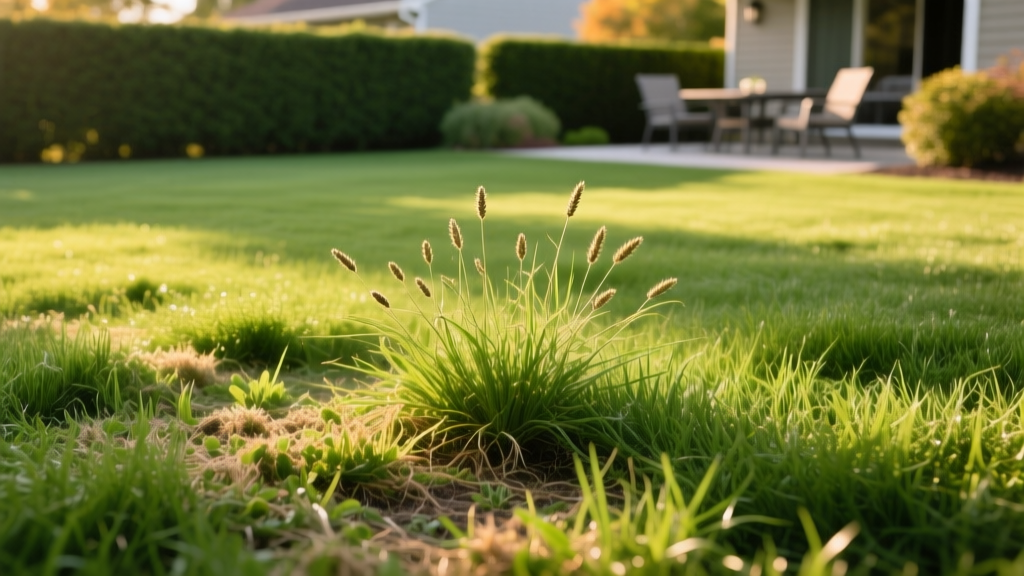
Controlling Crabgrass Late Season: Spot Treatment & Eradication
The Biology of a Crabgrass Breakout
When homeowners realize they are controlling crabgrass (Digitaria sanguinalis) in the middle of summer, the battle has already shifted from prevention to active eradication. Crabgrass is a prolific annual weed capable of producing up to 150,000 seeds per plant. By late June or July, isolated clumps transition from minor nuisances to aggressive competitors that choke out desirable turf by monopolizing soil moisture and nutrients.
Spot-treating mature crabgrass requires a fundamentally different approach than spring pre-emergent applications. Because the weed has developed a robust fibrous root system and thick cuticle layers on its leaves, standard broadcast herbicides often fail. Success relies on selecting the correct post-emergent active ingredient, pairing it with the proper surfactant, and understanding the specific growth stage of the weed.
Pro-Tip: Identify Before You Spray
Ensure you are actually dealing with crabgrass and not goosegrass (Eleusine indica) or dallisgrass. Crabgrass features a distinctive membranous ligule that is tall and jagged, and its leaves are wider and lighter green than most cool-season turfgrasses. Goosegrass has a silver-white center and is highly resistant to standard quinclorac treatments.
Ensure you are actually dealing with crabgrass and not goosegrass (Eleusine indica) or dallisgrass. Crabgrass features a distinctive membranous ligule that is tall and jagged, and its leaves are wider and lighter green than most cool-season turfgrasses. Goosegrass has a silver-white center and is highly resistant to standard quinclorac treatments.
The '3-Tiller Gap': Why Your Herbicide Failed
The most common failure mode in controlling crabgrass post-emergence is ignoring the plant's tiller stage. A 'tiller' is a side shoot that emerges from the base of the plant. Agronomic field trials consistently reveal a bizarre phenomenon known among turf professionals as the 3-Tiller Gap.
- 1- to 2-Leaf Stage: Crabgrass is highly susceptible to almost all post-emergent herbicides. A single application will kill it within 7 days.
- 3- to 4-Tiller Stage: The plant enters a transitional growth phase where its metabolic pathways shift, and its leaf cuticle thickens rapidly. Herbicide uptake plummets, leading to 'burn-back' (where leaves turn purple and crispy, but the crown survives and regenerates).
- 5+ Tiller Stage (Mature): Susceptibility actually increases again as the plant pushes energy into seed head production, though the kill time extends to 14–21 days.
If your crabgrass is in the 3-to-4 tiller stage, you must plan for a mandatory second application 14 to 21 days after the first to catch the regrowth before it matures again.
Active Ingredients for Post-Emergent Spot Treatment
Not all weed killers are created equal. According to turfgrass management guidelines from institutions like Penn State Extension, selecting an active ingredient that is safe for your specific turf type is critical to avoid chemical burn or total lawn loss.
1. Quinclorac (The Industry Workhorse)
Quinclorac is the gold standard for controlling crabgrass in cool-season lawns (Kentucky Bluegrass, Tall Fescue) and most warm-season lawns (Bermuda, Zoysia). It mimics auxin hormones, causing the weed to grow itself to death. Crucial Warning: Quinclorac is highly toxic to St. Augustine and Centipede grasses. If you have these warm-season varieties, do not use Quinclorac.
2. Fenoxaprop-p-ethyl (The Cool-Season Specialist)
Sold under trade names like Acclaim Extra, this is an ACCase inhibitor that stops lipid synthesis in the weed. It is exceptionally safe for cool-season grasses and is highly effective on mature crabgrass, but it cannot be used on Bermuda or Zoysia lawns without causing severe stunting and chlorosis.
3. Mesotrione (The Bleacher)
Mesotrione (Tenacity) inhibits photosynthesis, causing the crabgrass to turn stark white before dying. It is safe for almost all turf types, including St. Augustine, making it the go-to choice for southern homeowners. However, it requires multiple applications spaced 14 days apart and can temporarily whiten desirable Bermuda grass.
Herbicide Comparison Matrix (2026 Formulations)
| Active Ingredient | Trade Name Example | Safe For | Est. Cost per 1,000 sq ft | Surfactant Required? |
|---|---|---|---|---|
| Quinclorac (75% WP) | Drive XLR8 | KBG, Fescue, Bermuda, Zoysia | $0.15 - $0.25 | Yes (MSO) |
| Fenoxaprop-p-ethyl | Acclaim Extra | KBG, Fescue, Ryegrass | $0.30 - $0.45 | No (Built-in) |
| Mesotrione (40% SC) | Tenacity | KBG, Fescue, St. Augustine, Centipede | $0.20 - $0.35 | Yes (NIS) |
Step-by-Step Spot Treatment Protocol
Broadcast spraying an entire lawn for isolated crabgrass clumps is a waste of chemicals and increases the risk of turf stress. Follow this targeted spot-treatment protocol for maximum efficacy, adhering to EPA safe pest control guidelines for handling and application.
- Mow the Turf Low: Drop your mower deck by one notch (e.g., from 3.5 inches to 2.75 inches) two days before application. This removes the upper canopy of the crabgrass, exposing the younger, more vulnerable tissue and the crown to the herbicide.
- Mix with the Correct Surfactant: Herbicides bead up and roll off the waxy leaves of mature crabgrass.
- For Quinclorac: Add 0.5 oz of Methylated Seed Oil (MSO) per gallon of water. MSO penetrates the thick cuticle.
- For Mesotrione: Add 0.125 oz of Non-Ionic Surfactant (NIS) per gallon. NIS spreads the droplet evenly without excessive burn.
- Calibrate for Spot Spraying: Mix 0.75 oz of Quinclorac per 1,000 square feet. If using a 2-gallon backpack sprayer to treat specific clumps, mix 1.5 oz of Quinclorac and 1 oz of MSO in 2 gallons of water. Spray the clump until the leaves are uniformly wet, but not dripping.
- Delay Watering and Mowing: Do not irrigate the lawn for 48 hours post-application. Wait at least 5 days before your next mowing to allow the chemical to fully translocate down to the root crown.
Troubleshooting Common Application Failures
Symptom: The crabgrass turned purple and stopped growing, but didn't completely die after 3 weeks.
Diagnosis: You likely sprayed during the '3-Tiller Gap' or during a period of high heat stress (above 85°F). When temperatures exceed 85°F, cool-season turfgrasses shut down, and crabgrass slows its metabolism to conserve water, halting herbicide translocation.
Fix: Wait for a cool front (evening temperatures below 70°F) and apply a second treatment. Do not increase the chemical rate, as this will only burn the leaf tissue and prevent the chemical from reaching the roots.
Diagnosis: You likely sprayed during the '3-Tiller Gap' or during a period of high heat stress (above 85°F). When temperatures exceed 85°F, cool-season turfgrasses shut down, and crabgrass slows its metabolism to conserve water, halting herbicide translocation.
Fix: Wait for a cool front (evening temperatures below 70°F) and apply a second treatment. Do not increase the chemical rate, as this will only burn the leaf tissue and prevent the chemical from reaching the roots.
The 'Nuke' Option: Non-Selective Eradication
If you are dealing with massive, mature crabgrass clumps (football-sized or larger) in late August, post-emergent selective herbicides may fail to kill the deep crowns before the plant drops seed. In these isolated scenarios, use a non-selective herbicide like Diquat (Reward) or a 2% Glyphosate solution. Use a paintbrush or a sponge applicator to wipe the chemical directly onto the crabgrass leaves, avoiding contact with your desirable turf. Once the clump is dead (usually 5–7 days), rake out the debris and drop a handful of grass seed and topsoil into the void to prevent new weeds from colonizing the bare dirt.
Transitioning to Pre-Emergent Defense
Spot-treating in the summer is damage control; the ultimate goal is eradication before the weed germinates. Any crabgrass that survives and drops seed this year will create a massive seed bank in your soil. To break the lifecycle, you must apply a pre-emergent herbicide like Dimension (dithiopyr) or Prodiamine next spring when soil temperatures at a 2-inch depth consistently reach 55°F for three consecutive days. Dimension is particularly valuable because it offers early post-emergent control, meaning it will still kill 1-leaf crabgrass seedlings even if you apply it a week or two after germination begins.

