
Lawn Care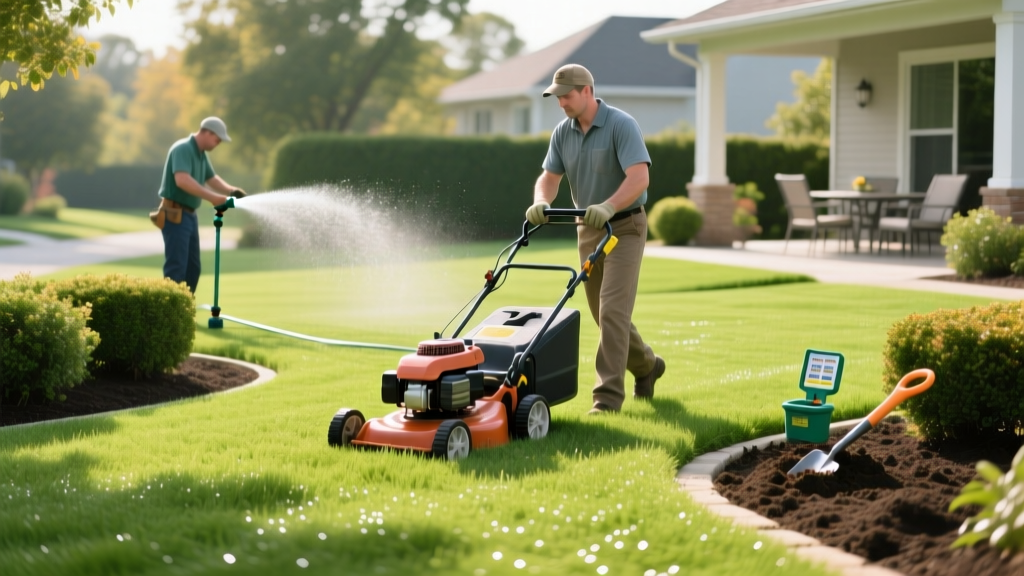
Core Lawn Care Practices: A Step-by-Step Seasonal Maintenance Guide
Amateur lawn maintenance relies on guesswork; professional lawn care practices rely on agronomic data, precise timing, and calibrated equipment. Transitioning from basic mowing to a comprehensive turf management program requires understanding the biological needs of your specific grass species. Whether you are managing a cool-season Tall Fescue lawn in the transition zone or a warm-season Zoysia stand in the deep south, executing the correct procedures in the proper sequence is the difference between a surviving lawn and a thriving one.
Step 1: Soil Diagnostics and Base Amendment
Before applying any fertilizer or seed, you must understand your soil's chemical baseline. Guessing your soil's pH leads to nutrient lockout, where expensive fertilizers remain unavailable to the turf's root system.
Executing a Professional Soil Test
Skip the cheap analog probes from the hardware store. Collect 5 to 7 core samples (4 inches deep) from across your lawn using a clean stainless steel soil probe. Mix them in a plastic bucket, let the soil air-dry, and send a 2-cup sub-sample to a reputable lab like Logan Labs or your local university extension. Expect to pay between $25 and $35 for a standard agronomic analysis.
Target pH Parameters:
- Cool-Season Grasses (Fescue, Kentucky Bluegrass): 6.2 to 6.8
- Warm-Season Grasses (Bermuda, Zoysia, Centipede): 5.8 to 6.5
If your pH is below 5.8, apply pelletized calcitic limestone at a rate of 25-50 lbs per 1,000 sq ft to raise it. If above 7.2, apply elemental sulfur at 5-10 lbs per 1,000 sq ft to lower it. Always base exact application rates on the SMP Buffer pH reading from your lab report, not just the active pH.
Step 2: Precision Mowing Protocols
Mowing is the most frequent lawn care practice, yet it causes the most mechanical stress to the plant. The objective is to maximize leaf surface area for photosynthesis while maintaining a dense canopy that shades out weed seeds.
The One-Third Rule and Blade Calibration
Never remove more than one-third of the leaf blade in a single mowing. Removing more shocks the plant, forcing it to divert energy from root growth to shoot recovery. For a Tall Fescue lawn maintained at 3.5 inches, you must mow when the grass reaches 5.25 inches. During peak spring growth, this may require mowing every 4 days.
Blade sharpness is non-negotiable. A dull mower blade tears the grass tip, creating a ragged edge that loses moisture and invites fungal pathogens like Dollar Spot. Sharpen rotary mower blades every 25 hours of operation. If you are managing a warm-season lawn like Bermuda or Zoysia under 1.5 inches, transition from a rotary mower (like the Toro Recycler) to a reel mower (like the McLane 20-inch) to prevent scalping the uneven soil surface.
Step 3: Strategic Irrigation and Moisture Management
Overwatering is responsible for more turf mortality and fungal outbreaks than underwatering. Modern lawn care practices dictate deep, infrequent watering to drive root growth downward into the soil profile.
Calculating Precipitation Rates
Most lawns require 1 to 1.5 inches of water per week during active summer growth, including rainfall. However, knowing how long to run your sprinklers requires understanding your system's precipitation rate. Standard spray heads output roughly 1.5 inches per hour, while rotary nozzles (like the Hunter MP Rotator) output only 0.4 inches per hour.
| Grass Type | Weekly Water Need (Summer) | Optimal Watering Frequency | Drought Dormancy Threshold |
|---|---|---|---|
| Kentucky Bluegrass | 1.2 - 1.5 inches | 2x per week (deep soak) | 21 days without water |
| Tall Fescue | 1.0 - 1.2 inches | 1x to 2x per week | 30 days without water |
| Bermudagrass | 0.8 - 1.0 inches | 1x per week | 45+ days without water |
| Zoysiagrass | 0.5 - 0.8 inches | 1x per week | 45+ days without water |
According to the University of Minnesota Extension, watering deeply but infrequently encourages roots to grow 6 to 8 inches deep, whereas daily light watering keeps roots in the top inch of soil, making the turf highly susceptible to heat stress. Pair your system with a smart controller like the Rachio 3, which utilizes local weather station data to automatically skip cycles during rain events and adjust run times based on seasonal evapotranspiration rates.
Step 4: Nutrient Loading and Weed Defense
Fertilization and weed control are two sides of the same coin. A thick, aggressively growing turf canopy is the most effective pre-emergent herbicide available. However, synthetic inputs are often required to maintain this density.
Fertilizer Selection and Timing
Look for fertilizers with a high percentage of slow-release nitrogen (methylene urea, sulfur-coated urea, or polymer-coated urea). Fast-release synthetic nitrogen (urea or ammonium sulfate) causes rapid, weak top-growth that requires frequent mowing and increases disease susceptibility. A professional-grade product like Lesco 24-0-11 with 50% slow-release nitrogen costs roughly $45 for a 50lb bag, covering 12,000 sq ft at a rate of 1lb of nitrogen per 1,000 sq ft.
Warning: Pre-Emergent Timing
Applying pre-emergent herbicides like Prodiamine (Barricade) or Dithiopyr (Dimension) based on the calendar is a critical failure point. These chemicals must be applied when soil temperatures at a 2-inch depth consistently reach 55°F for three consecutive days. Use a digital soil thermometer or track local soil temp data via the EPA's turf management resources. Applying too early wastes the chemical's half-life; applying too late allows crabgrass germination.
Step 5: Aeration and Overseeding Mechanics
Soil compaction restricts oxygen flow to the rhizosphere and prevents water infiltration. Core aeration physically removes 3-inch soil plugs, alleviating compaction and creating micro-environments for new seed.
Executing the Renovation Protocol
- Mark Utilities: Always call 811 to mark shallow utility lines before renting a heavy walk-behind core aerator (like a Billy Goat or Classen model, typically $120-$180 for a half-day rental).
- Double Pass: Make two passes over the lawn in perpendicular directions. Aim for 20-40 holes per square foot.
- Overseed Immediately: For Tall Fescue, apply 5 to 8 lbs of seed per 1,000 sq ft directly into the aeration holes. Use a mix containing at least three different cultivars (e.g., Titanium 2LS, Falcon IV, and Raptor III) to ensure genetic diversity against disease.
- Starter Fertilizer: Apply a high-phosphorus starter fertilizer (like Scotts Turf Builder Starter 24-25-4) to accelerate root development of the new seedlings. Phosphorus is heavily restricted in many states for established lawns, but legally permitted and biologically necessary for new seed establishment.
- Moisture Maintenance: Keep the top inch of soil consistently moist (watering lightly 2-3 times a day) for 14-21 days until germination is complete, then transition back to deep, infrequent watering.
Troubleshooting Common Practice Failures
Even with meticulous execution, environmental variables can disrupt your lawn care practices. Use this diagnostic matrix to correct course.
| Symptom | Probable Cause | Corrective Action |
|---|---|---|
| Circular brown patches with smoke-ring borders in high heat | Brown Patch fungus (Rhizoctonia solani) | Apply Azoxystrobin (Heritage G) at 2.5 lbs/1000 sq ft. Water only in the early morning. |
| Footprints remain visible on grass for hours after walking | Severe moisture stress / Wilting | Apply 0.5 inches of water immediately. Check irrigation heads for clogged nozzles. |
| Yellowing grass blades with green veins in new growth | Iron Chlorosis (often due to high soil pH) | Apply chelated iron (Fe-EDDHA) as a foliar spray at 2-4 oz per 1000 sq ft. |
| Spongy feel underfoot, thatch layer > 0.5 inches | Excessive thatch buildup blocking water | Rent a power dethatcher (verticutter) in early fall. Set blades to penetrate 1/4 inch into soil. |
Implementing these core lawn care practices transforms turf management from a reactive chore into a proactive science. By anchoring your maintenance schedule to soil data, precise irrigation metrics, and calibrated nutrient loading, you build a resilient root system capable of withstanding the extremes of summer heat and winter dormancy.

