
Lawn Care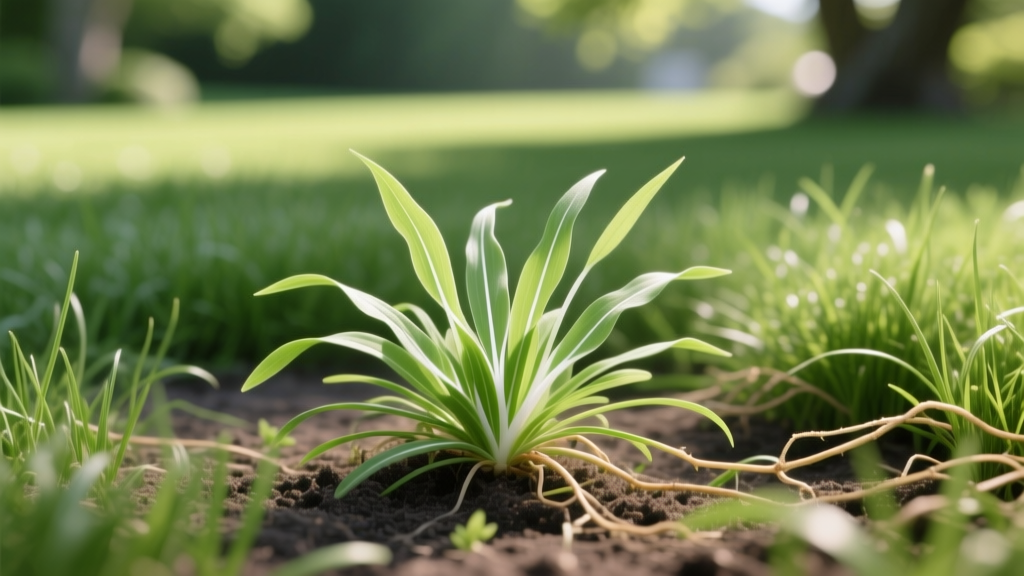
What Does Crab Grass Look Like? A Stage-by-Stage Identification Guide
The Biology of Invasion: Why Early Identification Matters
Crabgrass (Digitaria spp.) is an aggressive, warm-season annual weed that exploits thin turf, compacted soil, and high summer temperatures. Because it completes its entire lifecycle in a single year—germinating in spring, maturing in summer, and dying after the first frost—its primary survival strategy is prolific seed production. A single mature plant can generate up to 150,000 seeds. Understanding what crab grass looks like at every developmental stage is the only way to time pre-emergent and post-emergent herbicide applications correctly. Misidentifying it as a cool-season grass or a perennial weed leads to wasted chemicals and a compromised lawn.
Stage 1: The Seedling and Cotyledon Phase
Crabgrass germination is strictly temperature-dependent. According to University of Minnesota Turfgrass Science, seeds begin to sprout when soil temperatures at a 1-inch depth reach 55°F to 60°F for three to five consecutive days. This typically aligns with the blooming of forsythia bushes in early spring.
Visual Cues of the Seedling
- Cotyledon Leaf: The very first leaf to emerge is not a true grass blade. It is a cotyledon—short, pale green, rounded at the tip, and significantly wider than the emerging true leaves.
- First True Leaf: As the plant develops, the first true leaf emerges. It is distinctly light green, often a shade or two lighter than the surrounding desirable turf (like Kentucky bluegrass or tall fescue). The leaf blade is parallel-veined and slightly hairy, even in varieties that are classified as "smooth."
- Growth Habit: Unlike bunchgrasses that grow upward, crabgrass seedlings immediately exhibit a prostrate (low-lying) growth habit, hugging the soil surface to avoid mower blades.
Stage 2: Vegetative Growth (Smooth vs. Hairy)
Once established, crabgrass rapidly expands via tillering. In North America, homeowners primarily battle two species: Smooth Crabgrass (Digitaria ischaemum) and Hairy Crabgrass (Digitaria sanguinalis). While their management is identical, their physical characteristics differ at the collar region (where the leaf blade meets the stem).
| Feature | Smooth Crabgrass (D. ischaemum) | Hairy Crabgrass (D. sanguinalis) |
|---|---|---|
| Leaf Blade Surface | Mostly smooth, sparse hairs near the base | Densely covered in long, stiff white hairs |
| Ligule (Membrane) | Short (1-2 mm), membranous, toothed at the top | Tall (up to 3 mm), membranous, jagged edge |
| Stem Base Color | Often exhibits a distinct purplish or reddish tint | Typically pale green to white at the base |
| Mature Height | Shorter, rarely exceeds 6 inches if unmowed | Taller, can reach up to 12 inches in unmowed areas |
Stage 3: Maturity and Seed Head Formation
By mid-to-late summer, crabgrass transitions from vegetative growth to reproductive maturity. This is when it becomes most visually offensive to homeowners. The plant forms thick, sprawling mats that choke out desirable turf. The stems root at the nodes (stolons), allowing the weed to pull nutrients from multiple points in the soil.
The Panicle Seed Head
The most definitive visual identifier of mature crabgrass is its seed head. It produces a digitate panicle—a cluster of 3 to 13 slender, finger-like spikes that radiate outward from a single point on the main stem, resembling a bird's foot or an open umbrella. These spikes are lined with thousands of tiny, oval-shaped seeds. Initially green, the seed heads turn a dull, yellowish-brown as the seeds ripen in late August and September.
The "Pull Test" and Lookalike Decision Matrix
Homeowners frequently misidentify other grasses as crabgrass, leading to incorrect herbicide selection. Use this diagnostic framework to rule out common lookalikes before applying chemicals.
Diagnostic Decision Tree
- Suspect 1: Quackgrass (Elymus repens)
Visual Check: Quackgrass grows upright in distinct clumps and has a much coarser texture. It possesses "auricles" (small, claw-like appendages where the leaf meets the stem). Crabgrass completely lacks auricles.
The Pull Test: Grab the base and pull. Quackgrass is a perennial with deep, white, fleshy rhizomes that will snap and resist pulling. Crabgrass has shallow, fibrous roots and pulls up easily in a mat. - Suspect 2: Annual Bluegrass (Poa annua)
Visual Check: Poa annua is a cool-season weed that thrives in spring and fall, unlike the heat-loving crabgrass. Look at the leaf tip: Poa annua has a distinct "boat-shaped" or prow-shaped tip, while crabgrass tips are pointed.
Seed Head: Poa annua produces open, airy, whitish-green panicles, not the tight, finger-like spikes of crabgrass. - Suspect 3: Goosegrass (Eleusine indica)
Visual Check: Goosegrass has a distinct silver or whitish color at the very center of the plant's base. Its seed heads look like a zipper, with seeds arranged in two distinct rows along the spike, whereas crabgrass seeds are clustered haphazardly.
Actionable Eradication: Chemical Timelines and Rates
Identifying the weed is only half the battle. Eradication requires precise chemical timing based on the plant's current visual stage. According to University of Missouri Extension, applying the wrong active ingredient at the wrong growth stage will result in total control failure.
Pre-Emergent Specifications (Before Seedlings Appear)
Pre-emergents do not kill seeds; they create a chemical barrier in the top 1-2 inches of soil that inhibits cell division (microtubule formation) in the emerging root radicle.
- Prodiamine 65 WDG (Active Ingredient: Prodiamine): Apply at a rate of 0.4 oz per 1,000 sq ft for 3 to 4 months of residual control. Cost is approximately $45 for a 5 oz bottle. Must be watered in with 0.5 inches of irrigation within 48 hours to activate the soil barrier.
- Dimension 2EW (Active Ingredient: Dithiopyr): Apply at 0.5 oz per 1,000 sq ft. Dithiopyr is unique because it offers early post-emergent control. If you miss the pre-emergent window and spot 1-leaf crabgrass seedlings, Dimension will still kill them. Cost averages $60 for a half-gallon jug.
Post-Emergent Specifications (Visible Vegetative Stage)
Once crabgrass has passed the 2-leaf stage, pre-emergents are useless. You must switch to systemic post-emergent herbicides.
- Drive XLR8 (Active Ingredient: Quinclorac): The industry standard for residential crabgrass control. Quinclorac acts as a synthetic auxin, causing uncontrolled, fatal growth (epinasty) in the weed. Apply at 0.54 oz per 1,000 sq ft. Critical Requirement: You must add a Methylated Seed Oil (MSO) surfactant at 0.5% v/v (approx. 0.6 oz per gallon of spray solution) to penetrate the waxy cuticle of the crabgrass leaf. Without MSO, control drops below 40%.
- Temperature Restrictions: Do not apply Quinclorac when ambient air temperatures exceed 85°F. High heat causes the herbicide to volatilize (turn into a gas), which can drift and severely damage desirable broadleaf plants and nearby ornamental shrubs.
Warning on MSMA: You may find older forum posts recommending MSMA (Monosodium methanearsonate) for crabgrass. MSMA is an organic arsenical that has been heavily restricted by the EPA. It is no longer legal for use on residential lawns and is strictly limited to golf courses and sod farms. Do not purchase or apply MSMA for home lawn care.
Cultural Prevention: Fixing the Root Cause
Crabgrass is an opportunistic invader. It requires high light intensity at the soil level to germinate. If your lawn is thin, crabgrass will exploit the gaps. To prevent future infestations without relying solely on herbicides:
- Increase Mowing Height: Raise your mower deck to 3.5 or 4 inches. Taller desirable turf shades the soil surface, dropping soil temperatures by up to 10°F and physically blocking the sunlight crabgrass seeds need to trigger germination.
- Deep, Infrequent Watering: Crabgrass has a shallow root system. Watering deeply (1 inch per week) encourages deep roots in your desirable turf while stressing the shallow-rooted crabgrass.
- Fall Overseeding: Apply tall fescue or Kentucky bluegrass seed in early fall. A dense turf canopy in the spring is the most effective biological pre-emergent available.

