
Lawn Care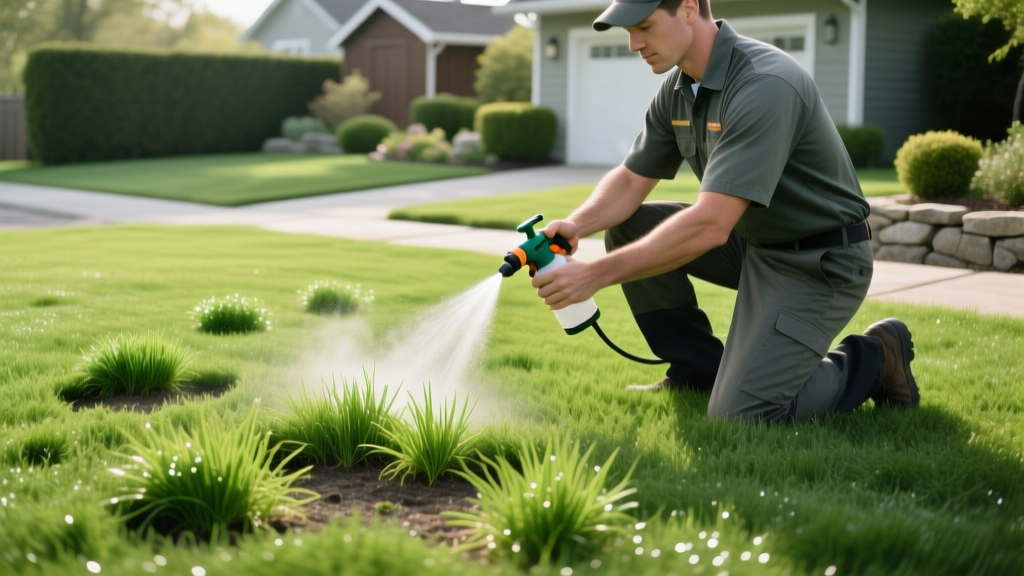
Stop Crabgrass Sprouting: Early Season Spot-Treatment Guide
The Thermal Trigger: When Crabgrass Sprouting Actually Begins
Crabgrass (Digitaria sanguinalis) does not germinate based on calendar dates or air temperature; it responds strictly to soil thermal thresholds. The initial phase of crabgrass sprouting begins when soil temperatures reach 50°F to 55°F for three to five consecutive days at a 1-inch depth. This typically occurs in early to mid-spring, depending on your hardiness zone, and coincides with the blooming of forsythia bushes.
Critical Germination Data:
- Initial Sprouting: 50°F - 55°F (1-inch soil depth)
- Peak Germination: 60°F - 70°F (Late spring / early summer)
- Germination Depth: 90% of seeds sprout from the top 0.5 inches of soil
- Moisture Requirement: Requires adequate soil moisture; drought delays sprouting even if temps are optimal
Because crabgrass sprouting happens in localized flushes rather than all at once, blanket applications of post-emergent herbicides are economically inefficient and chemically taxing on your turf. Spot-treating the exact zones where sprouting occurs—such as along heat-retaining driveways, sidewalks, and south-facing slopes—is the most effective strategy. According to University of Minnesota Turf Science, targeting these microclimates before the weed establishes a deep taproot reduces seasonal herbicide volume by up to 60%.
Spot-Treatment Arsenal: Pre-Emergent vs. Early Post-Emergent
When you observe the first crabgrass sprouting in your lawn, you are in a transitional window. You can still apply certain pre-emergents that offer early post-emergent activity, or switch to dedicated early post-emergents. Choosing the right chemistry depends entirely on your turfgrass species and the exact growth stage of the weed.
| Active Ingredient | Brand Example | Target Stage | Est. Cost (2026) | Turf Safety |
|---|---|---|---|---|
| Dithiopyr | Dimension 2EW | Pre-emergent & 1-leaf post | $75 / 2.5 gal | KBG, Fescue, Bermuda, Zoysia |
| Quinclorac | Drive XLR8 | 1-leaf to 3-leaf post | $130 / 2.5 gal | KBG, Fescue, Bermuda (Avoid St. Aug) |
| Mesotrione | Tenacity | Pre-emergent & early post | $60 / 4 oz | KBG, Fescue, St. Aug (Avoid Bermuda) |
If crabgrass sprouting has already pushed past the 1-leaf stage, Dithiopyr will fail as a post-emergent. You must transition to Quinclorac or Mesotrione. However, Mesotrione causes severe bleaching on Bermudagrass, while Quinclorac will severely damage St. Augustine and Centipede grass. Always cross-reference your turf type before mixing.
The 3-Leaf Rule: Executing the Spot Treatment
The efficacy of post-emergent spot treatments drops precipitously once crabgrass reaches the 4-leaf stage and begins tillering (growing lateral shoots). At the 1-leaf to 3-leaf stage, the weed's vascular system is actively pulling nutrients—and herbicides—down into the root zone. Follow this exact protocol for spot-treating early sprouts:
- Map the Flush: Walk your lawn in the early morning when dew highlights the lighter green, lime-colored blades of young crabgrass against your darker turf. Mark heavy patches with landscaping flags.
- Mow First: Mow your lawn 24 to 48 hours before application. This removes excess turf canopy, ensuring the herbicide directly contacts the crabgrass leaves rather than being intercepted by your desirable grass.
- Mix the Tank: For Quinclorac (Drive XLR8), mix 0.75 fluid ounces per 1,000 square feet. For Mesotrione (Tenacity), mix 1/3 teaspoon per 1,000 square feet. Do not guess; use a dedicated measuring syringe.
- Add the Surfactant: This is where most homeowners fail. Tenacity requires a Non-Ionic Surfactant (NIS) at 0.25% v/v (1/2 oz per gallon of water). Quinclorac requires a Methylated Seed Oil (MSO) or Crop Oil Concentrate (COC) at 1% v/v (1.3 oz per gallon). Using NIS on Quinclorac will result in a 40% to 60% reduction in kill rate.
- Apply and Wait: Spray until the leaves are uniformly wet but not dripping. Do not mow for 48 hours post-application to allow full translocation of the active ingredient.
Pro Tip: When spot-treating near heat-retaining hardscapes where crabgrass sprouting is most aggressive, use a spray shield or a foam brush applicator to prevent herbicide drift onto adjacent ornamental flower beds, which are highly susceptible to Quinclorac damage.
Equipment Calibration and Tank-Mix Chemistry
Spot-treating requires precision. A standard hose-end sprayer is entirely inappropriate for early post-emergent applications due to fluctuating pressure and uneven distribution. Use a 1-gallon or 2-gallon pump sprayer or a backpack sprayer calibrated to deliver exactly 1.5 to 2.0 gallons per 1,000 square feet.
- Nozzle Selection: Swap the standard flat-fan nozzle for an Air Induction (AI) nozzle, such as the TeeJet AIXR11004. AI nozzles produce larger, heavier droplets that resist wind drift and penetrate the dense thatch layer where crabgrass sprouting originates.
- Water pH: Mesotrione (Tenacity) degrades rapidly in alkaline water. If your municipal water has a pH above 7.0, add a water conditioner or pH buffer to your tank before adding the herbicide. Aim for a tank pH of 5.0 to 6.0.
- Agitation: Both Quinclorac and Mesotrione can settle in the tank if left static. Shake your pump sprayer vigorously every 3 to 5 minutes during application to maintain a uniform suspension.
Troubleshooting Failed Applications
If your spot treatment fails to halt crabgrass sprouting, the issue is almost always tied to environmental timing or chemical antagonism. Use this diagnostic framework to correct the failure:
Symptom: Leaves curl but the weed recovers after 7 days
Cause: Application occurred during a temperature inversion or when air temperatures exceeded 85°F. High heat causes the weed to close its stomata to conserve water, halting the translocation of the herbicide to the roots.
Fix: Restrict all spot treatments to early morning (between 6:00 AM and 9:00 AM) when stomata are open and temperatures are below 80°F.
Symptom: Weed turns white but does not die (Mesotrione only)
Cause: Insufficient surfactant or application made to drought-stressed crabgrass. Mesotrione inhibits HPPD, causing bleaching, but without adequate MSO/NIS and plant hydration, the weed will eventually metabolize the chemical and recover.
Fix: Irrigate the lawn lightly the evening before your application to ensure the weed is actively growing. Verify your surfactant rate is exactly 0.25% v/v. A second application 14 days later is often required for mature 3-leaf sprouts.
Symptom: Herbicide washes off after afternoon rain
Cause: Ignoring rainfastness windows. Quinclorac requires a minimum of 2 hours of dry weather to become rainfast. Mesotrione requires 4 hours.
Fix: Consult the Penn State Extension turf guidelines for local microclimate forecasts. If rain is imminent within 6 hours, delay the application. Once rainfastness is achieved, subsequent irrigation actually aids in soil activation for any pre-emergent residuals in the mix.
Controlling crabgrass sprouting is a game of biological timing and chemical precision. By monitoring 1-inch soil temperatures, respecting the 3-leaf threshold, and matching the correct surfactant to your chosen active ingredient, you can eradicate early flushes before they establish the deep, drought-tolerant root systems that make summer crabgrass nearly impossible to kill.

