
Lawn Care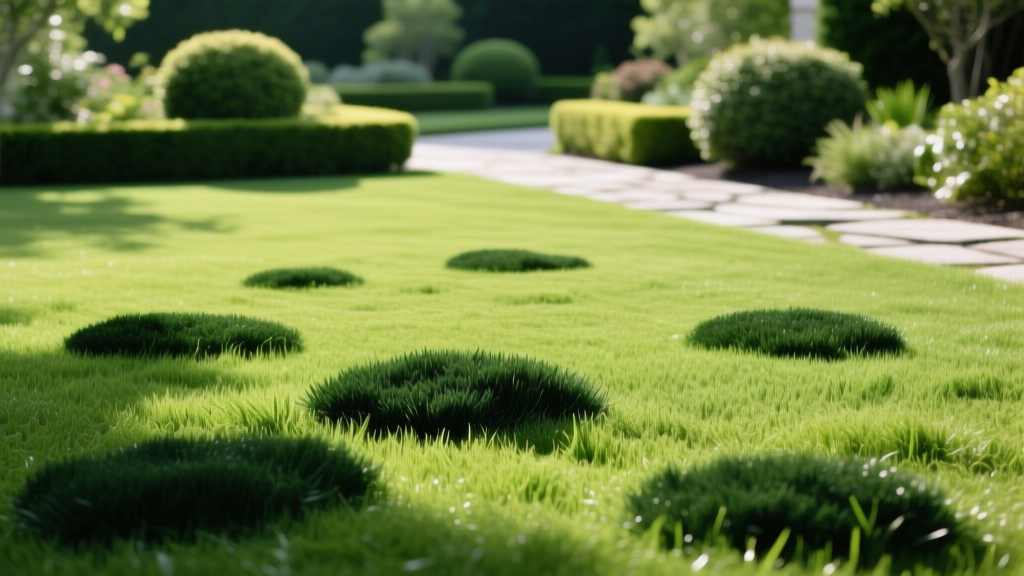
Dark Green Spots in Grass: 5 Causes and Rescue Fixes
The Diagnostic Framework: Identifying Your Specific Anomaly
When dark green spots in grass appear across your turf, you are looking at a localized biological or chemical anomaly. Unlike uniform yellowing, which points to systemic deficiencies, isolated dark green patches indicate a concentrated surplus of nitrogen, excessive moisture, or specific fungal activity. Misdiagnosing the root cause leads to wasted money on the wrong amendments. To execute the correct rescue fix, you must first classify the spot based on its geometric shape, soil texture, and surrounding turf condition.
Symptom 1: The "Bullseye" (Dog Urine Nitrogen Surge)
Visual Profile: A dark green outer ring (roughly 8 to 14 inches in diameter) often encircling a dead, brown, or straw-colored center.
The Science: A common misconception is that dog urine kills grass by altering soil pH. In reality, the damage is caused by a massive, localized surge of nitrogen salts and uric acid. The dead center is where the salt concentration was high enough to cause osmotic root burn. The dark green outer ring is where the nitrogen diluted just enough to act as a heavy fertilizer dose.
Rescue Protocol:
- Immediate Flushing: Within 12 hours of spotting fresh damage, apply 2 gallons of water per square foot to dilute the nitrogen salts below the root zone.
- Sodium Displacement: Apply pelletized gypsum (calcium sulfate) at a rate of 2 lbs per 100 square feet. The calcium binds with the sodium in the urine, allowing it to be flushed out of the soil profile without destroying soil structure.
- Reseeding: If the center is dead, rake out the necrotic tissue and overseed with urine-tolerant cultivars like RTF (Rhizomatous Tall Fescue) or Perennial Ryegrass, which handle nitrogen spikes better than Kentucky Bluegrass.
For long-term management, the Oregon State University Extension recommends training pets to use a designated mulch or gravel area, as dietary supplements marketed to "change urine pH" are largely ineffective and can cause canine urinary tract issues.
Symptom 2: The "Perfect Circle" (Type II Fairy Ring)
Visual Profile: A distinct, perfectly circular or arc-shaped band of dark green grass, sometimes accompanied by mushrooms at the perimeter, ranging from 3 feet to 30 feet in diameter.
The Science: Fairy rings are caused by basidiomycete fungi decomposing organic matter in the soil. As the fungal mycelium breaks down buried wood or thick thatch, it releases concentrated ammonia and nitrogen, creating the dark green band. In Type II fairy rings, the mycelium mat becomes so dense that it renders the soil hydrophobic (water-repellent), eventually choking the roots inside the ring.
Rescue Protocol:
- Deep Core Aeration: Use a standalone core aerator to pull 3-inch plugs spaced 2 inches apart directly over the dark green ring and 2 feet into the surrounding healthy turf. This physically fractures the hydrophobic mycelium mat.
- Wetting Agents: Apply a high-grade soil surfactant like Aquatrols Revolution (approx. $140 per gallon) or LescoAquify ($85 per gallon) at 3 oz per 1,000 sq ft. These block copolymers strip the waxy coating from the fungal threads, allowing water to penetrate the soil again.
- Targeted Fungicides: For severe outbreaks, apply a preventative fungicide containing azoxystrobin (e.g., Heritage TL or Syngenta Headway) at the curative rate of 0.4 to 0.8 fl oz per 1,000 sq ft. According to the University of Minnesota Extension, fungicides must be watered in immediately with 1/4 inch of irrigation to reach the soil-borne mycelium.
Symptom 3: The "Grid Pattern" (Spreader Overlap)
Visual Profile: Dark green stripes or a grid-like checkerboard pattern that aligns with your mowing or walking paths.
The Science: This is a mechanical application error. When using a drop spreader, overlapping the wheel tracks by even a few inches doubles the fertilizer application rate in those specific lines. While it rarely burns the grass immediately, the double dose of nitrogen causes rapid, lush, dark green growth that is highly susceptible to disease and drought stress.
Rescue Protocol:
- Immediate Mowing: Raise your mower deck by 1/2 inch and mow the dark stripes to remove the excessive, weak leaf tissue.
- Equipment Recalibration: Switch to a rotary spreader with edge-guard technology (like the Scotts EdgeGuard Mini) which throws fertilizer in a 180-degree swath, eliminating overlap. If you must use a drop spreader, calibrate it over a 10x10 ft tarp to measure exact output. The Penn State Extension provides the standard formula: (Ounces collected / Sq ft of tarp) x 1,000 = Application rate per 1,000 sq ft.
Symptom 4: The "Sponge Patch" (Buried Organic Decay)
Visual Profile: Irregular, amorphous dark green patches where the ground feels noticeably spongy or elevated underfoot.
The Science: During construction or landscaping, tree stumps, roots, or thick layers of sod were buried beneath the topsoil. As this subterranean wood decays, fungi break down the carbon-rich material, releasing a slow, continuous trickle of nitrogen to the grass above.
Rescue Protocol: There is no chemical fix for buried wood. You must physically excavate the area. Use a spud bar or digging bar to probe the soil. If you hit solid wood within 4 inches of the surface, dig out the decaying matter, backfill with native topsoil, and lay fresh sod to match the surrounding grade.
Symptom 5: The "Soggy Halo" (Irrigation Leak)
Visual Profile: A dark green spot that remains damp long after the rest of the lawn has dried, often accompanied by moss or algae at the periphery.
The Science: A slow leak at a sprinkler head joint or a misaligned nozzle creates a localized zone of perpetual saturation. The grass turns dark green due to constant moisture availability, but the shallow root system will eventually succumb to Pythium root rot or crown rot.
Rescue Protocol: Run a manual station test on your irrigation controller. Inspect the zone for weeping heads or low-head drainage. Install a check valve in the lowest sprinkler head on that zone (approx. $12 per valve) to prevent water from pooling at the lowest elevation point when the system is off.
Rescue Protocol Comparison Matrix
Use this decision matrix to quickly align your visual symptoms with the correct intervention strategy and budget expectations.
| Cause | Key Symptom Profile | Primary Rescue Action | Estimated Material Cost |
|---|---|---|---|
| Dog Urine Surge | Bullseye pattern; dead center, green ring | Flush with water; apply pelletized gypsum | $15 - $25 (Gypsum) |
| Type II Fairy Ring | Perfect circles; hydrophobic soil | Core aeration; apply soil surfactant | $85 - $140 (Wetting Agent) |
| Spreader Overlap | Linear stripes or grid patterns | Recalibrate equipment; switch to rotary | $0 - $60 (New Spreader) |
| Buried Wood Decay | Spongy, irregular patches; elevated soil | Physical excavation and backfilling | $20 - $40 (Topsoil/Sod) |
| Irrigation Leak | Perpetually damp; moss at edges | Install check valves; adjust nozzles | $12 - $30 (Check Valves) |
Long-Term Prevention Strategies
Once the immediate dark green spots in grass are neutralized, implement a baseline maintenance program to prevent recurrence. Transition from high-nitrogen, fast-release synthetic fertilizers (like urea) to slow-release, polymer-coated alternatives such as Polyon or Methylene Urea (MU). These coatings require microbial activity and soil temperature to break down, ensuring nitrogen is released uniformly rather than dumping in localized surges.
Additionally, maintain a thatch layer of exactly 1/2 inch. Thatch exceeding 3/4 inch provides the ideal carbon food source for fairy ring fungi and creates a hydrophobic barrier that exacerbates irrigation leaks. Perform annual dethatching with a power rake in early fall for cool-season grasses, or late spring for warm-season varieties like Bermuda and Zoysia, to keep the soil profile biologically balanced and visually uniform.

