
Lawn Care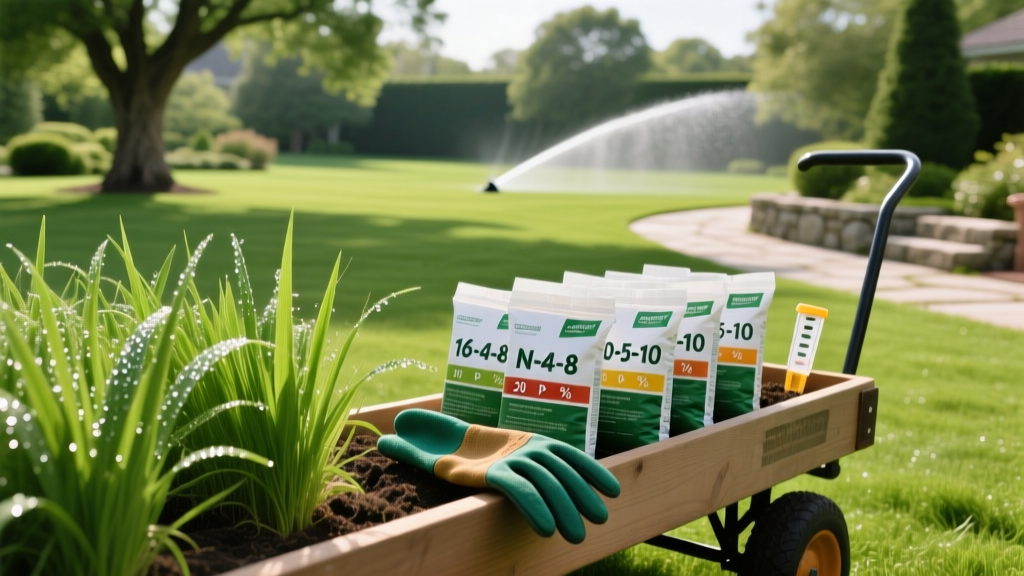
Fertilizer Numbers Meaning: Decoding N-P-K Ratios for Lawns
The Core Triad: What the First Three Numbers Actually Mean
Walk down the lawn care aisle of any hardware store, and you will see a dizzying array of bags plastered with three bold numbers. Understanding the fertilizer numbers meaning is the single most critical skill for turf health. These three digits represent the N-P-K ratio: the percentage by weight of Nitrogen (N), Phosphorus (P), and Potassium (K). They are always listed in this exact, legally mandated order.
Nitrogen (N): The Growth Engine
The first number represents Nitrogen, the primary driver of vegetative growth and chlorophyll production. Nitrogen dictates the deep, dark green color of your turf and its overall density. When a bag reads '24-5-11', it contains 24% Nitrogen. Cool-season grasses like Kentucky Bluegrass and Tall Fescue typically require 2.5 to 4 pounds of actual Nitrogen per 1,000 square feet annually, while warm-season grasses like Bermudagrass may require up to 4 pounds. A Nitrogen-deficient lawn will exhibit pale green or yellowing blades (chlorosis) starting at the older, lower leaves, accompanied by stunted vertical growth and thinning.
Phosphorus (P): The Root Builder
The middle number represents Phosphorus, expressed as P2O5 (phosphate). Phosphorus is vital for early root development, seed germination, and energy transfer within the plant cell. However, mature, established lawns rarely require supplemental Phosphorus because it binds tightly to soil particles and accumulates over time. Over-application leads to severe environmental consequences, specifically eutrophication in local waterways.
⚠ Regulatory Warning: The Phosphorus Ban
Due to watershed protection laws, many states (including New York, Michigan, Minnesota, and Washington) have banned the sale of Phosphorus-containing fertilizers for established lawns. In these regions, the middle number on standard lawn fertilizers will be '0' (e.g., 32-0-4) unless the product is specifically labeled for 'seed starting' or 'new lawn establishment', or accompanied by a verified soil test proving a deficiency.
Potassium (K): The Stress Shield
The third number is Potassium, expressed as K2O (potash). Potassium does not directly trigger top growth; instead, it regulates the plant's internal water pressure, enzyme activation, and cellular wall thickness. It is the ultimate 'armor' for your lawn, providing critical resistance against drought stress, winter freeze damage, foot traffic wear, and fungal diseases like brown patch. A lawn lacking Potassium will show necrotic (dead) tips and margins on the leaves, often described as 'scorched' edges, and will wilt rapidly under midday sun.
The Hidden Math: Calculating Actual Nutrient Weight
The most common mistake homeowners make is assuming a 50-pound bag of 20-5-10 fertilizer contains 20 pounds of Nitrogen. The fertilizer numbers meaning refers to percentages, not absolute weights. To determine the actual amount of nutrients you are applying, you must multiply the bag weight by the decimal equivalent of the N-P-K ratio.
Step-by-Step Calculation Framework
Let us break down a standard 50-pound bag of Lesco Professional 24-5-11 turf fertilizer:
- Nitrogen (24%): 50 lbs × 0.24 = 12 lbs of actual Nitrogen.
- Phosphorus (5%): 50 lbs × 0.05 = 2.5 lbs of actual Phosphate.
- Potassium (11%): 50 lbs × 0.11 = 5.5 lbs of actual Potash.
- Inert Filler: The remaining 30 pounds (60% of the bag) consists of inert carrier materials like limestone, sand, or clay, which ensure even distribution through your broadcast spreader.
If your lawn requires 1 pound of Nitrogen per 1,000 square feet, you would apply exactly 4.16 pounds of this specific product per 1,000 square feet (1 ÷ 0.24 = 4.16).
The Cost-Per-Pound Framework: Stop Overpaying for Filler
Retail marketing often obscures the true value of lawn treatments. To evaluate the financial efficiency of a fertilizer, ignore the total bag price and calculate the Cost Per Pound of Nitrogen (CPN). As of 2026, professional-grade synthetic fertilizers generally range from $2.50 to $4.50 per pound of Nitrogen, while organic or heavily coated slow-release options can push past $6.00.
| Product Example (50 lb Bag) | N-P-K Ratio | Lbs of N | Bag Price | Cost Per Lb of N |
|---|---|---|---|---|
| Scotts Turf Builder | 32-0-4 | 16.0 | $55.00 | $3.43 |
| Lesco Starter Fertilizer | 18-24-12 | 9.0 | $48.00 | $5.33 |
| Milorganite (Organic) | 6-4-0 | 1.8 (32lb bag) | $22.00 | $12.22 |
Note: While Milorganite has a high CPN, it provides significant soil microbiome benefits and micronutrients like Iron that synthetics lack. Always weigh CPN against secondary soil benefits.
Matching Ratios to Grass Types and Seasons
The ideal N-P-K ratio shifts dramatically depending on your turf species and the time of year. Applying a high-nitrogen, zero-potassium blend in late autumn will result in severe winter kill for cool-season grasses. According to turf management guidelines from the University of Minnesota Extension, timing and ratio alignment are non-negotiable for long-term turf survival.
Seasonal Ratio Cheat Sheet
- Early Spring (Pre-Emergent/Weed & Feed): 20-0-6. Moderate nitrogen to wake up the turf without pushing excessive blade growth that invites fungal pathogens; potassium to recover from winter.
- Late Spring/Early Summer: 24-0-11. Higher nitrogen for peak growing season; increased potassium to prepare the plant for impending summer heat stress.
- Late Summer/Fall (Winterizer): 10-0-20 or 8-2-16. Drastically reduced nitrogen to halt top growth; massive potassium surge to thicken cell walls, store carbohydrates in the roots, and prevent snow mold and freeze damage.
- Overseeding/Establishment: 18-24-12. The rare exception where the middle number (Phosphorus) is high to stimulate rapid root zone establishment for new seed.
The Fourth Number and Micronutrient Guarantees
Advanced turf managers know that the N-P-K numbers only tell half the story. Flip the bag over to read the 'Guaranteed Analysis' label. Here, you will often find a fourth number or a breakdown of secondary macronutrients and micronutrients.
Look specifically for Iron (Fe) and Sulfur (S). Iron is crucial for chlorophyll synthesis without triggering the aggressive vertical growth associated with Nitrogen. If your soil pH is above 7.0 (alkaline), Iron becomes chemically locked in the soil. In these cases, look for fertilizers containing chelated iron (like Fe-EDDHA), which remains available to the grass roots even in high-pH environments. Sulfur acts as a mild acidifier, slowly lowering soil pH over time while aiding in protein synthesis.
Water Insoluble Nitrogen (WIN)
Also on the back label is the WIN percentage. This tells you how much of the first number (Nitrogen) is coated or slow-release. A high-quality professional fertilizer should have a WIN of at least 40% to 50%. This ensures the Nitrogen feeds the lawn gradually over 8 to 12 weeks, preventing the massive 'flush and crash' growth cycle caused by cheap, highly soluble urea.
Why Guessing Fails: Calibrating with Soil Tests
Applying a standard 10-10-10 fertilizer based purely on the fertilizer numbers meaning without a soil test is a recipe for chemical imbalance and wasted capital. The UMass Amherst Extension strongly recommends baseline soil testing every three years. A professional soil test (typically costing $25 to $40 through university agronomy labs) will reveal your exact Phosphorus and Potassium reserves, your soil pH, and your Cation Exchange Capacity (CEC).
If your soil test reveals excessive Phosphorus levels (common in suburban lawns decades old), applying a fertilizer with a middle number greater than zero is not just illegal in many jurisdictions—it actively inhibits the grass's ability to absorb vital micronutrients like Zinc and Iron due to chemical antagonism in the root zone. Let the soil data dictate your N-P-K ratio, rather than relying on the marketing claims printed on the front of the bag.

