
Lawn Care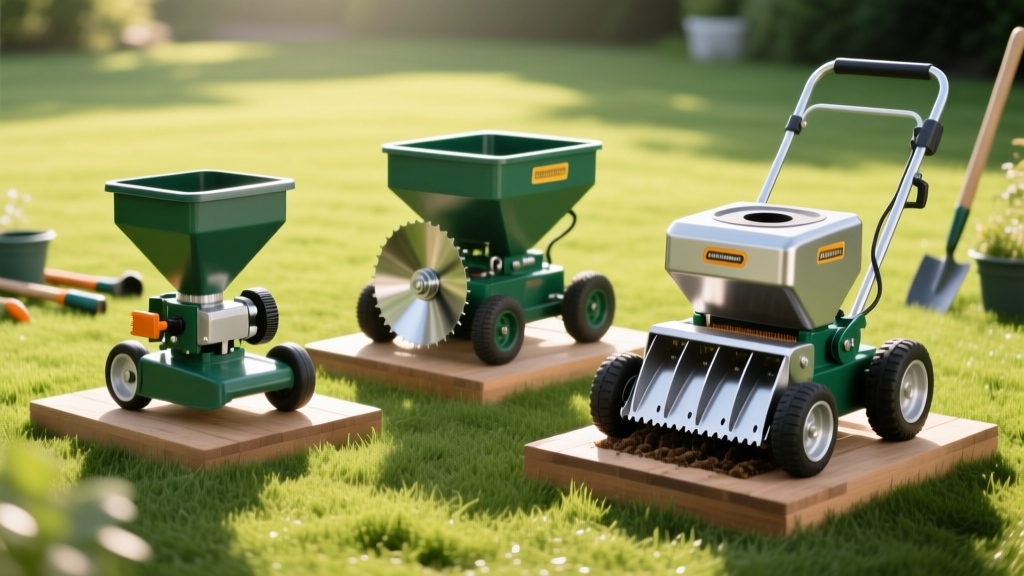
How to Define Seeder Types: Drop, Broadcast, and Slit Seeders
The Core Definition: What Separates a Seeder from a Spreader?
When homeowners and turfgrass managers define seeder equipment, they are drawing a distinct line between basic fertilizer spreaders and machines engineered specifically for seed distribution and soil engagement. While a standard rotary spreader is designed to fling granular synthetic fertilizers or pre-emergent herbicides across a surface, a dedicated seeder prioritizes seed-to-soil contact, precise volumetric calibration, and gentle handling of delicate seed coatings.
Grass seeds—particularly fine fescues and bentgrasses—are easily damaged by the aggressive impellers found in cheap fertilizer spreaders. Furthermore, true seeders often incorporate mechanical agitation systems designed to prevent the bridging and clumping common with organic, irregularly shaped seeds. Understanding how to properly categorize and select these machines is the first step in a successful lawn renovation.
Expert Insight: According to Penn State Extension, achieving proper seed-to-soil contact is the single most critical factor in germination success. A machine that merely drops seed onto existing thatch will result in a 40% to 60% germination failure rate compared to machines that integrate seed into the top 1/4 inch of soil.
Defining the Big Three: Broadcast, Drop, and Slit Seeders
To accurately define seeder categories for residential and commercial use, we must break them down by their delivery mechanisms. Each type serves a specific purpose depending on your lawn's current condition, the grass species you are planting, and your budget.
1. Broadcast (Rotary) Seeders
Broadcast seeders use a spinning horizontal disc to fling seed in a wide, fan-like pattern. High-end models, like the Lesco HPS-2000 or the Earthway EV-N-SPRED, feature adjustable side-shields and pneumatic tires to maintain consistent ground speed, which directly controls the application rate. These are best for overseeding large, open areas where precision edging is not a primary concern.
2. Drop Seeders
Drop seeders release seed directly downward through a series of metering holes along the bottom of the hopper. The Scotts Classic Drop Spreader is a common residential example. Because the seed falls in a strict, defined path matching the width of the hopper, drop seeders are ideal for seeding near garden beds, sidewalks, and property lines where stray seed would be wasteful or problematic.
3. Slit (Renovation) Seeders
When professionals define seeder equipment for severe lawn rehabilitation, they point to slit seeders. Machines like the Ryan RenovaThatch or Classen TS-20 utilize heavy, vertically rotating steel discs to slice 1/4-inch deep furrows into the soil, dropping the seed directly into the cuts before a trailing roller presses it in. This guarantees near-perfect seed-to-soil contact without requiring prior core aeration.
Equipment Comparison Matrix (2026 Market Data)
| Seeder Type | Primary Mechanism | Best Application | Avg. Price Range (2026) | Seed-to-Soil Contact |
|---|---|---|---|---|
| Broadcast (Push) | Spinning impeller disc | Overseeding large, open turf | $150 - $350 | Low (Requires prior aeration) |
| Drop (Push) | Gravity-fed metering holes | Precision seeding near hardscapes | $80 - $180 | Low (Requires prior aeration) |
| Slit / Slice (Walk-behind) | Steel cutting discs + drop tubes | Complete lawn renovation, bare dirt | $800 - $1,500 (or $65/day rental) | Excellent (Built-in) |
| Tow-Behind Broadcast | PTO or ground-driven impeller | Multi-acre properties, estates | $400 - $900 | Low (Requires prior aeration) |
Calibration: The Mathematics of Accurate Seeding
A seeder is only as effective as its calibration. Applying too much seed leads to overcrowding, fungal disease, and wasted capital; applying too little results in thin, weed-prone turf. The University of Minnesota Turfgrass Science program recommends the "100 Square Foot Test" for precise calibration.
Step-by-Step Calibration Protocol
- Measure a Test Area: Mark off a 10 ft x 10 ft (100 sq ft) section of your driveway or lay down a tarp.
- Weigh the Seed: Calculate the required seed for 100 sq ft based on the bag's recommendation. For example, if the bag suggests 8 lbs per 1,000 sq ft, you need exactly 0.8 lbs (12.8 oz) for your test area.
- Load and Weigh: Place the 12.8 oz of seed into the empty hopper. Weigh the entire seeder plus the seed on a digital scale.
- Execute the Pass: Push the seeder over the 100 sq ft area at your normal walking pace (roughly 3 mph).
- Re-weigh: Weigh the seeder again. The difference in weight is the exact amount of seed applied. Adjust the micrometer dial up or down and repeat until the weight loss matches your target.
Warning: Never calibrate a seeder on bare dirt or existing grass. The friction and bounce of the drive wheel on soil will alter your ground speed and skew the application rate. Always calibrate on a smooth, hard surface like asphalt or concrete.
Equipment Maintenance and Winterization
Seed coatings, particularly the graphite and limestone dust used on commercial turfgrass varieties, are highly abrasive and hygroscopic (moisture-attracting). Failing to clean a seeder after use will result in seized agitators and rusted metering gates within a single season.
Post-Use Cleaning Regimen
- Hopper Evacuation: Never leave seed in the hopper overnight. Empty all residual seed into a sealed, rodent-proof container.
- Dry Brushing: Use a stiff-bristled nylon brush to remove seed dust from the agitator bar and metering holes. Do not use compressed air or water, as moisture will turn the graphite dust into a concrete-like paste that binds moving parts.
- Lubrication: Apply a dry PTFE (Teflon) spray lubricant to the hopper gates, agitator shaft, and drive wheel gears. Avoid wet petroleum-based oils like WD-40, which attract dirt and seed dust.
Drive Wheel and Gearbox Care
The gearbox translates the rotation of the drive wheel into the spinning of the impeller or agitator. On push models, check the plastic or metal gears annually for stripped teeth. If your seeder features pneumatic tires, maintain them at 15-20 PSI; under-inflated tires reduce the wheel's circumference, causing the seeder to travel slower and drop significantly more seed per square foot than calibrated.
Troubleshooting Common Seeder Failures
Even well-maintained equipment experiences mechanical hiccups. Use this diagnostic framework to identify and resolve operational issues in the field.
| Symptom | Probable Cause | Corrective Action |
|---|---|---|
| Seed flows on one side but not the other | Clogged metering gate or uneven hopper distribution | Clear debris from the gate; ensure the hopper baffle is centered. |
| Application rate is too heavy despite correct dial setting | Drive wheel slipping or under-inflated tires | Inflate tires to 20 PSI; clean mud/debris from the drive wheel tread to restore traction. |
| Agitator bar is not turning, seed is bridging in hopper | Sheared cotter pin or stripped gearbox gear | Inspect the shear pin connecting the axle to the gearbox; replace with a manufacturer-specified pin (never use a hardened steel bolt, which will destroy the gearbox if it jams). |
| Uneven, streaky germination pattern in the lawn | Inconsistent walking speed or overlapping passes incorrectly | Use a GPS-guided smartphone app or physical marking flags to ensure exact 50% overlap on broadcast passes. |
By understanding how to properly define seeder mechanics, calibrate their output, and maintain their intricate moving parts, you transition from simply scattering seed to executing a precision agricultural operation on your home lawn. This level of detail is what separates a patchy, weed-filled yard from a dense, professional-grade turfgrass canopy.

