
Lawn Care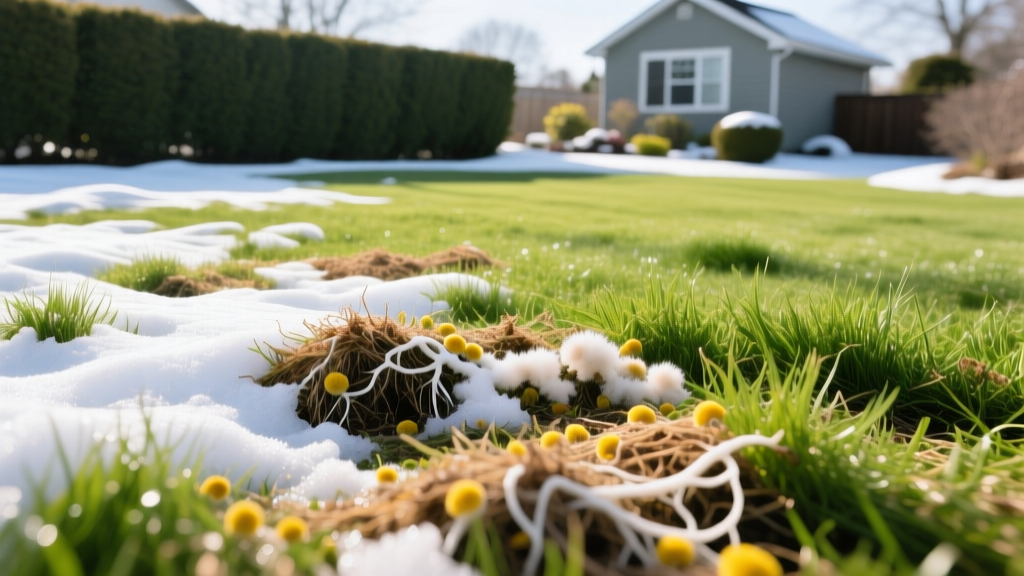
Delayed Leaf Cleanup: Diagnosing and Fixing Snow Mold Damage
Skipping autumn leaf cleanup or delaying it until spring is not merely an aesthetic oversight; it is a primary catalyst for severe turf pathology. When deciduous canopies drop, trapped moisture and zero sunlight create an anaerobic incubator for destructive fungal pathogens. According to research from the University of Minnesota Turfgrass Science program, lawns buried under wet leaf litter for more than four weeks during winter experience up to 40% crown tissue mortality due to anoxia and snow mold proliferation.
The Pathology of Trapped Leaves: Why Your Turf is Suffocating
Leaves act as an impermeable vapor barrier. When wet, a standard oak leaf can weigh up to three times its dry weight, physically crushing the delicate crown tissue of cool-season grasses like Kentucky bluegrass (Poa pratensis) and tall fescue (Festuca arundinacea). Beneath this mat, the microclimate remains at near 100% humidity. This prevents the turf from undergoing essential winter hardening (acclimation), leaving the cellular structure vulnerable to freeze-thaw ruptures and opportunistic fungi.
Diagnosing the Damage: Symptom-to-Pathogen Matrix
Before applying any treatment, you must accurately diagnose whether the damage is fungal or purely mechanical. Misidentifying physical smothering as a fungal infection leads to unnecessary chemical applications and wasted budget. Use this diagnostic matrix to identify the exact failure mode in your lawn.
| Visual Symptom | Primary Cause / Pathogen | Conditions Favoring Spread | Targeted Solution |
|---|---|---|---|
| Matted, grayish-white webbing over circular patches (1-3 feet wide) | Gray Snow Mold (Typhula incarnata) | Prolonged snow cover over un-raked leaves; late fall nitrogen spikes | Mechanical raking to break crust; time (fungus dies when turf dries) |
| Pinkish-white or salmon-colored mycelium at the leading edge of dead patches | Pink Snow Mold (Microdochium nivale) | Cold, wet conditions without snow; heavy leaf mats trapping moisture | Apply Azoxystrobin (0.72%) or Propiconazole (14.3%) fungicide |
| Brown, flattened blades with no visible fungal webbing or mycelium | Physical Anoxia (Smothering) | Heavy, wet sycamore/oak leaves left for 3+ weeks blocking photosynthesis | Dry-weather extraction followed by core aeration and spring overseeding |
Equipment Selection: CFM and Vacuum Metrics for Heavy Canopies
Standard residential electric blowers (typically rated under 400 CFM) fail to extract wet, matted leaves from dense turf without causing severe operator fatigue and incomplete extraction. For effective late-season leaf cleanup, you must match your equipment to your specific canopy density and yard size.
For Yards Over 0.5 Acres with Heavy Oak/Sycamore Drop
- Commercial Leaf Vacuums: The Billy Goat KV650H (approx. $3,800) features a 6.5 HP Honda engine and a specialized turf-friendly nozzle that lifts matted leaves without scalping the grass crown. This is the only viable solution for properties with mature oak trees where leaves interlock and mat down after heavy rain.
- High-CFM Backpack Blowers: The Echo PB-770T (75.6cc engine, 765 CFM, approx. $650) provides the sheer air volume required to break the surface tension of wet leaf mats. The key metric here is CFM (Cubic Feet per Minute), not just MPH. High MPH with low CFM will merely blow dry top leaves while leaving the wet bottom layer intact.
For Yards Under 0.5 Acres (Mulching Strategy)
- Recycling Mowers: The Toro Super Recycler 22-inch (approx. $450) utilizes a Vortex chamber to suspend leaves and chop them into sub-5mm particles. Crucial Caveat: This only works if the leaf layer is less than 1 inch thick and relatively dry. Attempting to mulch 3 inches of wet maple leaves will result in a clumped, anaerobic sludge that accelerates snow mold.
Thatch Accumulation vs. Leaf Litter: Identifying the True Barrier
Homeowners frequently confuse a mat of decomposing leaves with true thatch. True thatch is a tightly intermingled layer of living and dead stems, stolons, and roots that develops between the green vegetation and the soil surface. Leaf litter, conversely, sits on top of the thatch layer. If your lawn has a thatch layer exceeding 0.5 inches, late-season leaf cleanup becomes exponentially more difficult. The leaves become physically tangled in the fibrous thatch matrix, making standard blowing ineffective. In these scenarios, you must perform a mechanical dethatching (power raking) pass in early spring to rip out the intertwined leaf-thatch mat before the turf breaks dormancy. Failure to distinguish between the two will result in endless raking that only removes surface leaves while leaving the suffocating sub-layer intact.
Gas vs. High-Voltage Battery Blowers for Wet Extraction
As of 2026, the battery-powered outdoor power equipment market has matured significantly, but physics still dictates leaf cleanup efficacy. For dry, fluffy maple leaves, an 80V lithium-ion blower (like the EGO Power+ LB6504, producing 650 CFM) is more than adequate and offers zero-emission operation. However, for the specific problem of extracting wet, matted oak leaves trapped in dense thatch, gas-powered 2-stroke engines still hold a distinct advantage in sustained torque and air volume. Battery blowers often experience thermal throttling after 10 minutes of continuous high-load use, reducing their CFM output by up to 20% just as you are tackling the heaviest, wettest mats in low-lying yard zones. If your primary problem is heavy, wet canopy drop, a 75cc+ gas backpack unit remains the superior diagnostic and remediation tool.
Step-by-Step Remediation for Severely Matted Lawns
If you are diagnosing a lawn in early spring that was neglected during the fall, follow this strict remediation protocol to salvage the turf before the summer stress period.
- Dry-Weather Extraction (Days 1-3): Never use a metal thatch rake or stiff broom on wet, dormant turf. The crowns are brittle, and mechanical agitation will tear the plant from the soil. Wait for a 48-hour dry window with low humidity, then use a high-CFM blower or a soft-tine lawn sweeper to remove the bulk of the debris.
- Targeted Fungicide Application (Days 4-7): If the diagnostic matrix confirms active Pink Snow Mold (Microdochium nivale), apply a systemic fungicide containing Propiconazole 14.3% (e.g., Banner MAXX) at a rate of 2.0 fl oz per 1,000 sq ft. Water in lightly with 0.1 inches of irrigation to move the active ingredient into the thatch layer where the pathogen resides.
- Core Aeration and Topdressing (When Soil Hits 50°F): Once soil temperatures consistently reach 50°F at a 2-inch depth, perform deep-tine core aeration (pulling 3-inch plugs). This relieves the soil compaction caused by the heavy, wet leaf litter and restores oxygen to the root zone. Follow immediately with a 1/4-inch layer of screened compost topdressing to introduce beneficial microbes that outcompete residual fungal spores.
Critical Warning: The Pre-Winter Nitrogen Trap
Applying high-nitrogen, quick-release fertilizers (like Urea 46-0-0) in late October to promote green color before winter forces the turf to retain excess cellular water. When combined with poor leaf cleanup, this succulent, hydrated tissue becomes the perfect food source for snow mold pathogens. Guidelines from Penn State Extension emphasize switching to zero-nitrogen, potassium-rich winterizers (e.g., 0-0-25) if leaf extraction is delayed.
Preventative Timing: The 50-Degree Soil Temperature Rule
The ultimate solution to leaf-induced lawn damage is precise timing. Your final, exhaustive leaf cleanup must be completed before soil temperatures at a 2-inch depth consistently drop below 50°F. This is the biological threshold where cool-season grasses cease active top-growth and enter winter dormancy. Leaving even a 20% canopy cover of leaves past this thermal threshold guarantees localized anoxia and fungal incubation. Invest in a basic soil probe thermometer ($15-$25) to track this metric rather than relying on ambient air temperature or calendar dates, which vary drastically by microclimate and soil composition.

