
Lawn Care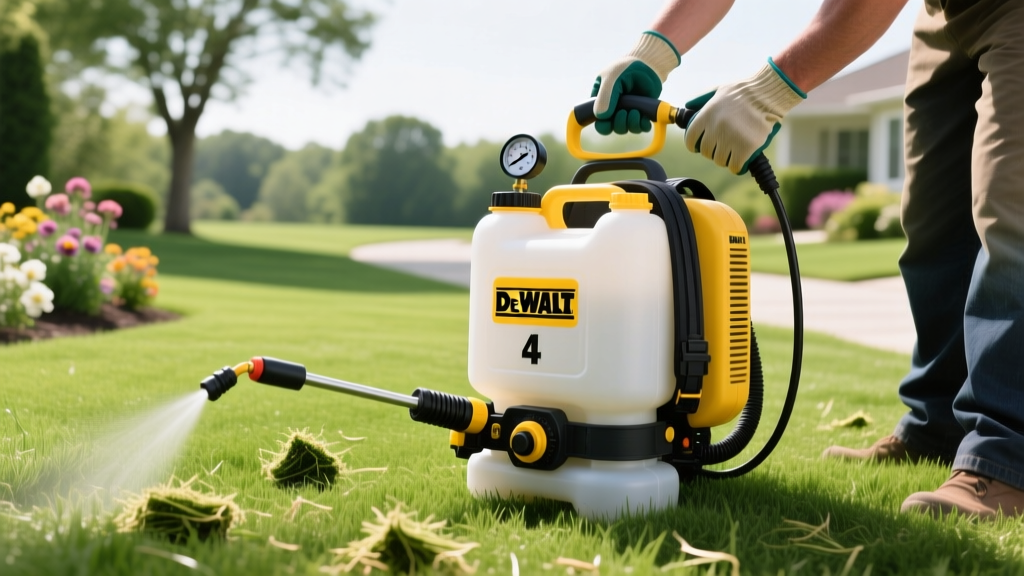
DeWalt 4 Gallon Backpack Sprayer: Dosage, Coverage & Cost Guide
The DeWalt 40V MAX 4-Gallon Backpack Sprayer (Model DXSP10202) has disrupted the professional and high-end residential lawn care market by replacing manual hand-pumping with a brushless, battery-powered diaphragm pump. While the tool promises consistent pressure and reduced fatigue, achieving precise chemical application requires a strict understanding of flow rates, nozzle selection, and calibration. Misjudging your dosage by even 10% can result in turf burn from concentrated herbicides or ineffective pest control.
This guide provides the exact mathematical frameworks, coverage metrics, and 2026 cost analyses required to operate the DeWalt 4 gallon backpack sprayer with commercial-grade precision.
DeWalt 4 Gallon Backpack Sprayer Coverage Metrics
Coverage is dictated by three variables: tank capacity (4 gallons / 512 ounces), nozzle flow rate (GPM), and your walking speed. The DeWalt DXSP10202 features a variable pressure dial ranging from 15 to 40 PSI. Operating at higher pressures atomizes the liquid into finer droplets, which increases coverage area but drastically increases the risk of chemical drift.
Pro Tip: The 2.5 MPH Standard
Most agricultural and turf calibration standards assume a walking speed of 2.5 to 3.0 miles per hour. If you walk slower (e.g., 2.0 MPH) while spot-treating weeds, your sprayer will apply 30-50% more chemical per square foot than the label intends unless you reduce the PSI or switch to a lower-flow nozzle.
Most agricultural and turf calibration standards assume a walking speed of 2.5 to 3.0 miles per hour. If you walk slower (e.g., 2.0 MPH) while spot-treating weeds, your sprayer will apply 30-50% more chemical per square foot than the label intends unless you reduce the PSI or switch to a lower-flow nozzle.
Baseline Coverage Table (TeeJet XR11004 Nozzle at 3 MPH)
| Pressure (PSI) | Flow Rate (GPM) | Coverage per Full Tank (Sq Ft) | Gallons Per Acre (GPA) |
|---|---|---|---|
| 15 PSI | 0.60 GPM | 6,200 sq ft | 28.5 GPA |
| 25 PSI | 0.80 GPM | 4,650 sq ft | 38.0 GPA |
| 40 PSI | 1.05 GPM | 3,540 sq ft | 50.0 GPA |
For standard broadleaf herbicides (like Trimec or SpeedZone), a rate of 1.5 gallons per 1,000 square feet is typical. At 25 PSI, a full 4-gallon tank of the DeWalt sprayer will cover approximately 2,666 square feet of turf.
Chemical Dosage & The 1/128th Acre Calibration Method
Never rely on the factory pressure dial alone. To ensure your DeWalt 4 gallon backpack sprayer is applying the exact dosage required by the chemical manufacturer, you must perform the Ounce Calibration Method (also known as the 1/128th acre method). This method, endorsed by Penn State Extension, directly translates ounces caught in a jar to gallons applied per acre.
Step-by-Step Calibration Protocol
- Mark the Test Area: Measure out 340.3 square feet (this is exactly 1/128th of an acre). For a 10-foot wide swath, mark a distance of 34 feet. For a 5-foot wide swath, mark 68 feet.
- Fill with Water: Fill the DeWalt DXSP10202 tank with clean water only. Set your pressure dial to your target operating PSI (e.g., 30 PSI).
- Spray the Area: Walk at your normal, comfortable application pace and spray the marked 340.3 sq ft area using your intended nozzle setup.
- Measure the Deficit: Use a graduated measuring cylinder to pour water back into the tank until it is completely full to the brim again.
- Calculate the Dosage: The number of fluid ounces of water you added equals the gallons per acre (GPA) your sprayer is applying. If you added 40 ounces of water, your sprayer applies 40 GPA.
Warning: PPE Requirements
Even when calibrating with water, always wear your standard Personal Protective Equipment (PPE) to build consistent muscle memory. When handling active chemicals, the CDC NIOSH guidelines mandate chemical-resistant gloves, long sleeves, and protective eyewear to prevent dermal absorption and ocular splash hazards.
Even when calibrating with water, always wear your standard Personal Protective Equipment (PPE) to build consistent muscle memory. When handling active chemicals, the CDC NIOSH guidelines mandate chemical-resistant gloves, long sleeves, and protective eyewear to prevent dermal absorption and ocular splash hazards.
Mixing Math for the 4-Gallon Tank
Once you know your GPA, calculate the chemical needed for a 4-gallon batch using this formula:
(Target GPA / 43,560 sq ft) * 4 Gallons = Chemical Rate per Tank
Example: If a pre-emergent label requires 2.0 ounces of product per 1,000 sq ft, and you are applying 1.5 gallons of carrier water per 1,000 sq ft, your 4-gallon DeWalt tank (covering 2,666 sq ft) requires exactly 5.33 ounces of chemical.
Cost Analysis: Is the DeWalt 4-Gallon Worth the Investment?
Transitioning from a $60 manual pump sprayer to a battery-powered DeWalt system requires a significant upfront capital expenditure. However, for lawn care professionals managing multiple properties or homeowners with lots exceeding 10,000 square feet, the ROI is realized through time savings and application accuracy.
2026 Equipment Pricing Breakdown
| Component | Model / Spec | Avg. Retail Price |
|---|---|---|
| Backpack Sprayer (Bare Tool) | DeWalt DXSP10202 | $179.00 |
| 40V MAX Battery (4.0 Ah) | DeWalt DCB404 | $149.00 |
| 40V MAX Fast Charger | DeWalt DCB1104 | $89.00 |
| Upgraded Nozzle (Drift Reduction) | TeeJet TT11004-VP | $12.00 |
| Total System Investment | $429.00 | |
Competitor Comparison Matrix
| Feature | DeWalt 40V 4-Gal | Ryobi 18V 4-Gal | Chapin Manual 4-Gal |
|---|---|---|---|
| Max Pressure | 40 PSI (Variable) | 35 PSI (Fixed) | 45 PSI (Manual Pump) |
| Motor Type | Brushless | Brushed | N/A (Hand Pump) |
| Continuous Runtime | ~3.5 Hours (4Ah) | ~2.5 Hours (4Ah) | User Fatigue Dependent |
| Kit Price (Approx) | $417 | $229 | $65 |
The DeWalt commands a premium primarily due to its brushless motor, which draws less amperage and generates less heat than the Ryobi's brushed alternative, and its integration into the extensive DeWalt 40V MAX outdoor power equipment (OPE) ecosystem. If you already own DeWalt 40V batteries from their string trimmers or blowers, the bare tool cost drops the entry price to just $179.
Nozzle Selection: The Hidden Variable in Dosage
The factory nozzle included with the DeWalt DXSP10202 is a standard flat fan, which is prone to wind drift at 40 PSI. For precise dosage control, especially when applying expensive, low-rate chemicals like Mesotrione (Tenacity) or Halosulfuron (SedgeHammer), swap the factory tip for an air-induction nozzle.
- TeeJet TT11004-VP (Turbo TeeJet Induction): Pulls air into the liquid stream, creating larger, heavier droplets that punch through wind and canopy. Ideal for systemic herbicides and pre-emergents at 20-30 PSI.
- TeeJet XR11004-VS (Extended Range): Produces a finer mist. Best reserved for contact fungicides or foliar fertilizers where leaf-surface coverage is more critical than soil penetration.
Pro Maintenance: Maximizing Pump and Battery Lifespan
Battery-powered diaphragm pumps are highly susceptible to crystallization damage. If liquid fertilizer or wettable powder herbicides dry inside the DeWalt's internal valves, the diaphragm will tear upon the next startup.
End-of-Season Winterization Protocol
- Flush the tank with 1 gallon of clean water and spray it entirely through the wand to clear the lines.
- Add 1 quart of RV/Marine Propylene Glycol Antifreeze (do NOT use automotive ethylene glycol, which is toxic to turf and pets) to the tank.
- Run the sprayer until the wand outputs a steady stream of the pink antifreeze, ensuring the internal pump housing is fully coated and protected from freezing.
- Remove the inline mesh filter (located at the wand connection), rinse it, and store it dry.
- Store the 40V MAX battery in a climate-controlled environment at a 50% state of charge to prevent deep-discharge cell degradation over the winter.
Frequently Asked Questions
Can I use the DeWalt 4 gallon backpack sprayer for liquid fertilizers?
Yes, but liquid fertilizers (like Urea Ammonium Nitrate or liquid iron) are highly corrosive and prone to crystallization. You must flush the DeWalt DXSP10202 with clean water immediately after application. Additionally, use a dedicated nozzle for fertilizers to prevent cross-contamination with broadleaf herbicides, which can cause severe damage to ornamental beds if sprayed later.
How many tanks can I spray on a single 40V 4.0Ah battery charge?
Under continuous operation at 30 PSI, the 4.0Ah DCB404 battery will run for approximately 3.5 hours. Since it takes roughly 12 to 15 minutes to empty a 4-gallon tank at a standard walking pace, you can expect to spray between 14 and 16 full tanks (roughly 55 to 65 gallons of mixed solution) before requiring a recharge.
Why is my DeWalt sprayer pulsing instead of spraying a steady stream?
Pulsation indicates a pressure drop, usually caused by three issues: a clogged inline wand filter, a failing O-ring seal on the tank lid allowing air into the pump head, or a depleted battery dropping below the voltage threshold required to maintain the brushless motor's RPM. Check the wand filter screen first, as it accounts for 90% of pulsation complaints.

