
Lawn Care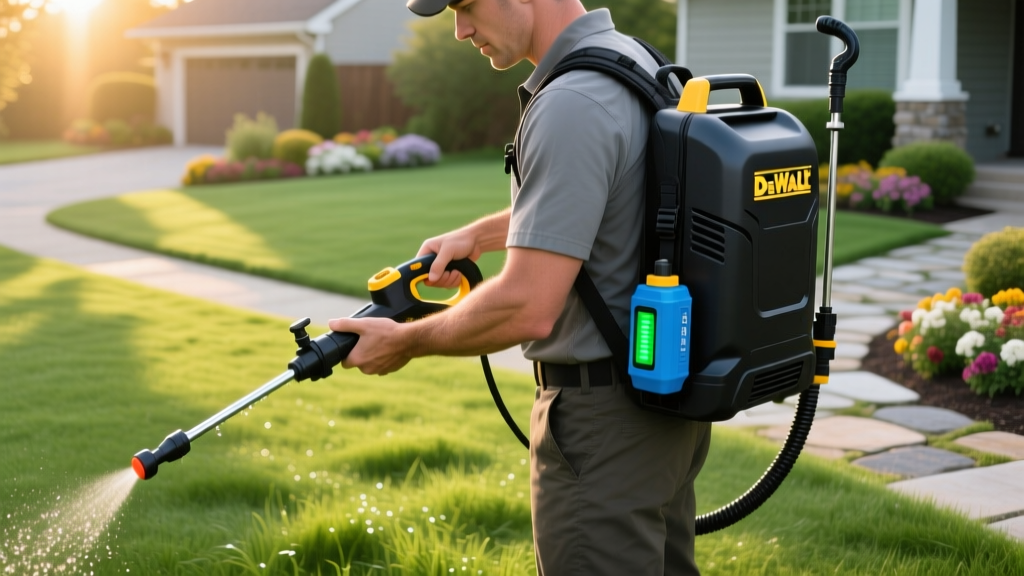
DeWalt 20V Battery Backpack Sprayer: 2026 Setup & Care Guide
DeWalt DCPS620 Series: Technical Specifications & Kit Options
The DeWalt 20V MAX Cordless Backpack Sprayer (DCPS620 series) has become an industry standard for lawn care professionals and serious homeowners. By replacing manual hand-pumping with a brushless diaphragm pump, it delivers consistent pressure up to 60 PSI across its 4-gallon tank. Understanding the exact kit configurations available in 2026 ensures you select the right power-to-weight ratio for your specific property size.
| Model Number | Kit Contents | Max Runtime (Approx.) | 2026 Avg. Price |
|---|---|---|---|
| DCPS620B | Bare Tool (No Battery/Charger) | N/A | $169.00 |
| DCPS620M1 | 1x 4.0Ah Battery, 1x Charger | ~40 Tanks | $249.00 |
| DCPS620R1 | 1x 2.0Ah Compact Battery, 1x Charger | ~20 Tanks | $199.00 |
Calibrating PSI for Targeted Lawn Applications
The most underutilized feature of the DCPS620 is the variable speed dial on the wand handle. Many users leave it at maximum (60 PSI) for every application, which leads to excessive atomization, chemical drift, and wasted battery life. Proper PSI calibration based on your nozzle type and chemical viscosity is critical for effective turf management.
- Pre-Emergent Herbicides (15-20 PSI): Use a coarse droplet flat fan nozzle (e.g., TeeJet XR8004). Lower pressure produces heavier droplets that penetrate the thatch layer and reach the soil surface without drifting onto neighboring ornamental beds.
- Systemic Post-Emergents (25-30 PSI): A medium droplet pattern ensures adequate coverage on broadleaf weeds like dandelions and clover without causing runoff.
- Liquid Fertilizers & Foliar Feeds (35-45 PSI): Higher pressure with a cone nozzle creates a fine mist necessary for foliar absorption, ensuring micronutrients coat the grass blade evenly.
According to Penn State Extension's sprayer calibration guidelines, maintaining a consistent walking speed while matching your PSI to the nozzle's optimal operating range is the single most important factor in preventing chemical burn and ensuring uniform application rates.
Battery Selection: Ah Ratings and Real-World Runtime
The brushless motor in the DeWalt sprayer is highly efficient, but your choice of 20V MAX battery dictates your workflow. While the 2.0Ah (DCB204) battery reduces shoulder fatigue, it is generally insufficient for properties larger than 1/4 acre. For professional lawn routes, the DCB248 (8.0Ah) or DCB542 (15.0Ah PowerStack) batteries are the standard in 2026. An 8.0Ah battery will reliably spray 75 to 80 full 4-gallon tanks on a single charge at moderate (30 PSI) settings, easily covering a full day of residential routes without requiring a mid-day swap.
Pro Tip: If you frequently use liquid iron or suspension concentrates, your pump will draw more amperage to maintain pressure. Always upgrade to a minimum 5.0Ah battery (DCB205) when spraying high-viscosity liquids to prevent voltage sag and motor stalling.
Preventative Maintenance: Extending the Brushless Pump Lifespan
The primary failure point for cordless backpack sprayers is not the battery or the motor—it is the degradation of the internal EPDM rubber O-rings and diaphragm seals. Improper lubrication and failure to winterize the unit account for 90% of warranty claims.
The O-Ring Lubrication Protocol
Never use petroleum jelly (Vaseline) or WD-40 on the sprayer's seals, cap gaskets, or wand connections. Petroleum distillates cause EPDM rubber to swell, soften, and ultimately disintegrate, leading to catastrophic pressure leaks.
Instead, use a 100% silicone-based grease (such as Super Lube Silicone Dielectric Grease). Apply a thin layer to the main tank cap O-ring and the quick-connect wand fittings every 15-20 tank fills, or whenever the cap feels difficult to thread.
End-of-Season Winterization Steps
Leaving water or chemical residue in the diaphragm pump over winter will cause freeze-cracking or dry-rot. Follow this exact winterization sequence:
- Flush with Clean Water: Fill the tank with 1 gallon of clean water and spray until the wand runs clear.
- Introduce RV Antifreeze: Add 1 gallon of propylene glycol (RV/Marine antifreeze). Never use automotive ethylene glycol, as it is highly toxic to pets and local waterways.
- Circulate and Coat: Spray the pink antifreeze through the wand until the fluid exits the nozzle. This coats the internal pump diaphragm and hoses.
- Depressurize: Turn the unit off, pull the wand trigger to release residual pressure in the line, and store the tank with the cap slightly loosened to allow airflow.
For official teardown and seal replacement diagrams, always refer to the DeWalt Product Support Manuals database to ensure you are ordering the correct OEM repair kit for your specific serial number.
Troubleshooting Common Pump & Flow Issues
Symptom: Motor Runs, But Wand Sputters or Loses Prime
Cause: Clogged inline filter or air leak at the tank pickup tube.
Fix: Disconnect the wand hose from the tank handle and inspect the 50-mesh inline strainer. If you are spraying wettable powders (like certain fungicides), this filter will clog rapidly. Remove the filter, rinse it backward with a high-pressure hose, and reinstall. If the issue persists, check the O-ring where the pickup tube meets the bottom of the tank housing.
Symptom: Battery Drains Rapidly and Motor Sounds Strained
Cause: Chemical crystallization inside the pump valves or spraying unagitated suspensions.
Fix: Products containing high amounts of copper or sulfur can crystallize inside the diaphragm check valves if the sprayer sits full for more than 48 hours. Run a 50/50 mix of warm water and white vinegar through the system to dissolve mineral deposits, followed by a clean water flush.
Frequently Asked Questions
Can I use the DeWalt DCPS620 for spraying deck sealers or stains?
No. The DCPS620 is engineered strictly for water-based agricultural and turf chemicals. Solvent-based stains, oil-based paints, and acetone-heavy cleaners will instantly melt the internal plastic pump housing and destroy the EPDM seals. For solvent applications, you must use a dedicated solvent-resistant sprayer with Viton seals.
How do I lock the wand trigger for continuous spraying?
The DCPS620 features a built-in trigger lock catch located just behind the main trigger lever. Push the catch forward while holding the trigger down to lock it into the 'ON' position. This is essential for large, open turf areas to prevent hand fatigue, but always disengage it when walking across hardscapes to prevent accidental overspray.

