
Lawn Care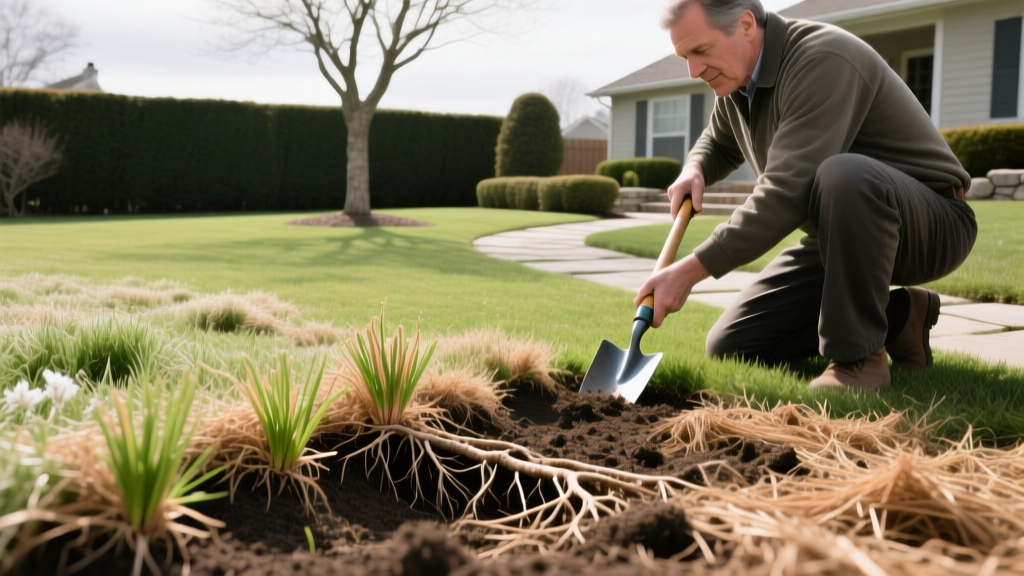
Dormant Grass vs Dead Grass: How to Diagnose and Rescue Your Lawn
When your lawn turns a uniform straw-brown during peak summer heat or deep winter freeze, the immediate assumption is often that the turf has died. However, turfgrasses possess a remarkable evolutionary survival mechanism called dormancy. Understanding the biological difference between dormant grass vs dead grass is the first step in saving your landscape from unnecessary and expensive renovation. Dormancy is a state of suspended animation where the grass halts top-growth to conserve water and protect its vital organs, while dead grass has suffered irreversible cellular necrosis.
This diagnostic guide provides the exact field tests, biological triggers, and rescue protocols you need to accurately assess your lawn's status and implement the correct recovery strategy.
The 3-Step Field Diagnostic Framework
Visual inspection alone is insufficient for distinguishing dormant grass vs dead grass, as both present with desiccated, brown leaf blades. You must evaluate the plant's structural integrity and vital organs using these three field tests.
1. The Tug Test (Root Anchorage)
Grab a small handful of brown grass blades near the soil surface and pull upward with moderate, steady pressure.
- Dormant Grass: The grass will resist pulling. The root system remains firmly anchored in the soil profile, actively holding the plant in place even though the leaves are brown.
- Dead Grass: The turf will slide out of the soil with zero resistance. The roots have decayed or detached, leaving the plant completely unanchored.
2. The Crown Inspection (Tissue Vitality)
The crown is the growing point of the turfgrass plant, located exactly at the soil line where the shoots meet the roots. Use a trowel to dig up a 2x2 inch plug of the brown turf.
- Dormant Grass: The crown tissue will be firm, plump, and white or pale green on the inside. This indicates the plant is alive and hoarding carbohydrate reserves.
- Dead Grass: The crown will be brown, dry, brittle, and mushy or hollow. If the crown is dead, the entire plant is dead and cannot be revived.
3. The 72-Hour Hydration Test
If the first two tests yield ambiguous results, isolate a 3x3 foot test patch. Apply exactly 1 inch of water using a calibrated rain gauge for three consecutive days. Dormant grass will begin pushing new green shoots from the crown within 7 to 14 days. Dead grass will show zero cellular response.
Dormant Grass vs Dead Grass: Comparison Matrix
Use this quick-reference matrix to compare the physiological states of your turf.
| Diagnostic Feature | Dormant Grass | Dead Grass |
|---|---|---|
| Crown Color | White, pale green, firm | Brown, black, mushy, or brittle |
| Root Resistance | High (resists tug test) | None (pulls easily) |
| Leaf Blade Texture | Dry but attached to crown | Decomposing, matting, or missing |
| Response to Water | Greens up in 7-14 days | No response; may grow mold |
| Carbohydrate Reserves | Stored in crown and rhizomes | Depleted or non-existent |
Biological Triggers: Why Grass Enters Dormancy
Dormancy is triggered by environmental stressors that threaten the plant's ability to maintain cellular turgor pressure. According to University of Nebraska-Lincoln Turfgrass Science, the triggers vary strictly by grass classification.
Cool-Season Grasses (Kentucky Bluegrass, Tall Fescue, Perennial Ryegrass)
Cool-season grasses thrive in soil temperatures between 50°F and 65°F. They enter summer dormancy when soil temperatures consistently exceed 85°F or during prolonged drought conditions where soil moisture drops below the permanent wilting point. In winter, they enter a secondary dormancy when soil temperatures drop below freezing to prevent intracellular ice crystal formation.
Warm-Season Grasses (Bermudagrass, Zoysia, Centipedegrass)
Warm-season grasses prefer soil temperatures between 75°F and 90°F. They enter winter dormancy when soil temperatures drop below 55°F for consecutive days. Unlike cool-season grasses, warm-season varieties are highly drought-tolerant and rarely enter true summer dormancy unless subjected to extreme, multi-week desert-like conditions.
💡 The Carbohydrate Reserve Factor: Grass survives dormancy by burning stored carbohydrates (starches) in its rhizomes and crown. If you force a dormant lawn to break dormancy repeatedly—such as by heavily watering a warm-season lawn during a mid-winter warm spell—the grass expends its reserves to push green shoots. When the freeze returns, the plant lacks the energy to survive, resulting in crown death.
Rescue Protocols: Managing a Dormant Lawn
If your diagnostic tests confirm the grass is dormant, your goal is not to make it green, but to keep the crown alive until favorable conditions return. Penn State Extension recommends the following 'survival maintenance' protocols.
- Survival Watering: Apply exactly 0.5 inches of water every 14 days. This is not enough to break dormancy and green up the lawn, but it provides just enough moisture to prevent the crown tissue from desiccating and dying. Use a standard tuna can (which is roughly 1 inch deep) to measure output.
- Halt Nitrogen Fertilization: Never apply high-nitrogen fertilizers (like a 30-0-3 NPK ratio) to dormant grass. Forcing top-growth during environmental stress depletes the root system and invites fungal pathogens like Rhizoctonia solani (brown patch).
- Raise the Mowing Deck: If you must mow to control weed height, raise your mower deck to 3.5 or 4 inches. Scalping a dormant lawn exposes the vulnerable white crown tissue to direct UV radiation, which will kill the plant.
- Suspend Aeration and Dethatching: These mechanical processes cause micro-trauma to the turf. Performing them on dormant grass prevents the plant from healing, leaving open wounds for disease and weeds to exploit.
Renovation Fixes: What to Do When the Grass is Dead
If the crown inspection reveals brown, mushy tissue across more than 40% of your lawn, the turf is dead. You must transition from rescue mode to full renovation. Here is the exact protocol and cost breakdown for a 1,000 square foot dead lawn patch.
Step 1: Site Eradication and Prep
Apply a non-selective herbicide containing 41% Glyphosate to kill remaining weeds and dead organic matter. Wait 7 to 10 days for complete translocation. Next, rent a core aerator ($85/day) to alleviate soil compaction and create seed-to-soil contact pockets.
Step 2: Seed Selection and Application
Do not buy cheap contractor-grade seed. Invest in coated, weed-free cultivars.
- Cool-Season Fix: Use Jonathan Green Black Beauty Ultra (approx. $85 per 20 lbs). It contains deep-rooting Texas Bluegrass and endophyte-enhanced fescues that resist future drought dormancy.
- Warm-Season Fix: Use Pennington Sahara Bermudagrass (approx. $45 per 10 lbs) for high heat tolerance, or lay fresh Zoysia sod at $0.45 - $0.65 per sq. ft.
Step 3: Starter Fertilizer and Hydration
Apply a phosphorus-heavy starter fertilizer (e.g., Scotts Turf Builder Starter Food, 24-25-4 NPK) at a rate of 3.2 lbs per 1,000 sq ft to stimulate rapid root development. Water lightly 2 to 3 times daily for 10 minutes to keep the top inch of soil constantly moist until germination occurs (typically 7-21 days depending on the species).
⚠️ Critical Herbicide Warning: If you are renovating dead grass via overseeding, do NOT apply pre-emergent herbicides like Prodiamine or Dithiopyr in the same season. Pre-emergents create a chemical barrier that prevents cell division in germinating seeds. You must wait at least 60 days after new grass seedlings emerge before applying pre-emergents.
Frequently Asked Questions
Can I use Epsom salt to revive dormant grass?
No. Epsom salt (magnesium sulfate) does not break dormancy or hydrate the crown. While magnesium is a secondary macronutrient required for chlorophyll production, applying it to dormant grass will not trigger greening and can lead to soil salinity issues if over-applied. Stick to the 0.5-inch survival watering protocol.
How long can grass stay dormant before it dies?
Most healthy cool-season grasses can survive 3 to 4 weeks of severe summer drought dormancy without supplemental water. Warm-season grasses like Bermudagrass can remain winter dormant for 4 to 5 months. However, if summer dormancy extends beyond 30 days without at least 0.5 inches of survival water, the crown tissue will desiccate and the plant will cross the threshold from dormant to dead.
Should I water my lawn during a winter freeze?
According to the EPA WaterSense guidelines, outdoor watering during freezing temperatures is generally discouraged due to ice hazard risks and the fact that frozen soil cannot absorb moisture. If your region experiences a dry, warm winter with no snow cover and temperatures above 40°F, you can apply 0.5 inches of water mid-day to prevent winter desiccation (winter kill) of the crowns.

