
Lawn Care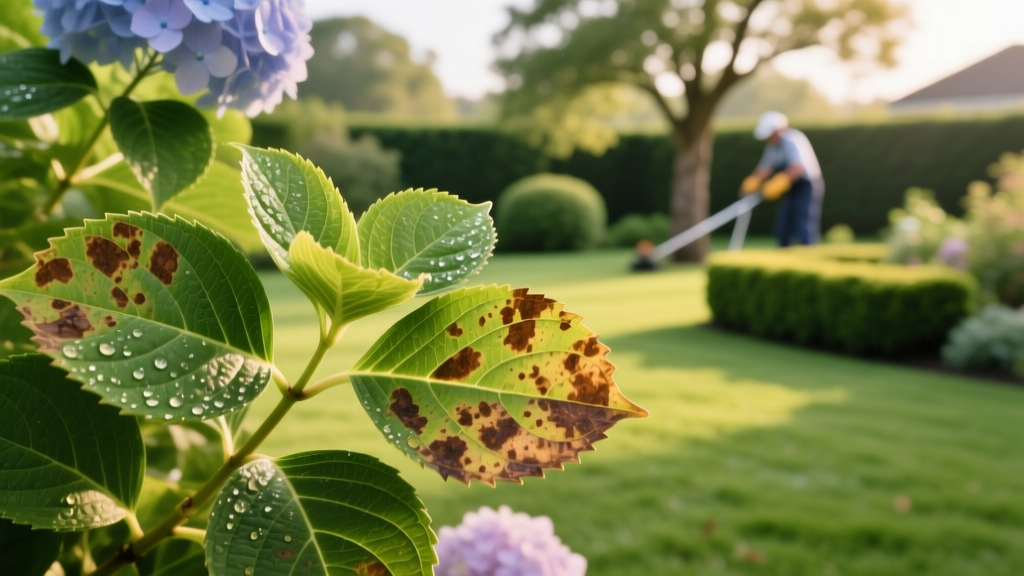
Diagnosing and Fixing Brown Spots on Hydrangea Leaves: A Rescue Guide
The Diagnostic Matrix: Identifying Your Hydrangea's Brown Spots
Hydrangeas (particularly Hydrangea macrophylla and Hydrangea quercifolia) are highly susceptible to foliar disorders, but applying a broad-spectrum fungicide without a precise diagnosis is a waste of money and chemical resources. Brown spots manifest differently depending on whether the culprit is a fungal pathogen, an abiotic environmental stressor, or a cultural error. Use the diagnostic matrix below to pinpoint the exact failure mode before initiating a rescue protocol.
| Symptom Profile | Location on Plant | Progression Pattern | Primary Suspect |
|---|---|---|---|
| Small (1/8 to 1/4 inch) circular spots with dark brown centers and purple/brown halos | Lower, older leaves first; near the soil line | Spreads upward as spores splash from wet soil during rain or overhead irrigation | Cercospora Leaf Spot (Cercospora hydrangeae) |
| Large, irregular brown blotches; may show target-like concentric rings | Both old and new growth; often affects flowers | Rapid expansion during hot (80-90°F), humid weather; causes severe defoliation | Anthracnose (Colletotrichum gloeosporioides) |
| Crispy, dry brown margins and tips; tissue feels brittle | Topmost canopy, newest leaves, and west-facing foliage | Appears suddenly after consecutive days of high heat and direct afternoon sun | Sunburn / Heat Scorch |
| Browning confined to leaf margins and tips; necrotic tissue lacks fungal fruiting bodies | Uniformly distributed across the shrub | Manifests 24 to 72 hours after applying granular or liquid synthetic fertilizers | Fertilizer Burn (Osmotic Stress) |
Pathogen Rescue: Fungicides and Application Mechanics
When dealing with fungal infections, the choice between contact and systemic fungicides dictates your success rate. According to Clemson University HGIC, timing and active ingredient selection are critical for halting spore germination.
Treating Cercospora Leaf Spot
Cercospora is a surface-level pathogen. You need a contact fungicide that creates a protective barrier on the leaf cuticle.
Recommended Active Ingredient: Chlorothalonil (e.g., Bonide Fung-onil, Daconil) or Mancozeb.
Application Rate: Mix 2.25 teaspoons of Chlorothalonil per gallon of water.
Execution: Spray to the point of runoff, ensuring thorough coverage of the undersides of the lower leaves. Chlorothalonil is rainfast within 2 hours and remains effective for 10 to 14 days. Reapply on this schedule until environmental conditions dry out.
Treating Anthracnose
Anthracnose penetrates plant tissue and can move systemically. Contact sprays alone will fail if the infection is already internalized. You must use a systemic fungicide that translocates through the plant's xylem.
Recommended Active Ingredient: Thiophanate-methyl (e.g., Cleary's 3336) or Copper Octanoate (e.g., Southern Ag Liquid Copper).
Application Rate: For Thiophanate-methyl, use 1.5 tablespoons per gallon of water for a curative drench and foliar spray.
Execution: Apply at the first sign of irregular blotches. Systemic fungicides protect new growth emerging at the apical meristems, which contact sprays cannot reach.
Environmental Rescue: Fixing Abiotic and Cultural Mistakes
Not all brown spots are biological. Abiotic stressors require immediate physical interventions rather than chemical treatments.
WARNING: The Fertilizer Burn Flush Protocol
If your hydrangea exhibits marginal browning 48 hours after feeding, the soil's osmotic potential has dropped below the root's water potential, literally pulling moisture out of the plant. Do not apply more water-soluble fertilizer. Instead, immediately leach the root zone by applying 2 to 3 inches of water over the soil surface to dissolve and push excess salt ions below the active root profile (typically 12-18 inches deep for established hydrangeas).
If your hydrangea exhibits marginal browning 48 hours after feeding, the soil's osmotic potential has dropped below the root's water potential, literally pulling moisture out of the plant. Do not apply more water-soluble fertilizer. Instead, immediately leach the root zone by applying 2 to 3 inches of water over the soil surface to dissolve and push excess salt ions below the active root profile (typically 12-18 inches deep for established hydrangeas).
Reversing Sunburn and Heat Scorch
Hydrangeas lack the thick waxy cuticles of xerophytic plants. When leaf temperatures exceed 104°F, stomata close to prevent water loss, halting evaporative cooling and causing photoinhibition (cellular damage from unabsorbed light energy).
The Fix: Install a temporary 30% to 50% density shade cloth over the affected shrub during peak afternoon hours (1 PM - 5 PM). Do not remove the scorched leaves immediately; they still provide partial shade to the inner canopy while the plant pushes new axillary buds. Increase deep-root watering to 1.5 gallons per square yard every three days during heat waves.
The 4-Step Emergency Pruning and Sanitation Protocol
Whether fighting Cercospora or Anthracnose, chemical controls will fail if the physical inoculum (spore load) is not reduced. Follow this exact sequence to sanitize the shrub:
- Execute Targeted Pruning: Use sharp bypass pruners (never anvil pruners, which crush tissue and invite secondary botrytis infections). Snip off heavily infected leaves at the petiole base. If a stem is entirely defoliated and necrotic, cut it back to a healthy, green lateral node.
- Chemical Tool Sanitation: After every single cut, wipe your pruner blades. While a 10% bleach solution is commonly cited, bleach pits and corrodes high-carbon steel. Instead, use 70% isopropyl alcohol applied via a microfiber cloth or spray bottle. It evaporates rapidly and preserves your tool's edge.
- Clear the Drip Line: Fungal spores overwinter in fallen debris. Rake and remove all leaf litter within a 3-foot radius of the hydrangea's drip line. Dispose of this material in municipal green waste bins; never compost diseased hydrangea foliage, as home compost piles rarely reach the 145°F required to kill Colletotrichum spores.
- Apply Fresh Mulch: Lay down a 2-inch layer of arborist wood chips or pine bark fines over the cleared soil. This physical barrier prevents raindrops from splashing soil-borne Cercospora spores back onto the lower canopy. Keep the mulch exactly 2 inches away from the main crown to prevent stem rot.
Seasonal Prevention Calendar
Rescue fixes stabilize a declining plant, but long-term health requires preemptive cultural adjustments. The University of Maryland Extension emphasizes that modifying the microclimate is the most effective disease deterrent.
- Early Spring (Bud Break): Apply a 2-inch layer of compost and a slow-release, low-nitrogen organic fertilizer (like Espoma Holly-tone 4-3-4). High nitrogen levels produce soft, succulent tissue that is highly vulnerable to Anthracnose penetration.
- Mid-Spring (Leaf Expansion): Transition from overhead sprinklers to drip irrigation or soaker hoses. Keeping the leaf canopy dry is the single most effective way to disrupt the fungal life cycle.
- Summer (Peak Heat): Monitor soil moisture using a 6-inch soil probe. Hydrangeas require consistently moist (but not waterlogged) soil. If the top 2 inches are dry, water deeply at the base.
- Late Autumn (Dormancy): Perform a final sanitation sweep. Remove all remaining dead leaves clinging to the stems and clear the ground. Apply a dormant spray of copper octanoate if the shrub suffered a severe fungal outbreak during the growing season.

