
Lawn Care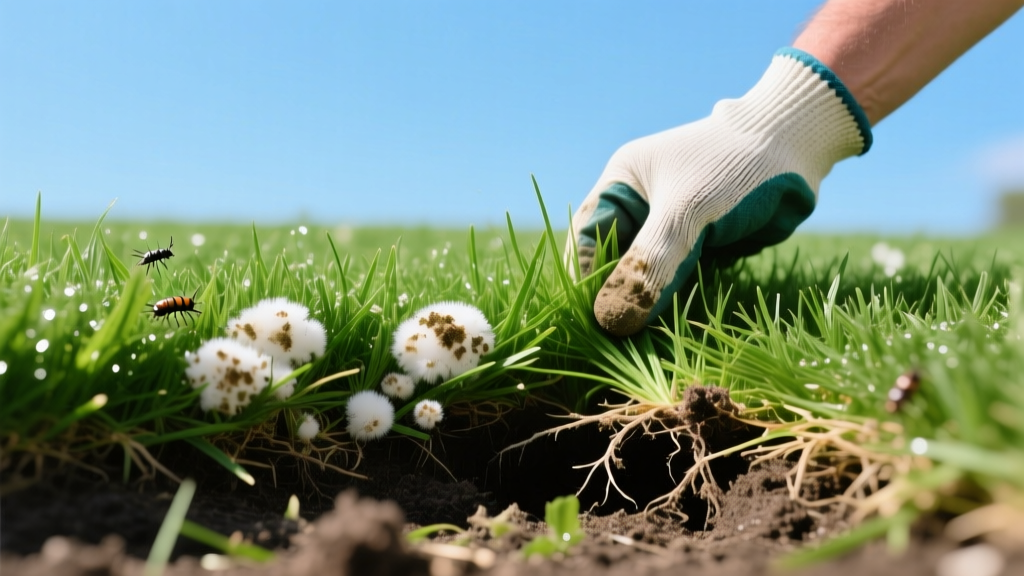
How to Diagnose and Fix White Spots on Lawn Grass Fast
The Diagnostic Framework: Why Turf Turns White
When you notice white spots on lawn grass, you are observing one of three distinct biological or chemical failures: fungal sporulation, osmotic desiccation (chemical burn), or pigment inhibition. Unlike brown patch or dollar spot, which present as necrotic brown lesions, white discoloration indicates that the grass blade is either coated in a pathogen, stripped of its chlorophyll, or actively dying from root-severing pests. Accurate diagnosis requires examining the texture, location, and timing of the white patches.
Rapid Triage Test: Rub the white spot between your fingers. If a white, powdery residue rubs off, you are dealing with a fungal infection (Powdery Mildew). If the blade is dry, brittle, and the white color is baked into the tissue, suspect fertilizer burn or herbicide phytotoxicity. If the entire patch pulls up like a loose carpet with white grubs underneath, the pale color is a precursor to total root failure.
Fungal Pathogens: Powdery Mildew and Snow Mold
Powdery Mildew (Erysiphe graminis)
Powdery mildew manifests as a superficial white, talcum-like dusting on the upper surface of grass blades. It predominantly affects cool-season grasses like Kentucky bluegrass and fine fescues situated in dense shade with poor air circulation. The pathogen thrives when daytime temperatures hover between 60°F and 72°F with high humidity, but it does not require free-standing water on the leaf to germinate.
Rescue Fix: Prune overhanging tree canopies to allow at least 20% direct sunlight penetration and improve cross-breeze airflow. For immediate chemical control, apply a systemic fungicide containing Myclobutanil (e.g., Spectracide Immunox Lawn Disease Control). Mix 0.5 fluid ounces per 1,000 square feet in a backpack sprayer. According to turfgrass pathology guidelines from UMass Amherst Extension, rotating Myclobutanil with a contact fungicide like Chlorothalonil prevents pathogen resistance.
Snow Mold (Typhula incarnata and Microdochium nivale)
If white spots on lawn grass appear immediately after the spring snowmelt, you are likely looking at gray snow mold (Typhula blight) or pink snow mold (Microdochium patch). Gray snow mold presents as circular, matted patches of white-to-gray mycelium, often pinning the grass to the soil. Pink snow mold can appear whitish-pink at the margins when wet.
Rescue Fix: Do not apply fungicides in the spring; the damage is already done and the fungus will naturally go dormant as soil temperatures exceed 50°F. Gently rake the matted white areas with a flexible leaf rake to break up the crust and allow the crown to dry. To prevent recurrence next year, apply a preventative strobilurin fungicide like Scotts DiseaseEx (Azoxystrobin, costing roughly $25 for 5,000 sq ft) in late November before the first permanent snow cover. The University of Minnesota Extension emphasizes that avoiding high-nitrogen fertilizers after October 1st is critical to preventing the lush, succulent growth that snow mold feeds on.
Chemical Bleaching and Osmotic Burn
Fertilizer Burn (Osmotic Desiccation)
Granular fertilizers with a high salt index—particularly urea-based products (46-0-0) or ammonium sulfate—draw moisture out of grass blades if they are not watered in immediately. This osmotic stress kills the leaf tissue, resulting in stark white or pale yellow spots exactly where the granules rested. This is highly common around the edges of driveways where spreaders overlap or when a spreader is stopped while the hopper gate is still open.
Rescue Fix: You cannot reverse the dead tissue, but you must leach the residual salts out of the soil profile to protect the living roots and crown. Apply 1.5 inches of water to the affected area over a 48-hour period using an oscillating sprinkler. Once the salts are flushed, overseed the white patches with a matching turfgrass seed blend at a rate of 3 to 4 pounds per 1,000 square feet.
Herbicide Phytotoxicity (HPPD Inhibitors)
If you recently applied a selective herbicide containing Mesotrione (e.g., Syngenta Tenacity) to control crabgrass or creeping bentgrass, white spots on lawn grass are an expected biochemical reaction. Mesotrione is an HPPD inhibitor; it blocks carotenoid biosynthesis in susceptible plants, causing them to lose their green pigment and turn stark white before dying. While safe for Kentucky bluegrass and tall fescue at labeled rates (4 to 8 oz per acre), overdosing or applying during heat stress (>85°F) will cause temporary whitening of the desirable turf.
Rescue Fix: Do not panic and do not apply more chemicals. The whitening of tolerant turf is temporary and usually resolves in 2 to 3 weeks as the grass metabolizes the active ingredient. To mask the cosmetic damage while the turf recovers, apply a liquid iron chelate (Fe-EDTA) spray at 4 oz per 1,000 square feet to force a temporary darkening of the unaffected chlorophyll.
Subterranean Pests: The White Grub Precursor
Before white grubs (the larvae of Japanese beetles and June bugs) cause the classic brown, dead patches, the severed grass roots fail to uptake water. The turf canopy will first turn a pale, sickly white-green before browning completely. The defining characteristic of grub damage is the 'tug test': if you grab a handful of the pale/white grass and pull, it rolls up like a carpet with no root resistance, exposing C-shaped white grubs in the topsoil.
For curative rescue in late summer when grubs are actively feeding, apply a fast-acting contact insecticide containing Trichlorfon (e.g., Bayer Advanced 24-Hour Grub Killer, approx. $35 for a 30 lb bag). Water it in immediately with 0.5 inches of irrigation to move the chemical into the root zone where the larvae are feeding. For long-term management, Penn State Extension recommends preventative applications of Chlorantraniliprole (Scotts GrubEx) in early June.
Symptom Comparison Matrix
| Symptom Profile | Texture & Behavior | Primary Cause | Immediate Rescue Action |
|---|---|---|---|
| Talcum-like dust on blades | Rubs off on fingers; shade-bound | Powdery Mildew | Apply Myclobutanil; prune canopy |
| Matted, webbed white circles | Appears post-snowmelt; crusty | Snow Mold | Rake gently; no spring fungicides |
| Crisp, bleached white spots | Brittle; localized to granule drops | Fertilizer Burn | Flush with 1.5 inches of water |
| Uniform white blade bleaching | Intact tissue; post-spray application | Mesotrione Herbicide | Wait 2 weeks; apply iron chelate |
| Pale white-green rolling turf | Detaches easily like a carpet | White Grubs | Apply Trichlorfon; water in deeply |
Frequently Asked Diagnostic Questions
Can dog urine cause white spots on lawn grass?
Yes, but indirectly. Dog urine contains high concentrations of urea and salts. While the center of the urine spot usually turns brown and dies due to nitrogen toxicity, the outer perimeter of the spot often turns pale white or bright yellow-green as the diluted nitrogen acts as a localized fertilizer flush before the salts burn the tissue. Flush the area immediately with a gallon of water if you catch the pet in the act.
Will watering at night cause white fungal spots?
Watering at night extends the leaf wetness period beyond 10-12 hours, which is the primary catalyst for fungal diseases like powdery mildew, dollar spot, and brown patch. Always calibrate your irrigation controller to water between 4:00 AM and 6:00 AM so the sun and morning wind can dry the canopy by mid-morning.

