
Lawn Care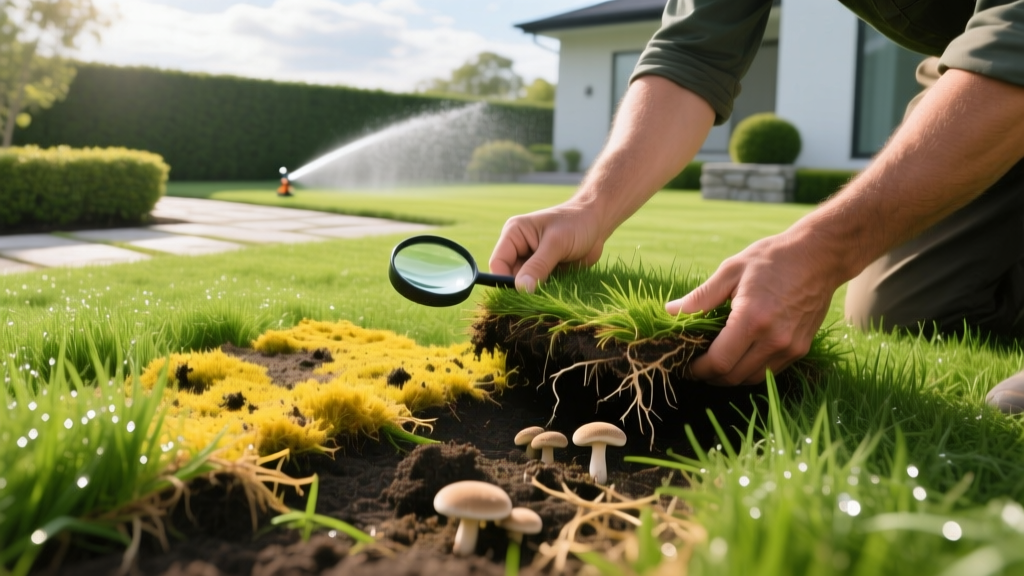
Diagnosing and Fixing Yellow Patches in Grass: A Rescue Guide
Yellow patches in grass are rarely a singular problem; they are a visual symptom of underlying biological, chemical, or environmental stress. Treating a fungal infection with nitrogen fertilizer will only accelerate the pathogen's growth, while applying fungicide to a grub-infested lawn wastes time and money. Successful rescue requires precise symptom triangulation before any product is applied.
The 5-Minute Triage: Identifying Your Yellow Patch Pattern
Before purchasing any treatment, perform a visual and physical inspection of the affected turf. Use this diagnostic matrix to narrow down the primary suspect.
| Symptom Pattern | Physical Evidence | Probable Cause | Immediate Diagnostic Test |
|---|---|---|---|
| Circular rings (2-10 ft wide), often with a dark 'smoke ring' border | Lesions on individual grass blades; mycelium visible in morning dew | Fungal Pathogen (Brown Patch or Dollar Spot) | Inspect blades at dawn for cobweb-like mycelium or distinct bleached lesions |
| Irregular, mottled yellowing; turf feels spongy underfoot | Roots severed; turf rolls back like a loose carpet | Subsurface Pests (White Grubs) | Perform the 'Tug Test' and cut a 1-square-foot section to count grubs |
| Uniform yellowing of new growth; veins remain green (interveinal chlorosis) | Soil pH tests above 7.0; common in alkaline soils | Iron Deficiency (Iron Chlorosis) | Test soil pH; check if recent heavy rainfall or overwatering occurred |
| Small, perfectly round yellow/brown spots with a dark green outer ring | Localized to areas where pets frequent | Nitrogen Burn (Dog Urine) | Check the center of the patch for dead roots vs. dormant crown tissue |
Fungal Pathogens: The Most Common Culprits
Fungal diseases are responsible for the majority of sudden yellow patches in both cool- and warm-season grasses. The two most frequent offenders are Rhizoctonia solani (Brown Patch) and Clarireedia jacksonii (Dollar Spot).
Brown Patch (Cool-Season & Zoysia)
Brown patch thrives when night temperatures exceed 68°F combined with high humidity and prolonged leaf wetness. According to the NC State TurfFiles pathology database, the disease manifests as circular patches that can expand rapidly within 24 to 48 hours.
- Rescue Fix: Apply a systemic fungicide containing Azoxystrobin (e.g., Syngenta Heritage or Scotts DiseaseEx). The application rate is typically 0.4 oz per 1,000 square feet for liquid concentrates, or 2.3 lbs per 5,000 square feet for granular formulations.
- Cost: Liquid Azoxystrobin concentrates cost between $45 and $65 per 8 oz bottle, which treats up to 20,000 sq ft at curative rates.
- Cultural Correction: Immediately shift irrigation to early morning (between 4:00 AM and 6:00 AM) to minimize leaf wetness duration. Reduce nitrogen applications until the fungus is eradicated.
Dollar Spot (All Turf Types)
Dollar spot creates smaller, silver-dollar-sized yellow-to-straw-colored spots that can coalesce into large yellow patches. Individual grass blades will show hourglass-shaped lesions with dark brown borders.
- Rescue Fix: Use a contact or penetrant fungicide with Propiconazole (e.g., Bayer Advanced Disease Control or Quali-Pro Propiconazole 14.3). Apply at 1 to 2 oz per 1,000 sq ft.
- Crucial Step: Fungicides will not work if the turf is starving. Dollar spot heavily targets nitrogen-deficient lawns. Apply a light dose of quick-release nitrogen (0.25 lbs N per 1,000 sq ft) alongside the fungicide to stimulate growth through the damaged tissue.
Warning: The Mowing Vector
Fungal spores are easily transported by mower wheels and decks. If you have active yellow patches caused by fungi, wash your mower deck with a 10% bleach solution or a commercial quaternary ammonium disinfectant before mowing healthy areas of the lawn. Never bag and compost clippings from an infected zone; leave them or dispose of them in municipal waste.
Fungal spores are easily transported by mower wheels and decks. If you have active yellow patches caused by fungi, wash your mower deck with a 10% bleach solution or a commercial quaternary ammonium disinfectant before mowing healthy areas of the lawn. Never bag and compost clippings from an infected zone; leave them or dispose of them in municipal waste.
Nutrient Deficiencies & Soil pH Lockout
When yellow patches in grass appear without distinct borders or circular patterns, suspect a nutrient issue. However, the type of yellowing dictates the exact deficiency.
Iron Chlorosis vs. Nitrogen Deficiency
Nitrogen deficiency causes uniform, overall yellowing starting from the older, lower leaves. Iron chlorosis, conversely, strikes the newest growth first, leaving the leaf veins green while the tissue between them turns bright yellow.
Iron chlorosis is rarely a lack of iron in the soil; it is a 'lockout' caused by high soil pH (above 7.2) or compacted, waterlogged soil that deprives roots of oxygen. Applying standard granular iron sulfate to alkaline soil is useless because it instantly oxidizes and becomes unavailable to the roots.
- The Rescue Protocol: Apply a chelated liquid iron product, specifically Fe-EDDHA (which remains stable in high pH soils up to 9.0). Products like Southern Ag Chelated Liquid Iron or Ironite Plus 10-10-10 cost around $15 to $25 per quart.
- Application Rate: Mix 2 to 3 oz of liquid chelated iron per gallon of water and spray 1,000 sq ft. You will see visible greening within 24 to 72 hours.
- Long-Term Fix: Lower the soil pH by applying elemental sulfur at a rate of 5 to 10 lbs per 1,000 sq ft in the fall or early spring, based on a lab-tested soil sample.
Pest Damage: Subsurface Grub Feeding
If your yellow patches feel spongy when walked on, and the grass pulls up with almost zero resistance, you are likely dealing with white grubs (the larval stage of Japanese beetles, June bugs, or European chafers). Grubs sever the root system just below the thatch layer, causing the turf above to yellow and die from drought stress, even if you are watering heavily.
According to Penn State Extension's turfgrass pest guidelines, a threshold of more than 5 to 7 grubs per square foot warrants immediate curative intervention.
The Grub Rescue Strategy
Preventative grub controls (like Chlorantraniliprole/Acelepryn) take months to work and will not save an actively yellowing lawn. You need a fast-acting curative insecticide.
- Select the Right Chemical: Purchase a product containing Trichlorfon (e.g., Dylox 6.2 Granular). This active ingredient penetrates the thatch rapidly and kills active grubs within 24 to 48 hours.
- Cost & Coverage: A 30 lb bag of Dylox costs approximately $45 to $55 and covers up to 10,000 sq ft for preventative rates, but for curative rescue, apply at the higher label rate (approx. 3 lbs per 1,000 sq ft).
- The Watering Mandate: Trichlorfon degrades quickly in sunlight and high pH water. Apply the granules in the late afternoon, then immediately irrigate the lawn with 0.25 to 0.5 inches of water to wash the chemical into the root zone where the grubs are feeding.
- Post-Rescue Recovery: Once the grubs are eliminated, the severed roots cannot reattach. You must lightly aerate the yellow patches, top-dress with compost, and overseed (for cool-season lawns) or encourage lateral stolon spread (for warm-season lawns) to fill the voids.
Environmental & Mechanical Stressors
Not all yellow patches are biological. Mechanical damage and localized chemical burns frequently mimic disease.
Dog Urine (Nitrogen Burn)
Female dogs tend to deposit high volumes of urea in a single spot, creating a concentrated nitrogen burn. This results in a dead yellow center surrounded by a lush, dark green ring of stimulated growth.
- Rescue Fix: Do not apply gypsum or tomato juice (common internet myths); they do not neutralize urea. Instead, immediately flood the spot with 2 to 3 gallons of water to dilute the nitrogen salts below the root zone. If the crown tissue is still white and firm, the grass will recover in 2 to 3 weeks. If the crown is brown and mushy, rake out the dead material and plug the area with healthy sod.
Mower Scalping & Dull Blades
Yellow patches that appear on the crests of small hills or uneven terrain are often the result of mower scalping. Cutting into the woody crown tissue exposes the lower, unchlorophyllous stems to the sun, causing immediate yellowing.
- Rescue Fix: Raise your mower deck by one notch (aim for a minimum cutting height of 3.0 inches for Tall Fescue and 2.5 inches for Bermuda). Inspect your mower blade; a dull blade shreds the grass tip, leaving a frayed, yellow-white tip that dies back. Sharpen or replace the blade if you see ragged tips on freshly cut grass.
Pro-Tip: The Screwdriver Compaction Test
If yellow patches appear in high-traffic areas (near gates, along fences, or where children play), the soil is likely compacted, suffocating the roots. Push a 6-inch flathead screwdriver into the soil. If you cannot push it to the handle using only your body weight, the soil is compacted. Rent a core aerator ($80-$120 for a half-day rental) and extract 3-inch soil plugs to restore oxygen flow to the root zone.
If yellow patches appear in high-traffic areas (near gates, along fences, or where children play), the soil is likely compacted, suffocating the roots. Push a 6-inch flathead screwdriver into the soil. If you cannot push it to the handle using only your body weight, the soil is compacted. Rent a core aerator ($80-$120 for a half-day rental) and extract 3-inch soil plugs to restore oxygen flow to the root zone.
Your 7-Day Rescue Action Plan
When confronted with unexplained yellowing, follow this sequential protocol to avoid compounding the stress:
- Day 1 (Diagnosis): Perform the tug test, inspect blades with a magnifying glass, and conduct a soil pH test using a digital meter or mail-in lab kit (e.g., SoilKit or local university extension).
- Day 2 (Targeted Application): Apply the specific curative product (fungicide, Trichlorfon, or chelated iron) based on your Day 1 findings. Water in granular products immediately.
- Day 3 (Cultural Shift): Adjust irrigation timers to water only between 4:00 AM and 6:00 AM. Check sprinkler head overlap to ensure the yellow patch isn't simply a dry spot caused by a clogged nozzle.
- Day 7 (Evaluation): Check for new green shoots emerging from the crown. If the patch continues to expand despite treatment, re-evaluate for a secondary infection or misdiagnosis, and consider submitting a physical grass sample to your local university extension plant pathology lab for culturing.
Accurate diagnosis is the only bridge between a dying lawn and a recovered one. By matching the exact visual symptom and physical evidence to the correct chemical or cultural intervention, you can halt turf decline and restore uniform color within a single growing cycle.

