
Lawn Care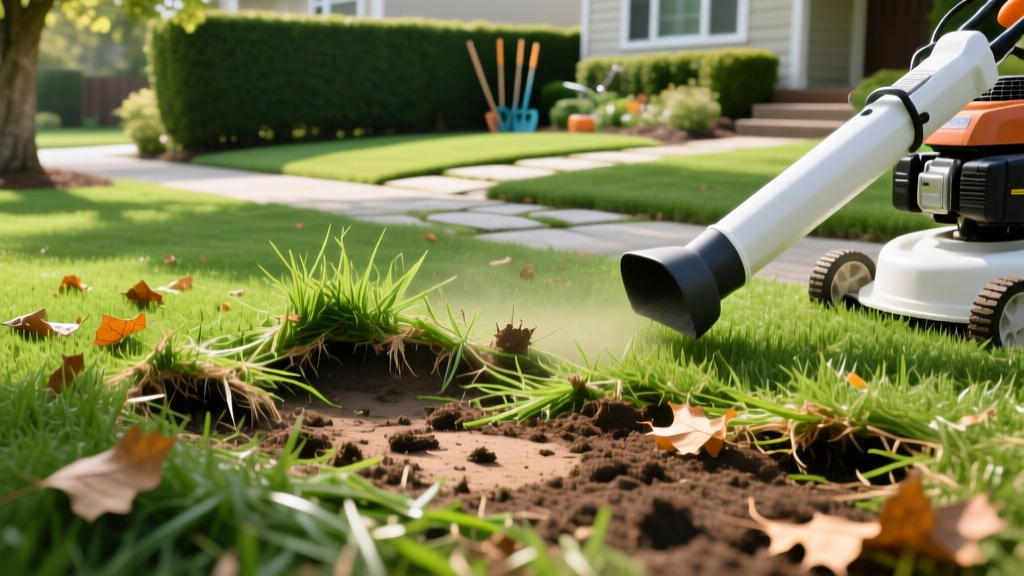
Diagnosing Lawn Damage After You Blow Leaves: Causes and Fixes
The Hidden Aerodynamics of Turf Damage
Homeowners frequently view leaf blowers as simple wind machines, but improper use turns them into turf-destroying tools. When you blow leaves across a lawn, the high-velocity air stream can strip topsoil, tear stolons, and desiccate the grass crown. The core of the problem lies in boundary layer aerodynamics. Air exiting a blower nozzle travels at peak velocity (often exceeding 150 MPH) in a concentrated column for the first 12 to 18 inches before expanding and decelerating. If this high-velocity core intersects the turf canopy, the kinetic energy transfers directly to the grass blades, stolons, and soil surface.
Diagnosing the exact failure mode requires matching the visual symptoms on your lawn to the specific aerodynamic error made during cleanup. According to NC State TurfFiles, mechanical damage to the turf crown during late fall or early spring can delay green-up by several weeks and invite opportunistic pathogens like snow mold or dollar spot.
Warning: The Wet Leaf Compaction Trap
Attempting to blow leaves when the turf is wet or the soil is saturated forces the high-velocity air to act as a soil compactor. The downward pressure of the air stream pushes water into the soil profile, collapsing soil macropores and reducing oxygen availability to the root zone. Never blow leaves on saturated ground.
Attempting to blow leaves when the turf is wet or the soil is saturated forces the high-velocity air to act as a soil compactor. The downward pressure of the air stream pushes water into the soil profile, collapsing soil macropores and reducing oxygen availability to the root zone. Never blow leaves on saturated ground.
Symptom Checker: Diagnosing Your Blower Damage
Use this diagnostic matrix to identify the specific type of damage your lawn has sustained and the operational error that caused it.
| Visual Symptom | Primary Cause | Operational Error | Recovery Timeframe |
|---|---|---|---|
| Brown, circular patches appearing 24-48 hours after blowing | Crown desiccation and moisture stripping | Blowing at high MPH on dry, dormant turf without prior irrigation | 2-4 weeks (requires deep watering and amino acid biostimulants) |
| Uprooted grass runners (stolons) mixed into the leaf pile | Nozzle scouring on stoloniferous grass | Nozzle held too close (under 3 inches) to Centipede or Bermuda | 4-8 weeks (requires stolon regeneration and light topdressing) |
| Bare soil spots with exposed, dried-out roots | Topsoil erosion and thatch displacement | Using high-CFM backpack blowers at a steep downward angle | Full season (requires aeration, compost topdressing, and overseeding) |
| Frayed, white-tipped grass blades across the entire yard | Blunt force wind tearing | Using narrow concentrator nozzles instead of wide lawn nozzles | 1-2 mowing cycles (the damaged tissue will be cut off naturally) |
Grass-Specific Vulnerabilities to Air Velocity
Not all turfgrass reacts to high-velocity air the same way. The growth habit of your specific grass dictates its vulnerability when you blow leaves off the surface.
Stoloniferous Warm-Season Grasses (Centipede, St. Augustine, Bermuda)
These grasses spread via above-ground runners called stolons. Centipedegrass and St. Augustine have thick, exposed stolons that sit directly on the soil surface. According to turfgrass specialists at University of Minnesota Extension, aggressive air streams can literally rip these stolons from their shallow root nodes. If you are managing Centipedegrass, you must maintain a minimum nozzle standoff distance of 6 inches and use a wide-dispersion nozzle to reduce pounds-per-square-inch (PSI) impact on the runners.
Bunch-Type and Rhizomatous Cool-Season Grasses (Tall Fescue, Kentucky Bluegrass)
Cool-season grasses grow in bunches or spread via underground rhizomes, making them immune to stolon tearing. However, their primary vulnerability is crown desiccation. In late autumn, when humidity drops and winds are already high, blasting dry air across Tall Fescue strips the microscopic moisture layer from the leaf cuticle. This causes the crown—the growing point of the plant—to freeze-dry, resulting in winterkill or delayed spring green-up.
Equipment Calibration: Matching CFM and MPH to Turf
Understanding the difference between Cubic Feet per Minute (CFM) and Miles per Hour (MPH) is critical for diagnosing equipment-induced damage. MPH measures air speed (useful for breaking up stuck, wet leaf piles on driveways). CFM measures air volume (useful for moving large amounts of dry leaves off lawns). For lawn safety, you want high CFM and low MPH.
| Blower Type | Average Specs | Best Use Case | Lawn Safety Rating |
|---|---|---|---|
| Handheld Concentrator (e.g., Echo PB-2620) | 456 CFM / 158 MPH | Hardscapes, driveways, tight garden beds | Poor (High risk of turf scouring) |
| Handheld with Wide Nozzle (e.g., Husqvarna 125B) | 425 CFM / 170 MPH (dispersed) | Small cool-season lawns, dry leaves | Moderate (Safe if kept 4+ inches above canopy) |
| Backpack with Standard Tube (e.g., Stihl BR 800) | 912 CFM / 239 MPH | Large properties, heavy wet oak leaves | Dangerous (Will strip topsoil if angled down) |
| Backpack with Gutter/Lawn Extension Tube | 912 CFM / 45 MPH (at exit) | Large turf areas, commercial properties | Excellent (High volume, low impact velocity) |
If you own a high-MPH backpack blower, purchasing a $25 to $40 extension tube or a wide-mouth lawn nozzle is mandatory. This increases the distance the air travels before hitting the turf, allowing the velocity to drop below the threshold that causes mechanical tearing (typically around 60 MPH at the leaf surface).
The 4-Step Safe Leaf Removal Protocol
To safely blow leaves without triggering the damage symptoms outlined above, follow this exact operational sequence:
- Hydrate the Canopy (If Not Dormant): If your grass is still actively growing or just entering dormancy, run your irrigation system for 5 minutes the night before. Turgid (water-filled) grass blades are highly flexible and resist tearing, whereas dry, brittle blades will shatter under high-velocity air.
- Set the Throttle to 75%: Most gas and premium battery blowers (like the Ego LB6504) have variable speed triggers. Running at 100% throttle creates micro-turbulence that scatters leaves rather than rolling them. A steady 75% throttle creates a laminar air stream that pushes leaves in a cohesive wave.
- Angle at 15 Degrees Downward: Never point the nozzle directly at the ground. Aim slightly downward (about 15 degrees) so the air stream gets underneath the leaf layer, lifting it rather than driving it into the turf canopy.
- Employ the 'Float' Technique: Keep the nozzle moving in a steady, sweeping side-to-side motion while walking forward. Stopping or hovering the nozzle in one place for more than two seconds will instantly cause soil scouring and thatch displacement.
"The biggest mistake homeowners make is treating the lawn like a driveway. A driveway requires brute force to clean; a lawn requires aerodynamic finesse. You are trying to levitate the leaves, not blast them."
— Dr. Grady Miller, Professor of Crop Science, NC State University
When to Abandon the Blower: Alternative Solutions
Sometimes, diagnosing the problem means realizing the blower is the wrong tool for the current environmental conditions. Switch to these alternatives when specific thresholds are met:
- Heavy, Wet Oak or Sycamore Leaves: These leaves mat down and adhere to the turf via surface tension. Blowing them requires destructive MPH levels. Instead, use a mulching mower with high-lift Gator blades. Set the deck to 3.5 inches and make two passes in perpendicular directions. The blades will vacuum and shred the leaves into 1/4-inch pieces that filter into the thatch layer, providing free nitrogen and organic matter.
- Wet Soil Conditions: If the ground is saturated from autumn rains, abandon all motorized blowing. Use a traditional flexible poly-tine leaf rake. The flex of the tines will glide over the soil without compacting it or tearing the turf crowns.
- Pine Needles on Zoysia: Pine needles weave themselves into the Zoysia canopy. Blowing them out will rip the Zoysia stolons. Use a specialized thatch rake or a lawn sweeper with adjustable brush heights set 1/2 inch above the soil line.
By diagnosing the specific aerodynamic and mechanical stresses your equipment places on the turf, you can adjust your technique, modify your nozzle setup, and protect the structural integrity of your lawn heading into the winter months. For more comprehensive seasonal transition strategies, consult your local cooperative extension office or refer to the Penn State Extension Lawn Care guidelines for cool-season turf management.

