
Lawn Care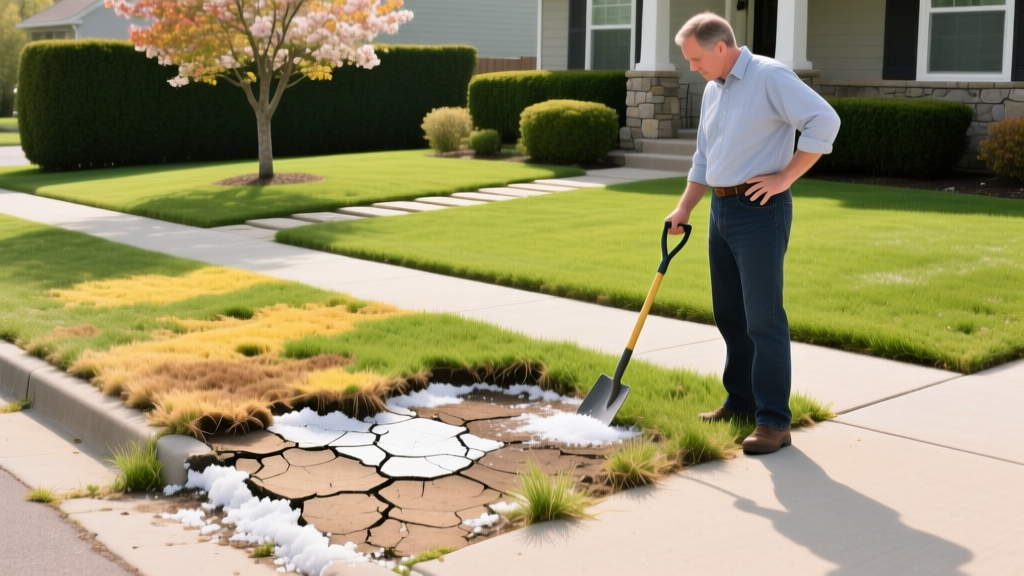
Lawn Salt Damage: Symptoms, Soil Tests, and Rescue Fixes
Spotting the Symptoms: Is It Salt or Something Else?
When spring arrives, homeowners often discover unsightly brown, necrotic strips of turfgrass bordering driveways, sidewalks, and roadways. While winter desiccation and snow mold are common culprits, lawn salt damage from sodium chloride (rock salt) de-icing agents presents a unique set of physiological and structural symptoms. According to the University of Minnesota Extension, salt injury typically manifests within 10 to 30 feet of heavily salted paved surfaces, with the most severe necrosis occurring within the first 3 feet.
Diagnosing salt toxicity requires distinguishing it from other early-spring turf issues. Use the diagnostic matrix below to isolate the root cause before applying any amendments.
| Symptom Profile | Lawn Salt Damage | Winter Desiccation | Snow Mold (Typhula/Microdochium) |
|---|---|---|---|
| Location | Adjacent to paved surfaces, walkways, or coastal spray zones. | Elevated areas, exposed ridges, or windy sites. | Patches under prolonged snow cover (40+ days). |
| Leaf Appearance | Tip burn progressing to marginal chlorosis; white crust on soil/blade. | Uniform straw-colored, brittle blades. | Matted, grayish-pink or white mycelium present. |
| Soil Condition | Surface crusting, poor drainage, hardpan formation. | Dry, loose, and easily pulverized. | Moist, often compacted by snow weight. |
| Root Health | Stunted, blackened, or lacking root hairs. | Dry but structurally intact. | Rotting or easily detached from crown. |
The Science of Sodium Toxicity in Turfgrass
To effectively rescue your lawn, you must understand the dual-mechanism of salt injury. Sodium chloride (NaCl) harms turf through both osmotic stress and soil structural degradation.
1. Osmotic Stress (Physiological Drought)
High concentrations of dissolved salts in the soil profile lower the osmotic potential of the soil water. As noted by the USGS Water Science School, this creates an environment where the energy required for roots to extract water exceeds the plant's cellular capacity. The grass experiences severe drought stress and wilts, even if the soil is physically saturated with spring meltwater.
2. Cation Exchange and Soil Dispersion
Turfgrass thrives in soil where calcium (Ca2+) and magnesium (Mg2+) dominate the Cation Exchange Capacity (CEC) sites on clay particles. Sodium (Na+) carries a single positive charge. When sodium floods the soil, it displaces calcium and magnesium. Because sodium ions are larger and hold water differently, they cause clay particles to repel one another—a process called dispersion. This destroys soil aggregates, collapses macropores, and creates an impermeable hardpan that suffocates roots and prevents future water infiltration.
Step-by-Step Soil Salinity Testing
Never apply gypsum or heavy leaching irrigation without confirming the salinity levels. Guessing can lead to nutrient lockout or wasted resources. You need to measure the Electrical Conductivity (EC) of your soil.
⚠️ Diagnostic Warning: Standard NPK soil test kits from garden centers do not measure salinity or Sodium Absorption Ratio (SAR). You must use a dedicated EC meter or request a saturation extract test from a university lab.
- Sample Collection: Using a soil probe or trowel, extract 4 to 6 cores from the damaged zone at a depth of 4 inches (the primary root zone). Mix them in a clean plastic bucket.
- Slurry Preparation: Mix the soil with distilled water (not tap water, which contains its own dissolved solids) at a 1:2 ratio (soil to water). Stir vigorously and let it settle for 30 minutes.
- EC Measurement: Insert a calibrated soil EC meter (such as the Hanna HI98331, retailing around $160, or a budget TDS/EC pen for $25) into the supernatant liquid.
- Interpret the Data:
- < 2.0 dS/m: Safe for most turfgrasses. Damage is likely from desiccation or fungus.
- 2.0 - 4.0 dS/m: Moderate stress. Sensitive grasses (Kentucky Bluegrass) will show tip burn.
- > 4.0 dS/m: Severe salinity. Immediate remediation required; most cool-season grasses will experience total necrosis.
The Rescue Protocol: Flushing and Amending
Once salinity is confirmed, execute this three-phase rescue protocol to displace sodium and restore soil structure. The UMass Extension Turf Program emphasizes that calcium amendment must precede deep watering to prevent the sodium from simply moving deeper into the subsoil where it can continue to damage deep taproots.
Phase 1: Physical Removal and Aeration
Before the spring thaw fully saturates the ground, physically shovel any remaining salt-laden snow piles off the lawn. Once the soil is workable (not muddy), perform core aeration using 3-inch to 4-inch tines. This fractures the sodium-induced hardpan and creates channels for the calcium amendments to penetrate.
Phase 2: Gypsum Application (Calcium Sulfate)
Apply agricultural gypsum (Calcium Sulfate Dihydrate). Do not use lime (Calcium Carbonate). Lime raises soil pH, and salt-damaged soils are often already alkaline. Gypsum provides the necessary Ca2+ ions to displace Na+ from the soil exchange sites without altering the pH.
- Moderate Damage (2-4 dS/m): Apply 25 lbs of pelletized gypsum per 1,000 sq ft.
- Severe Damage (>4 dS/m): Apply 50 lbs of pelletized gypsum per 1,000 sq ft.
- Cost Expectation: A standard 40 lb bag of high-quality turf gypsum costs between $15 and $22 in 2026 markets.
Phase 3: Deep Leaching Irrigation
After the gypsum is applied and watered in lightly to activate the cation exchange, you must flush the displaced sodium out of the root zone. This requires applying 2 to 3 inches of water over a 48-hour period. If your soil drainage is poor due to severe dispersion, apply the water in 0.5-inch increments to prevent surface runoff, allowing each increment to infiltrate before applying the next. This pushes the sodium below the 8-inch root zone.
Selecting Salt-Tolerant Grass Varieties for Re-seeding
If the rescue protocol fails and the turf crown is dead, you must re-seed. Avoid Kentucky Bluegrass (*Poa pratensis*) in parkways and driveway edges, as it is highly susceptible to sodium toxicity. Instead, utilize these salt-tolerant cultivars:
- Weeping Alkaligrass (*Puccinellia distans*): The gold standard for extreme salt zones. Cultivars like 'Fultalk' can tolerate EC levels up to 10 dS/m and are frequently used on coastal properties and highway medians.
- Tall Fescue (*Festuca arundinacea*): Modern rhizomatous tall fescue (RTF) cultivars, such as 'Salinity' or 'RTF Pro', offer excellent deep-rooted drought and moderate salt tolerance, blending well with existing lawns.
- Fine Fescues (*Festuca rubra*): Creeping red fescue performs well in shaded, salty areas where tall fescue might struggle with turf density.
Preventative Hardscape and Landscape Strategies
Rescue fixes are labor-intensive. Preventing sodium chloride from reaching the turf is vastly more cost-effective.
💡 Pro-Tip: Alternative Ice Melters
Switch from sodium chloride (rock salt) to Calcium Magnesium Acetate (CMA) or Magnesium Chloride. While CMA is more expensive (approx. $35-$45 per 50lb bag vs. $10 for rock salt), it is biodegradable, non-toxic to turf, and prevents the cation exchange destruction that causes hardpan formation.
Switch from sodium chloride (rock salt) to Calcium Magnesium Acetate (CMA) or Magnesium Chloride. While CMA is more expensive (approx. $35-$45 per 50lb bag vs. $10 for rock salt), it is biodegradable, non-toxic to turf, and prevents the cation exchange destruction that causes hardpan formation.
Additionally, install physical barriers. Erecting burlap snow fencing or heavy-duty geotextile fabric stakes 12 inches from the pavement edge catches salt spray from snowplows and vehicle tires. For permanent solutions, grade the hardscape so that driveway runoff flows into a dedicated French drain or rain garden planted with halophytic (salt-tolerant) shrubs, rather than sheet-flowing directly onto the turf canopy.
Frequently Asked Questions
Can I use Epsom salt to fix lawn salt damage?
No. Epsom salt is magnesium sulfate. While it provides magnesium, it does not provide the calcium required to displace sodium from soil particles, and adding more sulfates to an already saline environment can exacerbate osmotic stress. Stick to calcium sulfate (gypsum).
How long does it take for grass to recover from salt damage?
If the turf crown is still alive, you will see new green shoots emerge 14 to 21 days after the gypsum application and deep leaching protocol is completed. If the crown is brittle and brown, the grass is dead, and you must rely on overseeding with salt-tolerant cultivars during the early fall or spring.

