
Lawn Care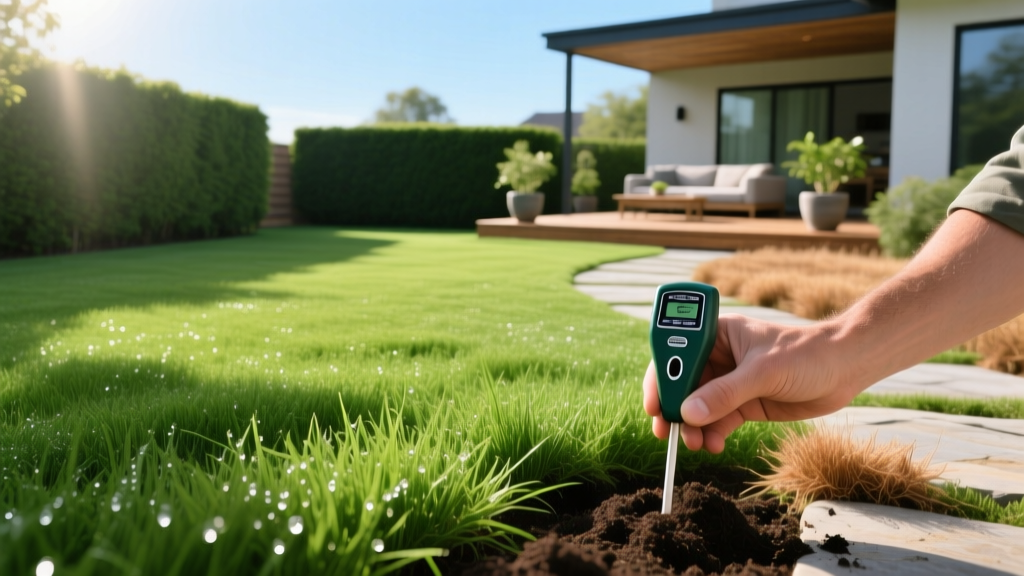
Why Is My Lawn Turning Brown? 7 Causes and Expert Fixes
The Diagnostic Trinity: Test Before You Treat
When homeowners ask, 'Why is my lawn turning brown?', the immediate instinct is often to apply more water or dump fertilizer on the problem. This is a costly mistake. Browning is a symptom of physiological stress, not a disease itself. Before buying any treatments, perform these three field tests to pinpoint the exact failure point in your turf's ecosystem.
The Screwdriver Test (Compaction & Moisture): Push a 6-inch flathead screwdriver into the soil. If it meets heavy resistance before reaching 4 inches, your soil is compacted or bone-dry. If it slides in effortlessly but the grass is brown, suspect overwatering or root rot.
The Tug Test (Pests): Grab a handful of brown grass at the edge of a damaged patch and pull straight up. If the turf rolls back like a loose carpet with no root resistance, subsurface pests (grubs) have severed the root system.
The Blade Inspection (Fungus): Examine the individual grass blades at the border of the brown and green grass. Look for distinct lesions, cobweb-like mycelium in the morning dew, or dark 'smoke rings' at the patch perimeter.
1. Moisture Mismanagement and Hydrophobic Soil
The most frequent cause of browning is improper irrigation, but it is rarely as simple as 'not enough water.' Lawns require 1 to 1.5 inches of water per week, but delivery method matters immensely. Daily, shallow watering (e.g., 10 minutes every morning) forces roots to stay in the top inch of soil, making them highly susceptible to heat stress.
Localized Dry Spot (Hydrophobic Soil)
If you are watering adequately but seeing irregular, isolated brown patches that repel water, you are dealing with Localized Dry Spot (LDS). This occurs when fungal mycelium and decomposing organic matter coat soil particles with a waxy substance, making them hydrophobic. Water simply runs off the surface or down the aeration holes without wetting the root zone.
- The Fix: Apply a soil surfactant (wetting agent). Commercial products containing yucca extract or alkylpolyglucoside break the surface tension. A budget-friendly alternative is mixing 2 ounces of clear, non-antibacterial baby shampoo per gallon of water and spraying it over 1,000 square feet, followed immediately by deep irrigation.
2. Fungal Pathogens: Brown Patch and Dollar Spot
Fungus thrives when three conditions align: a susceptible host, a pathogen, and the right environment (usually high humidity and specific temperature ranges). According to Penn State Extension, misidentifying the fungus leads to ineffective chemical applications.
Brown Patch (Rhizoctonia solani)
Brown patch primarily attacks tall fescue, perennial ryegrass, and bentgrass during hot, humid summer nights (when temperatures stay above 70°F). It manifests as circular patches ranging from a few inches to several feet across, often featuring a dark, purplish 'smoke ring' border in the early morning.
- Chemical Fix: Apply a preventative or early curative fungicide containing Azoxystrobin (e.g., Scotts DiseaseEx) or Propiconazole (e.g., BioAdvanced Fungus Control). Rotate active ingredients every 21 days to prevent pathogen resistance.
Dollar Spot (Sclerotinia homoeocarpa)
Unlike the large circles of brown patch, dollar spot creates small, straw-colored circles roughly the size of a silver dollar. It is heavily linked to low soil nitrogen levels. If you see dollar spot, your lawn is likely starving for nitrogen.
- The Fix: Apply a fast-release nitrogen fertilizer (like urea or ammonium sulfate) at a rate of 0.5 lbs of nitrogen per 1,000 sq ft to push the grass through the infection, combined with a contact fungicide like Chlorothalonil if the outbreak is severe.
3. Subsurface Pests: Grubs and Chinch Bugs
If the Tug Test reveals detached roots, you have a pest problem. The two most common culprits are white grubs and chinch bugs, but their treatment protocols are entirely different.
| Pest | Identification | Damage Threshold | Targeted Treatment |
|---|---|---|---|
| White Grubs | C-shaped, white larvae with brown heads in the top 2 inches of soil. | 5-10 grubs per square foot. | Curative: Trichlorfon (Dylox). Preventative: Chlorantraniliprole (GrubEx). |
| Chinch Bugs | Tiny black insects with white wings; found at the thatch line in St. Augustine/Bermuda. | 20-25 bugs per square foot. | Bifenthrin or Lambda-cyhalothrin granular applications. |
For a deep dive into grub lifecycles and regional timing, the University of Maryland Extension provides excellent regional scouting calendars. Applying preventative grub control (Chlorantraniliprole) in late May to early June is vastly more effective and environmentally safer than trying to kill mature, root-eating grubs in September with harsh curative chemicals.
4. Soil Compaction and Thatch Asphyxiation
Grass roots require oxygen. When soil becomes compacted from foot traffic, or when the thatch layer (the spongy mat of dead stems and roots between the soil and the green blades) exceeds 0.5 inches, water and air cannot penetrate the root zone. The grass essentially suffocates and starves, turning brown from the roots up.
- Core Aeration: Rent a core aerator (not a spike aerator, which worsens compaction) and pull 3-inch deep plugs when the soil is moderately moist. Leave the plugs on the lawn to break down naturally.
- Dethatching: Use a power rake or vertical mower in early fall (for cool-season grasses) or late spring (for warm-season grasses) to physically rip out the excess thatch layer.
5. Chemical Trauma: Fertilizer Burn and Dog Urine
Applying too much synthetic, fast-release fertilizer (especially in high heat) causes a massive spike in soil salts. This creates an osmotic gradient that literally pulls water out of the grass roots, resulting in 'fertilizer burn.' Similarly, dog urine spots are not caused by the pH of the urine, but by the concentrated nitrogen salts acting exactly like an overdose of fertilizer.
Emergency Flush Protocol: If you suspect fertilizer burn or heavy urine concentration, do not apply more chemicals. Immediately water the affected area with 1 inch of water daily for three consecutive days to leach the excess salts below the root zone.
6. Mowing Scalping and Dull Blades
Never remove more than 1/3 of the grass blade in a single mowing. Scalping the lawn exposes the sensitive, unhardened lower stems to direct UV radiation, causing rapid browning. Furthermore, a dull mower blade shreds the grass tip rather than cutting it cleanly. These shredded tips lose moisture rapidly and turn a distinct whitish-brown within 48 hours. Sharpen or replace your mower blades every 25 hours of operation.
7. Seasonal Dormancy vs. True Death
Finally, understand that browning is sometimes a natural survival mechanism. According to the EPA WaterSense program, allowing grass to enter natural dormancy during peak summer droughts saves billions of gallons of water annually.
- Cool-Season Grasses (Kentucky Bluegrass, Fescue): Naturally turn brown and go dormant when soil temperatures consistently exceed 75°F and air temperatures top 85°F. They will green up when autumn rains and cooler temperatures return.
- Warm-Season Grasses (Bermuda, Zoysia, St. Augustine): Turn completely brown and dormant after the first hard frost in autumn when soil temperatures drop below 55°F. They remain brown until mid-spring soil warming.
If your grass is dormant, the crowns (the base of the plant at the soil line) will still be firm and white/pale green. If the crowns are brittle, mushy, or entirely brown, the plant is dead and requires complete renovation via overseeding or sodding.

