
Lawn Care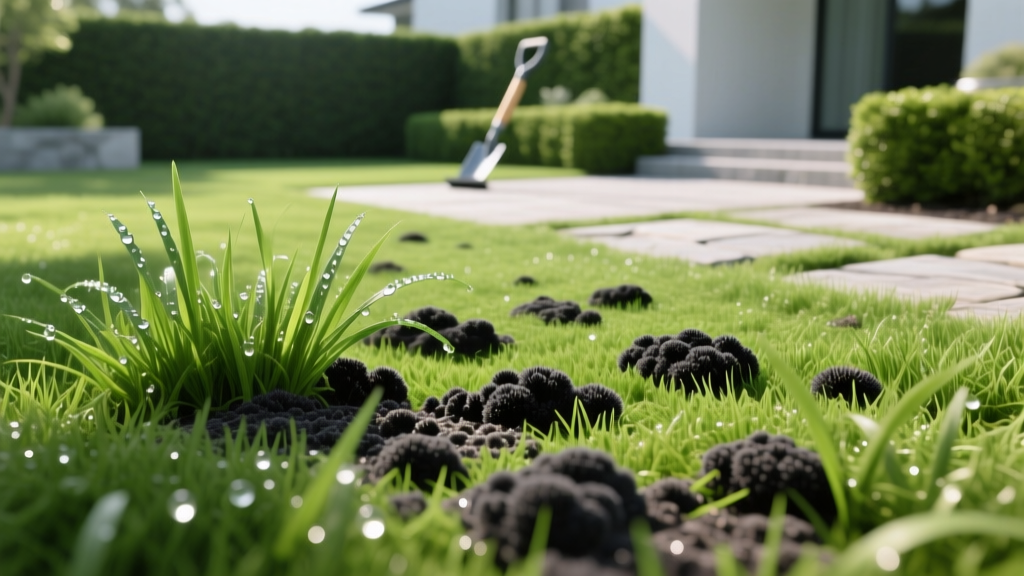
Black Mold on Grass: Symptom Diagnosis and Rescue Fixes
The 'Black Mold' Misnomer: What Is Actually on Your Lawn?
When homeowners spot black mold on grass, the immediate reaction is often panic, drawing associations with toxic indoor molds like Stachybotrys. However, true black mold does not parasitize living turfgrass. What you are observing is a symptom of one of three distinct biological processes: harmless slime molds, insect-induced sooty molds, or severe pathogenic turf fungi. Misdiagnosing the culprit leads to wasted money on ineffective fungicides and continued lawn decline. Accurate symptom diagnosis is the only way to deploy the correct rescue fix.
⚠️ Critical Diagnostic Rule: True indoor black mold requires professional remediation. Outdoor 'black mold' on turf is either a surface nuisance or a root-pathogen. Never use indoor mold-killing chemicals (like bleach or concrobium) on your lawn; these will destroy soil microbiology and burn grass crowns.
Diagnostic Decision Tree: Identifying the Culprit
Before purchasing any treatment, perform this three-step physical inspection to narrow down the exact organism affecting your turf.
- The Wipe Test: Put on a gardening glove and rub a blackened grass blade between your fingers. If it leaves a distinct black, powdery residue that wipes away cleanly, you are dealing with Sooty Mold.
- The Texture Test: If the black substance looks like a crusty, slimy, or powdery scab sitting on top of the grass blades and soil surface (often resembling dog vomit or spilled paint), and the grass underneath is still green and alive, you have Slime Mold.
- The Tug Test: If the black substance is a dark, web-like mycelium at the soil line (the crown), and the grass blades are dead, brown, and pull out of the soil with zero resistance, you are facing a Pathogenic Turf Fungus (such as advanced Snow Mold or Necrotic Ring Spot).
Suspect 1: Slime Mold (The Surface Nuisance)
Slime molds, primarily from the Physarum or Fuligo genera, are not true fungi; they are amoeba-like protists. They feed on decaying organic matter and bacteria in the thatch layer, not on the living grass itself. During their reproductive phase, they climb grass blades to form black, grey, or purplish fruiting bodies (sporangia) to release spores.
Rescue Fixes for Slime Mold
Because slime mold does not infect plant tissue, chemical fungicides are entirely useless and a waste of capital. According to turf pathology experts at the University of Minnesota Extension, slime molds are strictly cosmetic issues that resolve on their own. However, if the spore masses are thick enough to block sunlight and cause temporary yellowing, use these mechanical fixes:
- Hydraulic Disruption: Use a garden hose with a high-pressure nozzle to blast the spore masses off the blades and into the soil.
- Physical Removal: Mow the lawn and bag the clippings. Set your mower deck to 3 inches to remove the top 1/3 of the blade where the spores congregate.
- Raking: Lightly rake the affected area to break up the crust and improve air circulation at the soil level.
Suspect 2: Sooty Mold (The Insect Byproduct)
If the black substance wipes off like charcoal powder, you are looking at Sooty Mold (Capnodium species). This fungus does not attack the grass directly; it grows on 'honeydew'—the sugary, sticky excrement left behind by sap-sucking insects like aphids, mealybugs, or scale insects. The mold blocks sunlight, reducing photosynthesis and stunting turf growth.
Rescue Fixes for Sooty Mold
Treating the mold without treating the insects guarantees the mold will return within 14 days. You must break the honeydew supply chain.
- Eradicate the Insects: Apply a systemic insecticide containing Imidacloprid (e.g., Bayer Advanced 24-Hour Grub & Insect Killer, approx. $35 for 10 lbs). Apply at a rate of 2.5 lbs per 1,000 sq ft and water in with 0.5 inches of irrigation. For an organic approach, spray Spinosad (e.g., Captain Jack's Deadbug Brew, $20/pint) directly on the foliage at dusk to protect pollinators.
- Wash the Canopy: Mix 1 tablespoon of mild liquid dish soap (like Dawn) into 1 gallon of water. Spray this solution over the blackened grass to emulsify the waxy coating of the sooty mold. Wait 30 minutes, then rinse heavily with a garden hose.
Suspect 3: Pathogenic Turf Fungi (The Root Killers)
If the black appearance is accompanied by dead, mushy grass crowns and a dark, thread-like mycelium at the soil line, you are dealing with a destructive pathogen. The most common culprits are Microdochium nivale (which can appear dark grey/black in advanced decomposition) or Typhula incarnata (Grey Snow Mold), which leaves behind dark sclerotia (hard survival structures) on dead grass blades. Another possibility is severe Magnaporthe poae (Summer Patch) where blackened roots and crowns are visible upon close inspection.
Rescue Fixes for Pathogenic Fungi
Cultural practices alone will not stop an active, aggressive turf pathogen. You must deploy targeted chemistry to halt the spread and save the surrounding healthy turf.
- Contact/Preventative Fungicide: Apply Propiconazole 14.3% (e.g., Banner MAXX or generic equivalents, approx. $45 per pint). Mix at a curative rate of 2.0 fluid ounces per 1,000 square feet. Apply with a pump sprayer in the early morning when dew is present, allowing the chemical to penetrate the leaf tissue.
- Systemic Fungicide (For Severe Outbreaks): If the disease has reached the roots (like Summer Patch), use a QoI fungicide like Azoxystrobin (Heritage SC). This costs roughly $160 per gallon but treats 10,000 sq ft at a highly economical rate of 0.4 to 0.8 oz per 1,000 sq ft. Water it in immediately with 0.25 inches of water to push the active ingredient into the root zone.
- Post-Rescue Overseeding: Pathogens leave bare patches. Wait 14 days after the final fungicide application, then core aerate and overseed with a disease-resistant turfgrass cultivar (such as Titan Ultra Tall Fescue or NuGlide Kentucky Bluegrass).
Diagnostic Comparison Matrix
| Characteristic | Slime Mold | Sooty Mold | Pathogenic Fungi |
|---|---|---|---|
| Visual Appearance | Black/grey crusty scabs or sludge on blades | Fine, powdery black dust coating the leaf | Dark web-like threads at soil; dead grass crowns |
| Wipe Test Result | Smears like wet dirt; crusts break apart | Wipes off cleanly like charcoal powder | Nothing wipes off; grass blade disintegrates |
| Turf Health | Grass is alive; temporary yellowing from shade | Grass is alive; stunted growth | Grass is dead; roots are necrotic |
| Primary Fix | Mowing, raking, or water blasting | Imidacloprid/Spinosad + Soapy wash | Propiconazole or Azoxystrobin fungicides |
Long-Term Prevention: Canopy and Soil Management
All three of these organisms thrive in specific micro-environments characterized by poor air circulation, excess surface moisture, and thick thatch layers. According to pathology data from NC State Extension, modifying the turf canopy is the most effective long-term defense against fungal and slime outbreaks.
💡 Pro-Tip: The Thatch Threshold
Use a trowel to cut a wedge of your lawn and measure the brown, spongy layer between the green grass and the mineral soil. If this thatch layer exceeds 0.5 inches, it is acting as a sponge for fungal spores and a breeding ground for honeydew-producing insects. You must dethatch or core aerate immediately.
Use a trowel to cut a wedge of your lawn and measure the brown, spongy layer between the green grass and the mineral soil. If this thatch layer exceeds 0.5 inches, it is acting as a sponge for fungal spores and a breeding ground for honeydew-producing insects. You must dethatch or core aerate immediately.
Actionable Prevention Protocols
- Deep, Infrequent Irrigation: Stop watering daily for 15 minutes. Switch to watering twice a week, applying 0.5 inches per session (use a tuna can to measure). This forces roots deep and allows the surface thatch to dry out between waterings, starving slime and snow molds.
- Core Aeration: Rent a walk-behind core aerator ($75-$100/day) or hire a professional ($150-$200 for an average 5,000 sq ft yard) in early fall. The machine must pull plugs at least 3 inches deep to relieve soil compaction and improve drainage.
- Precision Mowing: Never scalp the lawn. Maintain cool-season grasses (Fescue, Bluegrass) at 3.0 to 3.5 inches, and warm-season grasses (Bermuda, Zoysia) at 1.5 to 2.5 inches. Taller grass shades the soil, reducing the surface humidity that triggers mold sporulation.
- Nitrogen Management: Avoid high-nitrogen, quick-release synthetic fertilizers in late fall. Excessive late-season nitrogen creates lush, weak tissue that is highly susceptible to overwintering snow molds. Switch to a slow-release methylene urea fertilizer with a maximum application rate of 0.75 lbs of nitrogen per 1,000 sq ft in autumn.
When to Call a Licensed Turf Professional
If you have applied a curative rate of Propiconazole and the black, necrotic patches continue to expand by more than 2 inches per week, the pathogen may be resistant to DMI (Demethylation Inhibitor) fungicides, or you may be misdiagnosing a severe nematode infestation that is causing secondary fungal rot. At this stage, hire a licensed agronomist to pull core samples and send them to a university plant diagnostic lab (typically $50-$100 per sample) for DNA-level pathogen identification.

