
Lawn Care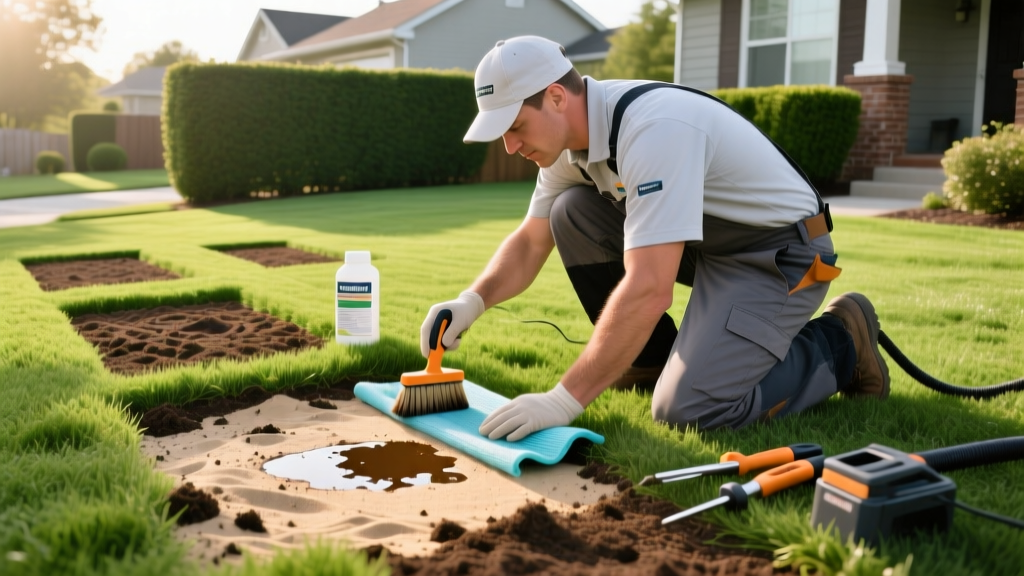
DEF for Lawns: Step-by-Step Diesel Spill Remediation
⚠️ Hazard Profile: Diesel Exhaust Fluid (AUS 32)
While not toxic to humans in small amounts, DEF is a severe turfgrass hazard. It consists of 32.5% high-purity urea and 67.5% deionized water. A single 1-gallon spill introduces roughly 1.35 lbs of concentrated nitrogen into a localized area, triggering immediate osmotic desiccation (reverse osmosis) that pulls water out of grass roots, causing rapid necrosis.
While not toxic to humans in small amounts, DEF is a severe turfgrass hazard. It consists of 32.5% high-purity urea and 67.5% deionized water. A single 1-gallon spill introduces roughly 1.35 lbs of concentrated nitrogen into a localized area, triggering immediate osmotic desiccation (reverse osmosis) that pulls water out of grass roots, causing rapid necrosis.
The Chemistry Behind the Burn
The intersection of diesel truck ownership and turfgrass management has created a highly specific nuisance: the accidental spill of Diesel Exhaust Fluid. When homeowners search for solutions regarding def for lawns, they are usually dealing with severe, localized nitrogen burn. Understanding the chemical reality of the spill is mandatory before attempting any lawn maintenance procedures.
According to the ISO 22241-1 standard for AUS 32, DEF is strictly formulated as 32.5% urea. Urea (CH4N2O) carries a 46-0-0 nitrogen analysis. To put this in perspective, a standard 2.5-gallon jug of DEF contains the equivalent nitrogen payload of nearly 3.5 lbs of pure urea. If spilled on a 2x2 foot patch of lawn, this translates to an application rate exceeding 5,000 lbs of nitrogen per acre. No turfgrass species—whether highly resilient Bermudagrass or delicate Kentucky Bluegrass—can survive this osmotic shock.
Agronomic Insight: The damage from a DEF spill is not caused by acidity or alkalinity (DEF has a near-neutral pH of ~7.5). The damage is purely osmotic. The massive concentration of soluble salts and urea in the soil creates a hypertonic environment, physically drawing moisture out of the turfgrass root cells until they collapse.
Spill Triage: The Time-Sensitive Decision Matrix
Your remediation procedure depends entirely on how long the DEF has been in contact with the soil. Do not deviate from this framework.
| Time Since Spill | Visual Symptoms | Required Protocol |
|---|---|---|
| 0 - 2 Hours | Wet soil, no leaf yellowing | Phase 1: Aggressive Hydraulic Flushing |
| 2 - 24 Hours | Leaf tips wilting, dark green 'halo' effect | Phase 1 + Surfactant Injection |
| 24+ Hours | Severe yellowing, brittle brown necrosis | Phase 2: Mechanical Extraction & Reseeding |
Phase 1: Aggressive Hydraulic Flushing (Immediate Action)
If you catch the spill immediately, your goal is to push the urea below the root zone (typically 6-8 inches deep) before the grass can absorb it. Standard watering is insufficient; you must calculate the leaching fraction.
- Calculate the Volume: You need a minimum of 15 gallons of water per square foot of the visible spill area to achieve a proper leaching fraction.
- Apply a Surfactant: Water alone will often pool and run off the urea-crust. Mix 3 ounces of a Yucca schidigera-based wetting agent (like Aqua-Aid) per 5 gallons of water. This breaks the soil's surface tension and forces the water to carry the urea straight down.
- Execute the Flush: Use a hose-end sprayer or a watering can to apply the surfactant-water mixture evenly over the spill site. Do not use high-pressure nozzles, which will cause contaminated runoff into storm drains.
- Aerate the Zone: Immediately after flushing, use a manual core aerator or a digging fork to punch 6-inch holes into the saturated soil. This provides an escape route for the urea-laden water to drain into the subsoil.
Phase 2: Mechanical Extraction (For Delayed Discovery)
If the spill has sat for more than 24 hours, the turfgrass in the immediate blast radius is dead. The urea has begun converting to ammonium and nitrate, spiking the soil's Electrical Conductivity (EC) to toxic levels. According to University of Minnesota Extension turfgrass guidelines, most cool-season grasses suffer severe osmotic stress when soil EC exceeds 3.0 dS/m. A DEF spill can easily push local EC past 10.0 dS/m.
🛠️ Tool Requirement: EC Meter Diagnostics
Before attempting to reseed an extracted spill site, use a soil EC meter (such as the Hanna Instruments HI98331). Insert the probe into the top 3 inches of soil. If the reading is above 2.5 dS/m, residual urea remains, and new seed will fail to germinate. Continue flushing until EC drops below 1.5 dS/m.
Before attempting to reseed an extracted spill site, use a soil EC meter (such as the Hanna Instruments HI98331). Insert the probe into the top 3 inches of soil. If the reading is above 2.5 dS/m, residual urea remains, and new seed will fail to germinate. Continue flushing until EC drops below 1.5 dS/m.
The Extraction Procedure
- Outline the Damage: Mark a 1-foot buffer zone beyond the visible brown grass. Urea spreads laterally in the thatch layer.
- Cut and Remove Sod: Use a sharp sod cutter or a flat spade to remove the dead grass and the top 2.5 inches of topsoil. The urea binds tightly to organic matter in the thatch and upper soil horizon.
- Neutralize the Subsoil: Apply a heavy dusting of granular humic acid (at a rate of 3 lbs per 1,000 sq ft) to the exposed subsoil. Humic acid increases the soil's Cation Exchange Capacity (CEC), helping to buffer residual ammonium ions.
- Backfill: Fill the void with a clean, screened topsoil/compost mix (80/20 ratio). Do not use soil from elsewhere in your yard, as it may harbor weed seeds or incompatible nematodes.
Phase 3: Biological Reset and Reseeding
Once the soil is physically replaced or chemically verified (EC < 1.5 dS/m), you must re-establish the turf canopy. Because the localized nitrogen levels may still be artificially high, avoid using starter fertilizers containing nitrogen.
- Select the Cultivar: Match your existing lawn. For a Kentucky Bluegrass lawn, use a 3-way KBG blend. For Tall Fescue, use a turf-type tall fescue (TTTF) mix. Do not use cheap 'contractor' mixes containing annual ryegrass, which will compete with your existing turf long-term.
- Apply Phosphorus-Only Starter: Use a 0-20-0 or 0-46-0 fertilizer. The residual nitrogen from the DEF spill will act as the nitrogen source for the new seedlings; they only need phosphorus for root development.
- Seed and Topdress: Broadcast seed at 5-6 lbs per 1,000 sq ft. Topdress with 1/4 inch of peat moss to retain moisture.
- Watering Schedule: Water lightly 3-4 times a day for the first 14 days to keep the top inch of soil perpetually damp. Transition to deep, infrequent watering once seedlings reach 2 inches in height.
Preventative Hardscaping for Diesel Owners
The most effective lawn maintenance procedure for DEF is prevention. Diesel truck owners who frequently park on grass or refill their AUS 32 tanks in the driveway should implement physical barriers.
- Spill Pans: Keep a $25 flexible PVC spill pan (minimum 36x48 inches) under the DEF fill port during refueling.
- Designated Parking Pads: Install permeable pavers or a gravel pad specifically for truck parking. This prevents both DEF spills and the soil compaction caused by heavy axle loads.
- Secondary Containment: Store bulk DEF jugs in a plastic secondary containment bin on a concrete surface, away from direct sunlight (UV degrades urea into ammonia gas).
Frequently Asked Questions
Will a heavy rainstorm wash away a DEF spill?
No. A typical rainstorm delivers roughly 0.5 to 1 inch of water, which equates to about 0.6 gallons per square foot. This is nowhere near the 15 gallons per square foot required to leach the urea below the root zone. Rain will actually spread the concentrated urea laterally, widening the burn patch.
Can I apply gypsum to neutralize the DEF?
Gypsum (calcium sulfate) is excellent for displacing sodium in sodic soils, but it does not neutralize urea or ammonium. Stick to hydraulic flushing for immediate spills, and humic acid for long-term biological buffering.
Is the soil permanently ruined?
DEF is entirely biodegradable. Soil microbes will eventually break down the excess urea into nitrate, which will either be taken up by plants or leached away. However, the 'eventual' timeline can take 3 to 6 months, during which the high salt index will prevent seed germination. Mechanical extraction is always faster than waiting for microbial degradation.

