
Lawn Care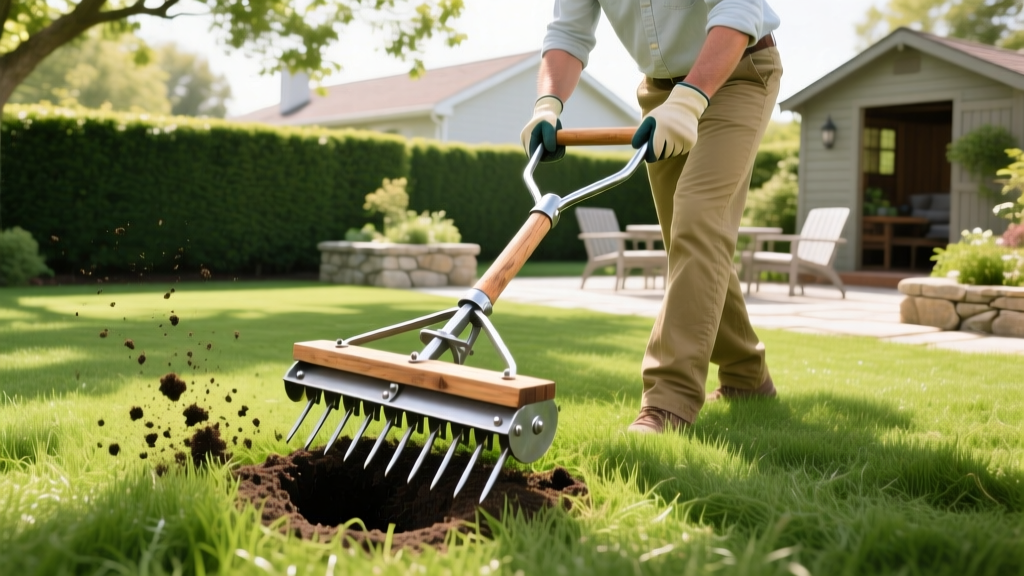
How to Build and Use a DIY Grass Aerator for Organic Lawn Care
The Role of Aeration in a Chemical-Free Lawn Ecosystem
Transitioning to an organic, chemical-free lawn care program requires a fundamental shift in how you view soil. Synthetic fertilizers feed the grass directly but often degrade the soil food web over time. Organic lawn care relies on soil microbes, mycorrhizal fungi, and earthworms to break down organic matter and deliver nutrients to the roots. However, these biological processes grind to a halt in compacted soil due to oxygen deprivation.
Mechanical aeration is the linchpin of any organic lawn maintenance strategy. By extracting physical cores of soil, you introduce oxygen to the root zone, relieve compaction, and create micro-channels for organic compost and natural soil amendments to penetrate deeply. While renting a gas-powered core aerator costs between $80 and $120 per day and introduces exhaust fumes and heavy machinery compaction to your yard, a targeted DIY grass aerator approach can yield superior results for small-to-medium lawns (under 5,000 square feet) while keeping your carbon footprint near zero.
Pre-Aeration Diagnostics: Testing Your Soil Profile
Before building or deploying a DIY grass aerator, you must confirm that compaction is actually your limiting factor. Aerating loose, sandy soil can disrupt delicate root structures without providing any compaction relief.
The Screwdriver and Ribbon Tests
- The Screwdriver Test: Take a standard 6-inch flathead screwdriver and push it into the lawn. If you cannot easily sink it to the handle using only your body weight, your soil is compacted and requires core aeration.
- The Ribbon Test (Moisture Check): Grab a handful of soil from a 3-inch depth and squeeze it. If it crumbles immediately, it is too dry to aerate (the cores will shatter). If it forms a slick, shiny ribbon over 2 inches long, it is too wet (aerating now will smear the clay and worsen compaction). The ideal moisture level forms a loose ball that breaks apart when poked.
Expert Warning: The Aerator Sandal Myth
Many DIYers purchase strap-on aerator sandals with solid metal spikes. According to the USDA Natural Resources Conservation Service, solid spikes do not remove soil volume; they merely push soil outward, increasing lateral compaction in clay-heavy yards. For organic lawn care, you must use hollow-tine core extraction or liquid surfactant aeration.
3 Effective DIY Grass Aerator Builds and Protocols
Below are three distinct, low-cost DIY methods tailored for the organic lawn care enthusiast. These range from mechanical core extraction to biological soil softening.
Build 1: The Heavy-Duty Manual Core Pitchfork (Modified)
Standard garden pitchforks have solid tines. To build a true manual core aerator, you need a hollow-tine foot-lever extractor. While you can weld one from square steel tubing, the most cost-effective DIY route is modifying a heavy-duty manual coring tool (like a standard yard coring fork, typically $40-$50) for maximum leverage.
- The Leverage Mod: Most manual coring tools fail because the foot bar is too narrow, causing foot fatigue. Bolt a 12-inch length of 1.5-inch aluminum angle iron across the existing foot pegs using 3/8-inch carriage bolts. This distributes your weight evenly and allows you to punch through heavy clay crusts.
- The Core Clearing Wire: Hollow tines clog with wet clay. Bend a piece of 12-gauge galvanized wire into a tight "U" shape, slightly narrower than the tine diameter. Keep this in your pocket to manually punch out clogged clay cores every 3-4 plunges.
- Target Depth: Aim for exactly 2.5 to 3 inches. This reaches the primary root zone of most cool-season fescues and warm-season bermudagrasses without bringing up dormant weed seeds from deeper soil horizons.
Build 2: The DIY Chain-Link Core Breaker Drag
In organic lawn care, what you do after pulling cores is more important than the aeration itself. You want to break the extracted cores and drag them into the turf canopy to act as a natural topdressing that introduces soil microbes to the thatch layer.
- Materials: A 4x4 foot section of heavy-duty galvanized chain-link fencing, two 8-foot nylon tow straps, and a reclaimed wooden shipping pallet.
- Assembly: Wrap the chain-link fencing tightly around the wooden pallet and secure it with heavy-duty zip ties and galvanized wire. Attach the tow straps to the pallet's front stringers.
- Execution: Hitch the drag mat to a riding mower or an ATV (or pull it manually with a harness). Drive over the extracted cores at a slow pace (2-3 MPH). The chain-link will pulverize the clay cores, filtering the soil down into the aeration holes and leaving the thatch exposed to decompose.
Build 3: Organic Liquid Aeration Surfactant Mix
If your lawn is too steep for manual tools or you want to supplement mechanical aeration, liquid aeration uses natural saponins to reduce the surface tension of water, allowing it to penetrate hydrophobic (water-repellent) soils. This is a staple in chemical-free golf course management.
DIY Liquid Aerator Recipe (Per 1,000 sq. ft.)
- Yucca Extract (Liquid Saponin): 2 ounces. (Acts as a natural wetting agent to break up soil tension).
- Blackstrap Molasses: 4 ounces. (Provides a rapid carbon food source for soil bacteria, which exude glomalin to bind soil aggregates).
- Fulvic Acid: 1 ounce. (Chelates minerals and stimulates root hair growth).
- Water: Mix into 2 gallons of non-chlorinated water (let tap water sit for 24 hours to off-gas chlorine, which harms soil biology).
Application: Spray evenly using a pump sprayer. Water the lawn with 1/2 inch of irrigation immediately after to drive the surfactants into the root zone.
Method Comparison: DIY vs. Gas-Powered Rental
| Method | Estimated Cost | Core Depth | Best Soil Type | Organic Impact |
|---|---|---|---|---|
| Manual Hollow-Tine (Modified) | $45 - $60 | 3.0 inches | Heavy Clay / Loam | High (Zero emissions, precise targeting) |
| Chain-Link Drag Mat (DIY) | $15 - $25 | N/A (Surface) | All (Post-aeration) | High (Accelerates thatch decomposition) |
| Liquid Surfactant Mix | $12 - $18 | Chemical penetration | Sandy / Hydrophobic | Moderate (Feeds microbes, no physical holes) |
| Gas-Powered Rental | $85 - $120 / day | 2.5 - 3.5 inches | Large Lawns (>5k sq ft) | Low (Fossil fuels, heavy machine compaction) |
Step-by-Step: The Organic Aeration and Topdressing Protocol
To maximize the biological benefits of your DIY grass aerator, follow this precise sequence. Timing is critical; aerate cool-season grasses (Fescue, Kentucky Bluegrass) in early fall, and warm-season grasses (Bermuda, Zoysia) in late spring.
- Mow Low: Drop your mower deck to 1.5 inches. This exposes the soil surface and ensures the hollow tines make direct contact with the earth, not the thatch.
- Pre-Soak: Apply 1 inch of water 24 hours before aeration. This softens the clay crust, allowing your manual tools to penetrate fully without bending the tines.
- Extract Cores: Use your modified manual coring tool, spacing holes 4 to 6 inches apart in a grid pattern. Overlap high-traffic areas (like pathways and play zones) with a second pass.
- Organic Topdressing: Immediately after core extraction, spread a 1/4-inch layer of screened organic compost over the lawn. The compost must have a particle size smaller than 1/4 inch so it falls into the aeration holes rather than smothering the grass blades. Apply at a rate of roughly 1 cubic yard per 1,000 square feet.
- Drag and Water: Use your DIY chain-link drag mat to pull the compost and the pulverized clay cores into the holes. Finish with a deep, 45-minute watering cycle to activate the compost microbes and settle the soil.
Troubleshooting Common DIY Aeration Failures
Even with the best DIY builds, edge cases occur. Here is how to troubleshoot them without resorting to chemical soil softeners.
- Tines Bending on Impact: If your manual coring tines are bending, you are likely hitting sub-surface builder's rubble or extreme hardpan clay. Switch to a liquid aeration surfactant protocol for two weeks to soften the soil profile, then retry mechanical extraction.
- Grass Smothering Post-Topdressing: If your grass turns yellow after compost topdressing, your compost was likely unscreened or applied too thickly (>1/2 inch), blocking photosynthesis. Rake the lawn vigorously with a stiff-bristled push broom to lift the grass blades and redistribute the excess compost.
- Weed Flare-Ups: Aeration can expose dormant weed seeds (like crabgrass) to sunlight. In an organic program, counter this by heavily overseeding with a competitive, region-specific turfgrass blend immediately after topdressing. The new grass will outcompete weeds for the newly available root space.
"Aeration is not just about making holes; it is about managing the gas exchange between the atmosphere and the soil microbiome. When you pair physical core extraction with organic carbon inputs like compost, you transition your lawn from a chemical dependency to a self-sustaining ecosystem."
By utilizing these DIY grass aerator methods, you maintain complete control over your lawn's ecological trajectory. You eliminate the need for synthetic wetting agents, avoid the soil-smearing risks of cheap spike tools, and build a resilient, drought-tolerant root system powered entirely by natural biological processes.

