
Lawn Care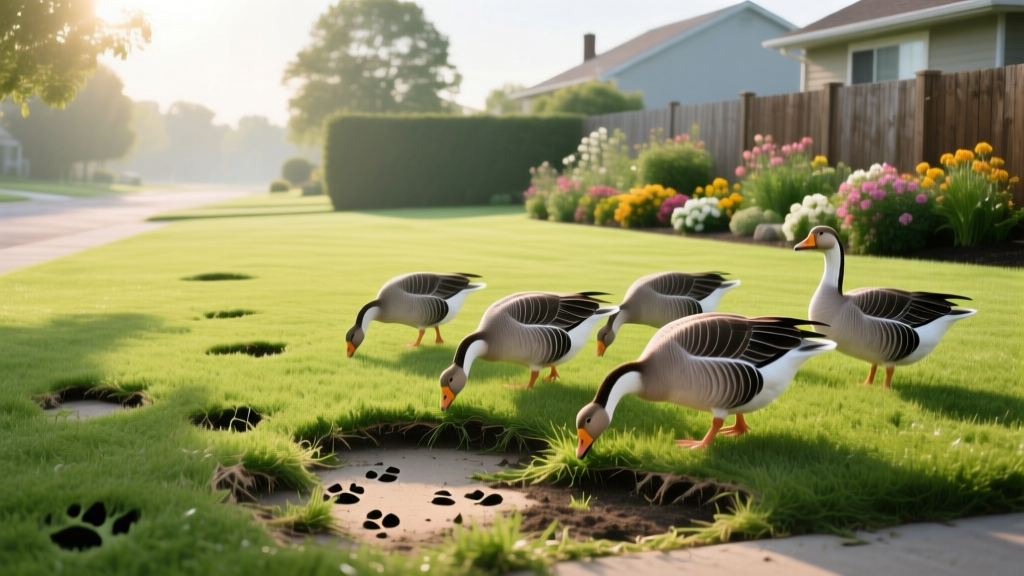
Do Geese Eat Grass? Identifying Damage and Protecting Your Lawn
The short answer to whether geese eat grass is a definitive yes. In fact, turfgrass is the primary dietary staple for suburban and urban populations of Canada geese (Branta canadensis). While they are often seen near water, geese are fundamentally grazing herbivores. An adult goose can consume between 3 to 4 pounds of fresh grass daily, turning pristine residential lawns into heavily grazed, compacted, and fouled wastelands.
For homeowners, the question is rarely about if geese eat grass, but rather how to identify the specific damage they leave behind and how to implement a scientifically backed deterrent strategy. This guide breaks down the biological mechanics of goose grazing, the hidden chemical damage caused by their waste, and actionable frameworks to protect your turf.
The Biological Reality: Why Geese Target Turfgrass
Unlike ruminants such as cows or sheep, geese possess a relatively simple digestive tract. They lack a multi-chambered stomach to ferment and break down tough cellulose efficiently. To compensate for this low digestive efficiency, geese must graze almost continuously during daylight hours to extract sufficient calories and nutrients.
Suburban lawns—particularly those planted with Kentucky bluegrass (Poa pratensis) and perennial ryegrass (Lolium perenne)—offer an ideal, low-effort food source. These grasses are tender, heavily watered, and often treated with nitrogen-rich fertilizers that increase the protein content of the blades, making them highly attractive to foraging flocks.
Data Highlight: The Grazing Impact
A single flock of 20 resident geese can strip and remove over 800 pounds of turfgrass biomass in a single week, while simultaneously depositing roughly 40 pounds of fecal matter across the same area.
A single flock of 20 resident geese can strip and remove over 800 pounds of turfgrass biomass in a single week, while simultaneously depositing roughly 40 pounds of fecal matter across the same area.
Damage Identification Matrix: Geese vs. Other Lawn Pests
Misdiagnosing lawn damage leads to wasted time and ineffective treatments. Geese possess serrated cartilage structures along their beaks called tomia, which act like pinking shears. This leaves a very specific signature on the turf that differs from mammalian grazers or insect pests.
| Pest / Cause | Turf Damage Signature | Dropping / Physical Evidence | Peak Activity Window |
|---|---|---|---|
| Canada Geese | Ragged, torn, and frayed grass tips; uneven grazing heights; pulled-up seedlings. | Cylindrical, dark green/brown droppings; heavy webbed-foot compaction in muddy areas. | Dawn to dusk (continuous grazing) |
| White-Tailed Deer | Clean, angled cuts on broadleaf weeds and ornamental shrubs; rarely graze turfgrass heavily. | Pellet-like, oval droppings; distinct cloven hoof prints. | Crepuscular (dawn and dusk) |
| Skunks / Raccoons | Turf is not eaten; instead, 2-inch deep divots are peeled back as they forage for grubs. | Loose, tubular scat containing undigested insect parts or seeds. | Nocturnal |
| Sod Webworms | Grass blades chewed down to the crown; silk webbing visible on soil surface at dawn. | Small, green/brown frass (pellets) scattered at the soil line. | Nocturnal (larvae feed at night) |
The Chemical Threat: Goose Droppings and Soil Toxicity
While the physical loss of grass blades is visually alarming, the secondary damage from goose feces poses a severe threat to long-term soil health and turf viability. Goose droppings are not a benign organic fertilizer.
Nitrogen Overload and Fertilizer Burn
Because geese digest food inefficiently, their waste is highly concentrated. A heavy concentration of droppings introduces massive spikes of localized nitrogen and phosphorus. Rather than nourishing the lawn, these concentrated deposits cause severe osmotic stress, resulting in localized 'fertilizer burn' that kills the grass down to the root zone.
Soluble Salts and Soil pH Alteration
According to Cornell University's Wildlife Damage Management program, the accumulation of avian waste significantly increases the soluble salt index of the topsoil. High salt concentrations draw moisture away from turfgrass roots, causing drought-like stress even in well-irrigated lawns. Furthermore, the bacterial load in goose feces—including E. coli and Salmonella—makes the lawn a biohazard for children and pets.
The Deterrent Framework: Reclaiming Your Yard
Relying on a single deterrent method inevitably fails due to habituation. Geese are highly intelligent and quickly learn to ignore static threats. A successful strategy requires a layered approach combining chemical, visual, and physical disruptions.
Tier 1: Chemical and Biological Repellents
The most effective chemical deterrents do not rely on bad tastes, as geese will simply wash the taste away in nearby ponds. Instead, look for products containing Anthraquinone (e.g., FlightControl PLUS). Anthraquinone is a post-ingestion repellent. When the goose eats the treated grass, it triggers a mild, temporary digestive upset. The goose quickly associates the visual appearance of your specific lawn with illness and avoids it entirely.
- Application Rate: Typically 1.5 to 2 ounces per gallon of water, covering roughly 1,000 square feet.
- Cost Expectation: Commercial-grade anthraquinone concentrates cost between $130 and $160 per gallon in 2026.
- Timing: Apply during the early spring molting season when geese are flightless and heavily reliant on localized grazing.
Tier 2: Sonic and Visual Disruption
For larger properties (over half an acre), visual and sonic deterrents provide necessary reinforcement. The Bird-X GooseBuster Pro utilizes bio-acoustic technology, broadcasting recorded distress calls of Canada geese alongside predator vocalizations. To prevent habituation, the device must be set to a randomized interval and frequency-shifting mode.
Pair sonic devices with moving visual threats. Static plastic coyote decoys lose their effectiveness within 48 hours. Instead, deploy laser deterrent systems like the AVIX Autonomic Marksmen, which project a randomized, moving green laser beam across the lawn. Geese perceive the laser beam as a physical approaching predator and will flee the area.
Turf Recovery Protocol: Healing Grazed Lawns
If your lawn has already been subjected to heavy goose grazing, standard watering and mowing will not restore it. You must implement a targeted recovery protocol to address both the physical damage and the soil chemistry alterations.
- Soil Flushing and Testing: Before seeding, water the affected areas deeply (1 to 1.5 inches) to leach excess soluble salts from the goose droppings out of the root zone. Follow this with a standard soil test to check for pH imbalances.
- Core Aeration: Geese have flat, webbed feet that cause severe surface compaction, especially near water features. Rent a core aerator to pull 3-inch plugs from the soil, restoring oxygen flow to the damaged root systems.
- Endophyte-Enhanced Overseeding: When reseeding bare patches, select turfgrass varieties that contain fungal endophytes (such as specific cultivars of tall fescue or perennial ryegrass). According to Penn State Extension, these naturally occurring fungi produce alkaloids that make the grass blades bitter and mildly toxic to grazing insects and birds, including geese, without harming the turf itself.
Warning: Local Ordinances and Federal Law
Canada geese are protected under the Migratory Bird Treaty Act. While you are legally permitted to use non-lethal deterrents (lasers, repellents, noise) to protect your private property, it is a federal offense to harm, trap, or destroy the eggs of geese without specific permits from the U.S. Fish and Wildlife Service.
Canada geese are protected under the Migratory Bird Treaty Act. While you are legally permitted to use non-lethal deterrents (lasers, repellents, noise) to protect your private property, it is a federal offense to harm, trap, or destroy the eggs of geese without specific permits from the U.S. Fish and Wildlife Service.
Frequently Asked Questions
Will planting clover stop geese from eating my grass?
No. Clover is a legume that is highly palatable and rich in protein. Geese actively seek out clover in mixed-grass lawns. If you are trying to deter geese, avoid planting clover, alfalfa, or tender broadleaf weeds.
Do fake owls work to keep geese off the lawn?
Static fake owls are largely ineffective against Canada geese. Geese are large, aggressive birds and do not view owls as a primary predator. Furthermore, they will recognize that a plastic owl does not move within a few hours. Moving deterrents like laser systems or bio-acoustic sound emitters are vastly superior.
How high should I mow my grass to deter geese?
Geese prefer short, tender grass that is easy to tear with their beaks. Allowing your turf to grow slightly taller (between 3.5 to 4.5 inches) makes the grass blades tougher, more fibrous, and less appealing for grazing. Tall fescue maintained at 4 inches is significantly less attractive to geese than Kentucky bluegrass mowed at 2 inches.

