
Lawn Care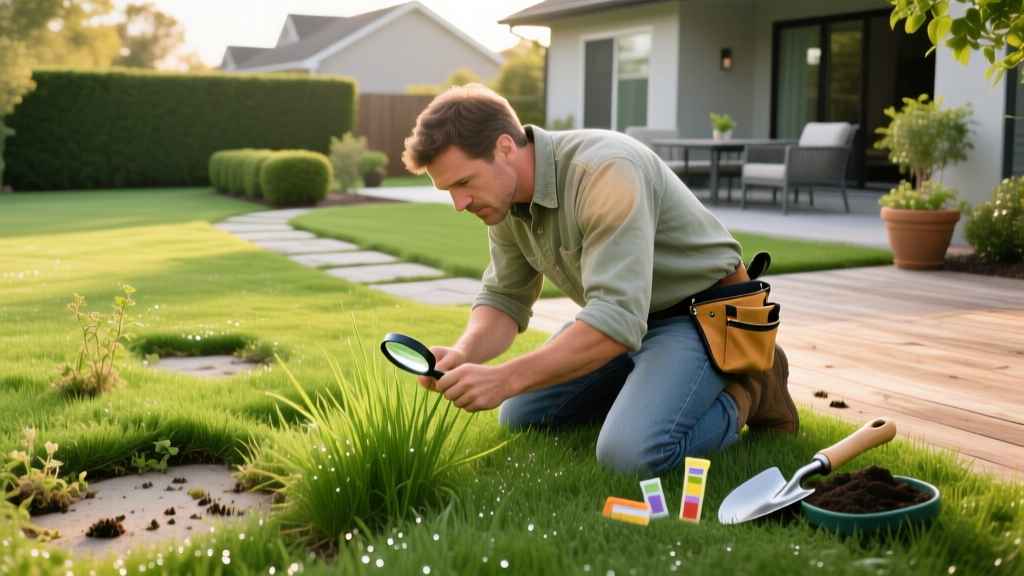
Do It Yourself Lawn Care: A Diagnostic Guide for Homeowners
Successful do it yourself lawn care is rarely about blindly following a calendar; it is about accurate diagnosis and precise execution. Most homeowners treat their lawns reactively, throwing generic weed-and-feed products at emerging problems. Professional turf managers, however, operate on a diagnostic framework. They read the visual and physical cues the grass provides and respond with targeted chemical or cultural interventions. This guide transitions you from a reactive consumer to a proactive turf manager, equipping you with the exact diagnostic matrices, calibration techniques, and commercial-grade product strategies needed to maintain a pristine lawn.
The 4-Point Turf Diagnostic Framework
Before applying any amendment, you must isolate the variable causing the stress. Agronomists use a four-point diagnostic framework to evaluate turf health. When your lawn shows signs of decline, run through this sequence:
- Soil Chemistry (The Foundation): Is the pH locking out nutrients? A soil pH above 7.2 will bind iron and manganese, making them unavailable to the roots regardless of how much fertilizer you apply.
- Root Architecture (The Engine): Pull a core sample. Are roots shallow and brown (indicating compaction or overwatering), or deep and white (healthy)?
- Shoot and Blade (The Indicator): Examine the leaf tissue. Are lesions present (fungus)? Is the yellowing on older or newer growth (nutrient mobility)?
- Environment (The Stressor): Evaluate shade density, soil compaction from foot traffic, and irrigation uniformity.
Agronomist Warning: Never apply nitrogen to a lawn suffering from severe drought stress or active fungal infections like Brown Patch (Rhizoctonia solani). Nitrogen forces top growth, which demands more water and creates a dense, humid canopy that accelerates fungal spread.
Symptom-to-Cause Decision Matrix
The most common failure point in do it yourself lawn care is misidentifying nutrient deficiencies. Nutrients are categorized by their mobility within the plant. Mobile nutrients (like Nitrogen and Phosphorus) will translocate from older leaves to newer growth during a deficiency, meaning older leaves show symptoms first. Immobile nutrients (like Iron and Calcium) cannot move, so newer leaves show symptoms first. Use this matrix to accurately identify and treat visual symptoms.
| Visual Symptom | Leaf Location | Probable Cause | Targeted DIY Fix & Product |
|---|---|---|---|
| Uniform yellowing (chlorosis) | Older leaves | Nitrogen Deficiency | Apply 0.75 lbs N per 1,000 sq ft using a fast-release urea or Milorganite (5-2-0). |
| Purplish or dark green tint | Older leaves | Phosphorus Deficiency / Cold Stress | Apply a starter fertilizer (e.g., Lesco 18-24-12) at 1.0 lbs P2O5 per 1,000 sq ft. |
| Interveinal chlorosis (green veins, yellow tissue) | Newer leaves | Iron Chlorosis (High Soil pH) | Foliar spray Chelated Iron (Fe-EDDHA) at 4 oz per 1,000 sq ft. Do not water in. |
| Footprints remain for hours | All leaves | Drought Stress (Loss of Turgor) | Apply 0.5 inches of water immediately. Switch to deep, infrequent soak-and-cycle irrigation. |
| Frog-eye pattern of brown dead grass | All leaves | Summer Patch or Brown Patch | Apply Azoxystrobin (Heritage G) at 2.0 lbs per 1,000 sq ft. Reduce evening watering. |
For comprehensive turf disease identification, the NC State TurfFiles database remains the gold standard for cross-referencing visual symptoms with active regional pathogens.
Calibrating Your Spreader: The 1,000 Sq Ft Test
The settings printed on the side of fertilizer bags are notoriously inaccurate. They assume a specific walking speed (usually 3.0 mph) and a perfectly level lawn. If you walk slower, you will over-apply, risking fertilizer burn; if you walk faster, you will under-apply. Professional applicators calibrate their equipment using the tarp method or the catch-pan method.
Step-by-Step Calibration Procedure
- Measure a Test Area: Mark off exactly 1,000 square feet on your driveway or a tarp (e.g., a 20 ft x 50 ft rectangle).
- Weigh the Product: Pour your granular product into a bucket and weigh it on a digital kitchen scale. Record the starting weight in grams.
- Run the Test: Set your spreader (e.g., Scotts EdgeGuard Mini) to an estimated setting. Walk at your normal, comfortable pace over the 1,000 sq ft area, engaging the spreader only within the marked zone.
- Weigh the Remainder: Pour the unused product back into the bucket and weigh it. Subtract this from the starting weight to find the exact amount dispersed.
- Adjust: If the bag calls for 3.5 lbs per 1,000 sq ft (approx. 1,587 grams) and you only dispersed 1,200 grams, open the dial one setting wider and repeat the test.
Pro Tip: Always perform your spreader calibration on a hard surface like a driveway. If you spill or over-apply, you can sweep it up. Calibrating directly on the grass risks burning a 100-foot strip of your lawn if your initial setting is too high.
The Economics of DIY: Commercial-Grade vs. Big Box Store
A major advantage of do it yourself lawn care is the ability to bypass expensive, watered-down consumer products in favor of commercial-grade concentrates. Below is a cost comparison for treating a standard 5,000 sq ft cool-season lawn for one year, comparing big-box consumer products with professional-grade alternatives.
| Treatment Category | Big Box Consumer Product (Cost for 5k sq ft) | Commercial-Grade DIY Alternative (Cost for 5k sq ft) | Annual Savings |
|---|---|---|---|
| Pre-Emergent Herbicide | Scotts Halts ($25.00) | Prodiamine 65 WDG ($6.50)* | $18.50 |
| Broadleaf Weed Control | Ortho WeedClear ($22.00) | 3-Way Selective Herbicide ($4.20)* | $17.80 |
| Fertilizer (4 Applications) | Scotts Turf Builder ($60.00) | Lesco Professional Grade ($45.00) | $15.00 |
| Grub Control | Bayer Advanced ($30.00) | Acelepryn G ($18.00) | $12.00 |
| Total Annual Cost | $137.00 | $73.70 | $63.30 |
*Note: Commercial-grade liquid herbicides require an initial investment in a backpack sprayer (approx. $60-$120) and a digital scale for measuring water-dispersible granules (WDG), but the per-application cost drops drastically.
Establishing the Baseline: Soil Testing
You cannot manage what you do not measure. Applying phosphorus or potassium without a soil test is not just a waste of money; it can lead to nutrient antagonism, where an excess of one element blocks the uptake of another. For example, excessive potassium can induce magnesium deficiency.
'A standard soil test should be conducted every three years. It provides exact base saturation percentages and cation exchange capacity (CEC) data, allowing you to prescribe exact elemental requirements rather than guessing with N-P-K ratios.' — University of Minnesota Extension
Send your soil cores to an independent lab like Logan Laboratories (approx. $30 per sample). Request the 'Standard Turf' package, which includes pH, buffer pH, organic matter percentage, and base saturation. When your results return, focus primarily on the pH and the CEC. If your CEC is below 10 meq/100g, your soil is sandy and cannot hold nutrients; you will need to split your fertilizer applications into smaller, more frequent doses (e.g., 0.25 lbs N every 2 weeks instead of 1.0 lbs N every 6 weeks) to prevent leaching.
Knowing the DIY Limit: When to Call a Professional
While do it yourself lawn care covers 90% of routine maintenance, certain scenarios require heavy machinery or restricted-use pesticides (RUPs) that are illegal for homeowners to purchase or apply.
- Severe Grub Infestations: If you are pulling up dead sod and counting more than 10 white grubs per square foot, the root system is entirely severed. DIY curative treatments like Dylox often fail to penetrate the thatch layer in time. Professional application of trunk-injection or high-volume liquid treatments may be required.
- Major Grading and Leveling: If your lawn has severe undulations causing water pooling, topdressing with a drag mat will not suffice. This requires a skid steer and laser grading to re-establish a 2% slope away from your foundation.
- Tree Root Competition: If large oak or maple trees are choking your turf, surface aeration is ineffective. You need an air-spade service to safely fracture the compacted soil around the tree's critical root zone without severing the primary roots.
By mastering the diagnostic framework, calibrating your equipment to the gram, and leveraging commercial-grade chemistry, your do it yourself lawn care program will rival, and often surpass, the results of standard commercial route services.

