
Lawn Care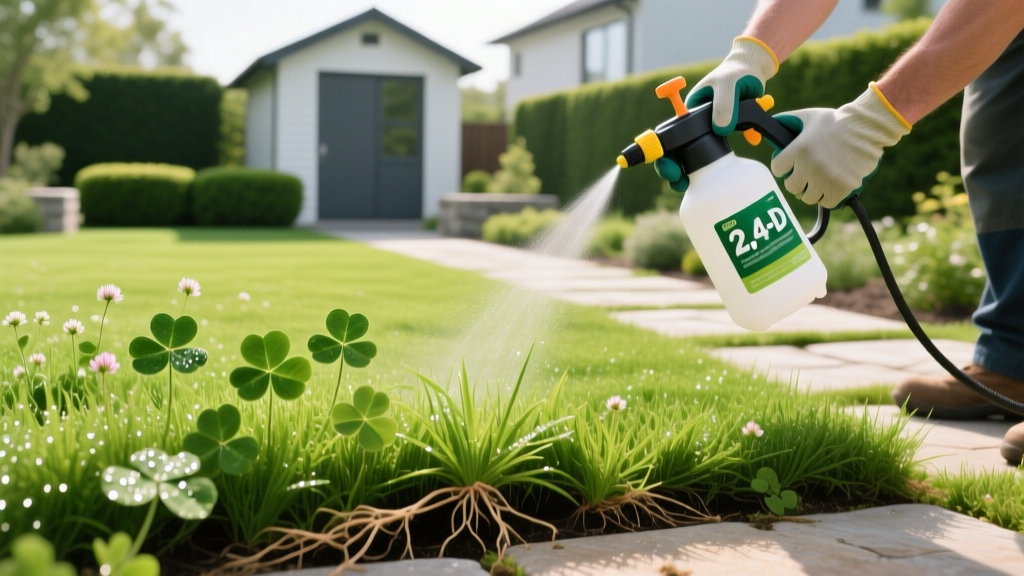
Does 2,4-D Kill Clover? The Complete Lawn Treatment Guide
The Short Answer: Yes, But With Caveats
Yes, 2,4-D (2,4-Dichlorophenoxyacetic acid) effectively kills clover. As a selective, systemic broadleaf herbicide, it targets the specific biological pathways of dicot plants (like white, red, and strawberry clover) while leaving most monocot turfgrasses unharmed. However, simply buying a bottle of 2,4-D and spraying it on your lawn is rarely enough to eradicate a mature clover infestation in a single pass.
Mature white clover (Trifolium repens) develops a thick, waxy cuticle on its leaves and a deep, resilient taproot that can survive initial herbicide shocks. To achieve total eradication, homeowners must understand the difference between 2,4-D formulations, the critical role of surfactants, and the specific temperature windows required for the chemical to translocate effectively to the root system. According to the U.S. Environmental Protection Agency (EPA), 2,4-D remains one of the most widely used and thoroughly tested turf herbicides on the market, but its success hinges entirely on proper application mechanics.
How 2,4-D Targets Clover (The Science)
2,4-D is a synthetic auxin. Auxins are natural plant hormones that regulate cell division and elongation. When clover absorbs 2,4-D through its foliage, the herbicide mimics natural auxins but in massive, unregulated doses. This triggers catastrophic, uncontrolled cellular growth. The clover's vascular tissue (phloem and xylem) essentially chokes itself, preventing the transport of water and nutrients. Within 48 to 72 hours, you will notice the clover leaves twisting, cupping, and curling—a phenomenon known as epinasty. Within 10 to 14 days, the root system starves and the plant dies.
Expert Insight: Because 2,4-D relies on the plant's active growth cycle to translocate the poison down to the taproot, spraying dormant or drought-stressed clover will result in top-kill only. The roots will survive and push up new shoots weeks later. Always apply when clover is actively growing and soil moisture is adequate.
Amine vs. Ester Formulations: Which Should You Use?
Not all 2,4-D is created equal. The active ingredient is bound to different carriers—most commonly amine or ester—and choosing the wrong one for your current weather conditions will lead to poor results or turf damage.
| Feature | Amine Formulation | Ester Formulation |
|---|---|---|
| Solubility | Water-soluble | Lipid/Oil-soluble |
| Cuticle Penetration | Moderate (requires surfactant) | Excellent (dissolves waxy leaf layers) |
| Ideal Temperature | Warm weather (60°F to 85°F) | Cool weather (45°F to 70°F) |
| Volatility Risk | Low (won't vaporize easily) | High (vaporizes above 75°F, drifting to damage nearby garden plants) |
| Best Use Case | Late spring and summer spot treatments | Early spring or fall blanket applications |
For most homeowners treating clover in the late spring or early summer, an amine-based product like Gordon's Amine 400 is the safest and most effective choice. Ester formulations are generally reserved for professional landscapers doing late-fall cleanups when temperatures drop and the clover's waxy cuticle thickens.
Step-by-Step Application Guide for Clover Eradication
To successfully kill clover without harming your surrounding turf, precision in mixing and application is mandatory. Follow this exact protocol:
- Mow First: Mow your lawn 24 to 48 hours before application. This encourages the clover to push out fresh, tender growth that is more susceptible to herbicide absorption.
- Add the Surfactant: Clover leaves are notoriously hydrophobic; they repel water. You must add a non-ionic surfactant (NIS) to your tank. Use a rate of 0.25% v/v, which equates to roughly 1/2 teaspoon of surfactant per gallon of water.
- Mix the Herbicide: For spot-treating clover patches with a standard 41% amine 2,4-D concentrate, mix 1.5 to 2.5 fluid ounces of herbicide per gallon of water. Fill your pump sprayer halfway with water, add the herbicide, add the surfactant, and then top off with the remaining water to ensure proper agitation.
- Spray to Wetness: Apply the mixture evenly over the clover patches. Do not spray to the point of runoff. You want a fine mist that coats the leaves without dripping onto the soil, as 2,4-D has limited soil activity and relies on foliar absorption.
- Wait to Water: Do not irrigate the lawn for at least 24 hours after application. The chemical needs a minimum of 6 to 8 hours to fully penetrate the leaf tissue.
Grass Type Compatibility & Safety Warnings
While 2,4-D is highly selective, it is not universally safe for all turfgrasses. Misidentifying your grass type can lead to severe stunting, yellowing, or total lawn death.
WARNING: Sensitive Warm-Season Grasses
If you have St. Augustinegrass, Centipedegrass, or Bahiagrass, do NOT use standard 2,4-D formulations. These grasses are highly sensitive to synthetic auxins and will suffer severe phytotoxicity. Instead, opt for Atrazine (for St. Augustine) or Metsulfuron-methyl (for Centipedegrass) to control clover safely.
If you have St. Augustinegrass, Centipedegrass, or Bahiagrass, do NOT use standard 2,4-D formulations. These grasses are highly sensitive to synthetic auxins and will suffer severe phytotoxicity. Instead, opt for Atrazine (for St. Augustine) or Metsulfuron-methyl (for Centipedegrass) to control clover safely.
Safe Grass Types: Kentucky Bluegrass, Tall Fescue, Fine Fescue, Perennial Ryegrass, Bermudagrass (use reduced rates), and Zoysiagrass are highly tolerant of 2,4-D and can be treated confidently at standard label rates.
Why 2,4-D Alone Might Fail (The 3-Way Herbicide Solution)
If you have tried 2,4-D and your clover keeps returning, you are likely dealing with a mature infestation that has developed partial tolerance, or you are missing the synergistic effect of multiple active ingredients. Commercial turf managers rarely use straight 2,4-D. Instead, they use 3-way or 4-way herbicides.
Products like SpeedZone Broadleaf Herbicide for Turf or Trimec Classic combine 2,4-D with MCPP, Dicamba, and sometimes Carfentrazone-ethyl. According to weed science research highlighted by the University of California Agriculture and Natural Resources (UC ANR), combining multiple modes of action prevents weed resistance and accelerates the burn-down process. Carfentrazone, for example, acts as a PPO inhibitor, causing rapid cell membrane disruption. This visibly burns the clover leaf within 24 hours, while the 2,4-D works systematically over the next two weeks to kill the taproot. If straight 2,4-D fails, upgrading to a commercial-grade 3-way ester/amine mix is the definitive solution.
Frequently Asked Questions
Will 2,4-D kill clover but not my grass?
Yes, provided you have a cool-season grass (like Fescue or Kentucky Bluegrass) or a tolerant warm-season grass (like Bermudagrass). 2,4-D specifically targets the broadleaf dicot biology of clover while leaving the monocot biology of turfgrasses unharmed. However, spraying during extreme heat (above 85°F) can cause temporary turf stunting.
How long does it take for 2,4-D to kill clover?
You will see visible twisting and curling of the clover leaves within 48 to 72 hours. Complete plant death, including the root system, typically takes 14 to 21 days. Do not reapply within this window; give the chemical time to translocate.
Can I pull clover by hand instead of spraying?
Hand-pulling is only effective for very small, isolated patches. Because white clover spreads via creeping stolons (above-ground stems) that root at the nodes, pulling often leaves fragments behind that quickly regenerate. For lawns with clover coverage exceeding 10%, chemical intervention with 2,4-D or a 3-way mix is vastly more efficient and cost-effective.

