
Lawn Care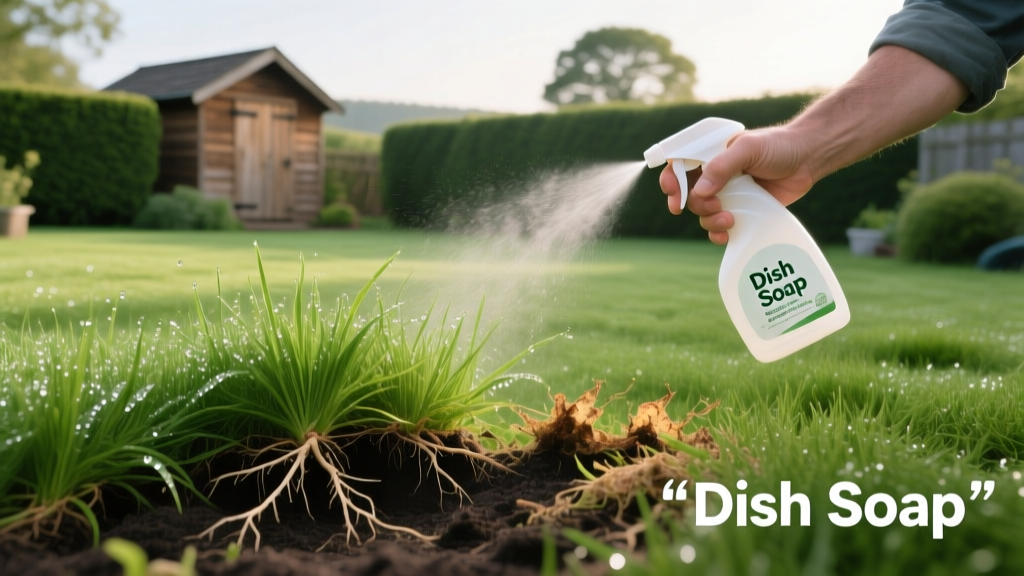
Does Dish Soap Kill Grass? The Science of DIY Surfactant Damage
When tackling lawn pests or trying to stretch a bottle of herbicide, many homeowners ask: does dish soap kill grass? The short answer is yes, dish soap can kill grass, but it is not a systemic weed killer. Instead, it acts as a harsh contact desiccant. While a heavily diluted soap solution can safely act as a wetting agent or mild insecticide, applying it at the wrong concentration will strip the protective wax from your turf, leading to rapid cellular dehydration and severe phytotoxicity.
Understanding the exact chemical mechanism behind this damage is critical for homeowners who want to use household products safely without destroying their Kentucky Bluegrass, Bermuda, or Fescue lawns. Below, we break down the science of surfactant burn, compare DIY mixes to commercial turf products, and provide exact protocols for reversing soap damage.
The Chemistry of Phytotoxicity: How Dish Soap Attacks Grass
To understand why dish soap damages turf, you have to look at the molecular structure of household detergents. Most commercial dish soaps (like Dawn Ultra or Palmolive) rely on anionic surfactants, primarily Sodium Lauryl Sulfate (SLS) or Sodium Laureth Sulfate (SLES). These molecules are engineered to bind to oils and grease, lifting them away from surfaces so water can wash them down the drain.
The Role of the Epicuticular Wax Layer
Turfgrass blades are coated in an epicuticular wax layer. This microscopic, hydrophobic barrier serves two vital functions: it prevents excessive moisture loss (transpiration) and protects the plant's cells from environmental stressors. When anionic surfactants in dish soap come into contact with this wax, they dissolve it entirely.
Once the wax is stripped away, the grass blade loses its ability to retain water. The stomata (pores) remain open, and the plant rapidly desiccates. Within 24 to 48 hours, the affected grass blades will curl, turn a pale gray-green, and eventually crisp into a brown, necrotic state. According to research on insecticidal soaps and plant phytotoxicity, this damage is strictly topical; the soap does not translocate down into the root system. Therefore, while the top growth is burned, established root systems and deep taproots of perennial weeds will often survive and push up new growth within two weeks.
Dish Soap vs. Commercial Turf Surfactants: A Comparison
Many DIY lawn care forums recommend adding a "few drops" of dish soap to herbicide mixtures to help the chemical stick to the leaves. However, professional turf managers strictly avoid anionic dish soaps, opting instead for non-ionic surfactants. Here is how they compare in real-world lawn applications:
| Feature | Household Dish Soap (Anionic) | Commercial Turf Surfactant (Non-Ionic) |
|---|---|---|
| Active Chemistry | Sodium Lauryl Sulfate (SLS) | Alkylpolyglucosides or Ethoxylated Alcohols |
| Phytotoxicity Risk | High (strips plant waxes, causes burn) | Very Low (spreads evenly without dissolving waxes) |
| Reaction with Hard Water | Precipitates (forms scum, reduces efficacy) | Stable (unaffected by calcium/magnesium) |
| Cost per Gallon of Mix | ~$0.05 | ~$0.15 - $0.25 |
| Best Use Case | Mild DIY grub deterrence, spot insect control | Herbicide adjuvant, soil wetting agent, fertilizer spreader |
⚠ Warning: Herbicide Incompatibility
Never mix dish soap with systemic herbicides like Glyphosate or 2,4-D. Because anionic surfactants carry a negative electrical charge, they can react with the active ingredients in certain herbicides, causing the spray droplet to shatter on the leaf surface rather than spreading evenly. This drastically reduces the herbicide's efficacy and increases the risk of chemical runoff into your soil.
Safe Dilution Ratios for Lawn Applications
If you are using dish soap as a low-cost minimum-risk pesticide to control soft-bodied insects (like aphids or chinch bugs) or to deter surface-feeding grubs, precision in your dilution ratio is non-negotiable. The threshold between a safe application and severe turf burn is incredibly narrow.
- Safe Insecticidal Ratio: 1 to 1.5 teaspoons of plain liquid dish soap (no added degreasers, bleach, or citrus solvents) per 1 gallon of water. This yields a roughly 0.25% to 0.5% solution.
- Surface Tension Breaker (Wetting Agent): 1/2 teaspoon per 1 gallon of water. Use this when applying liquid iron or chelated micronutrients to help the liquid penetrate hydrophobic thatch layers.
- Danger Zone (Phytotoxicity): Anything exceeding 2 tablespoons per gallon (approx. 1% solution or higher). At this concentration, you will see visible desiccation on tender grass shoots within 12 hours on a sunny day.
Pro Tip: Always apply soap mixtures in the early morning or late evening. UV radiation and high ambient temperatures (above 85°F) accelerate the evaporation of water from the soap mixture, leaving behind concentrated salts on the grass blade that magnify cellular damage.
Identifying and Treating Soap Burn on Turfgrass
If you have accidentally applied a mixture that was too hot, or if a neighbor's runoff has introduced heavy detergents into your soil, you must act quickly to neutralize the osmotic stress. Soap burn looks remarkably similar to fertilizer burn or drought stress, presenting as uniform yellowing that rapidly transitions to crispy, brown necrosis at the leaf tips.
Step-by-Step Recovery Protocol
- Immediate Flushing (0-2 Hours): Turn on your sprinklers or hose and apply at least 1.0 to 1.5 inches of water to the affected area. The goal is to push the sodium salts and surfactant residues down past the top 6 inches of the root zone where they can no longer interact with the grass crowns.
- Wait and Observe (48-72 Hours): Do not mow the burned grass. Mowing will remove the remaining green tissue the plant needs to photosynthesize and generate new cells. Allow the lawn to dry out slightly so you can assess the true extent of the damage.
- Gentle Tug Test: Grab a handful of the browned grass and pull gently. If the roots hold firm in the soil, the crown is alive, and the turf will recover. If it pulls up effortlessly, the crown has died, and you will need to overseed or lay new sod.
- Nitrogen Push (Day 7): Once the soil has dried and the salts are flushed, apply a quick-release nitrogen fertilizer to stimulate new leaf growth. Use 0.5 lbs of actual nitrogen per 1,000 sq ft (which equates to roughly 1 lb of 46-0-0 Urea). Water it in immediately with 1/4 inch of irrigation.
Frequently Asked Questions
Will dish soap kill lawn grubs?
Dish soap can kill grubs on direct contact by suffocating them and breaking down their protective outer membranes. However, a soapy drench will only affect grubs that are actively feeding near the soil surface (typically in early fall or late spring). It will not provide residual control, nor will it penetrate deep enough to reach grubs resting in the lower soil profile during the heat of summer.
Is Dawn dish soap safe for Bermuda grass?
Bermuda grass is a warm-season, highly resilient turf with a thick cuticle, making it slightly more tolerant of surfactant stress than cool-season grasses like Fine Fescue. However, Dawn Ultra contains concentrated degreasing agents that will still strip the Bermuda blade's wax layer if applied stronger than 1 teaspoon per gallon. Always test a 2x2 foot patch and wait 24 hours before treating the entire lawn.
Can I use dish soap to kill dandelions?
Spraying concentrated dish soap on a dandelion will burn the leaves and cause them to shrivel within a day. However, because dish soap lacks systemic action, it will not travel down into the dandelion's deep taproot. The root will simply push up a new rosette of leaves within 10 to 14 days. For permanent dandelion removal, a selective broadleaf herbicide containing Triclopyr or a manual weeding tool that extracts the full taproot is required.

